A friend of ours once landed in Mauritius expecting the honeymoon island every travel list promised. Instead, an immigration officer pulled her aside at baggage claim while white tourists walked straight through. The questions only stopped when she spoke with her American accent. It was funny when she related the story and we saw a pattern in many African countries. Things seem to be different with male travellers than female solo travellers. Hence, we must talk about safest African countries for Black solo travellers.
For Black travellers arriving on African passports, or simply arriving while Black, the picture at the border looks very different. Now it is even more different fore female travellers.
This guide ranks the safest African countries for Black solo travellers based on firsthand experience across more than ten countries, current entry policies, and documented treatment at borders. The safest countries by this measure are Tanzania (especially Zanzibar), Senegal, Kenya, Ghana, Zimbabwe, Botswana, and Namibia. Mauritius and Tunisia come with serious caveats that generic lists omit.
TL;DR – safest African countries for Black solo travellers
- Zanzibar, Tanzania is our top pick. It is safe, warm, and genuinely welcoming to Black solo travellers, including solo women.
- Senegal, Kenya, Ghana, and Zimbabwe round out the strongest destinations, with Botswana and Namibia as calm, stable additions.
- Mauritius ranks high on mainstream safety lists but has a documented pattern of profiling Black arrivals at the airport, plus a 2026 entry ban affecting travellers from DRC, Uganda, and South Sudan.
- Tunisia is not recommended for Black solo travellers. Egypt is worth visiting, but with a vetted group rather than alone.
- If you want to travel regionally, pair countries within West, East, or Southern Africa to get the most from one long-haul ticket.
Which Are the Safest African Countries for Black Solo Travellers?
Tanzania, Senegal, Kenya, Ghana, Zimbabwe, Botswana, and Namibia are the safest African countries for Black solo travellers in 2026. These countries combine low tourist-targeted crime with something the mainstream lists never measure: how Black visitors are actually received at the border and on the street.
Our contributor, a Black American woman who has traveled solo through Ghana, Senegal, Mauritius, South Africa, Zimbabwe, Kenya, Tanzania, Tunisia, and Egypt, puts it plainly that nowhere in Africa did she experience the kind of blatant racism she faced in the United States or Europe. The two exceptions where she felt unwelcome, Mauritius and Tunisia, are covered honestly below.
| Country | Verdict for Black solo travellers | Solo women? | Key caution |
|---|---|---|---|
| Tanzania (Zanzibar) | Top pick. Warm, safe, welcoming | Yes | Dress modestly in Stone Town |
| Senegal | Excellent. Culture, food, hospitality | Yes | Standard city precautions in Dakar |
| Kenya | Very good. Lively and welcoming | Yes | Watch valuables; petty crime exists |
| Ghana | Good. Meaningful for the diaspora | Yes | December crowds inflate prices |
| Zimbabwe (Victoria Falls) | Unexpected gem. Calm and easy | Yes | Best as a Southern Africa add-on |
| Botswana | Stable and safe | Yes | Avoid isolated areas after dark |
| Namibia | Safe with good infrastructure | Yes | Long remote drives; fuel up early |
| South Africa (Cape Town) | Beautiful, worth it, with awareness | Yes, with planning | Neighborhood-specific safety; colonial dynamics visible |
| Egypt | Visit with a vetted group | Group only | Cairo hassle; treatment of Sub-Saharan Africans |
| Mauritius | Caution. Documented profiling at entry | Yes, once inside | Airport profiling; 2026 entry ban for some African arrivals |
| Tunisia | Not recommended solo | No | Documented hostility toward Black Africans |
In summary: East Africa leads for welcome and beauty, West Africa leads for culture and connection, Southern Africa leads for stability and wildlife, and North Africa plus the Indian Ocean islands demand extra caution that generic safety lists never mention.
Why Generic “Safest Africa” Lists Fail Black Solo Travellers
Generic safety rankings measure crime statistics and tourism infrastructure, but they are written for, and largely by, white Western travellers. For example, a country can have low crime and still profile Black visitors at its border. Crime data will never capture the officer who stops every Black passenger at baggage claim while waving white tourists through.
Mauritius is the clearest example. It appears on nearly every mainstream list of safe African destinations for solo women, usually near the top, and by crime statistics it earns that spot. Yet Nigerian travellers reported in 2026 being separated from other passengers at Sir Seewoosagur Ramgoolam International Airport for intensive questioning, with some deported despite holding valid documents. Our friend experienced the same pattern years apart where they visibly single Black arrivals out, while white arrivals pass untouched.
The point isn’t that the rankings are fake, but that safety can’t be boiled down to a single number. For Black solo travellers in Africa, you have to ask three separate questions: Will I be safe from crime? Will I be treated fairly at the border? And will I actually feel welcome once I’m inside?
This guide answers all three, country by country. It draws on our firsthand experience as our solo female travel reported from the road, which you can read here Lagos to London Travel Overland Using Public Transport and here Solo Female Traveller From London to Lagos by Road.
Is Zanzibar Safe for Black Solo Travellers?
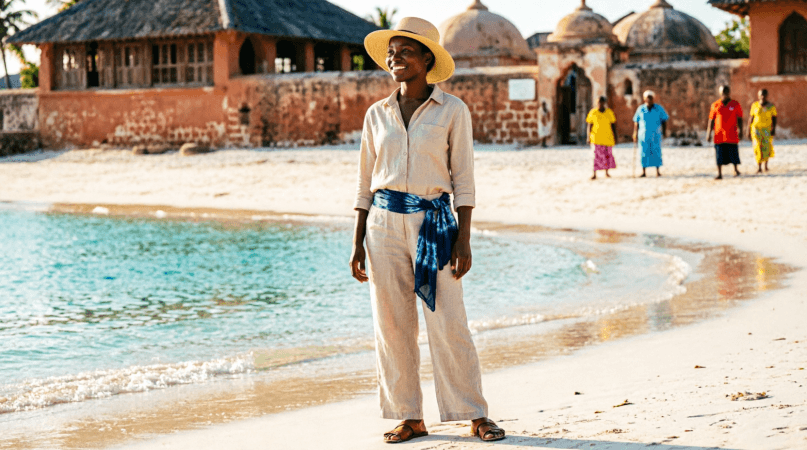
Yes. Zanzibar is the safest and most welcoming destination our contributor has visited anywhere in Africa, establishing Tanzania as a top choice among the safest African countries for Black solo travellers, and she has returned twice, once solo and once leading a group of other Black women. She calls it the most beautiful place she has seen with her own eyes.
The island delivers on every front. Stone Town, the UNESCO-listed capital, is layered with Swahili, Arab, Persian, and Indian history. Nungwi’s white sand beaches and turquoise water look like a postcard from every angle. Early-morning dolphin excursions from the northern coast are a genuine bucket-list moment.
What sets Zanzibar apart is the reception. Though the island is devoutly Muslim, our friend found people open, tolerant, and consistently kind to a solo Black woman traveling alone. Tanzanians describe this spirit as ujamaa, an ethic of extended family and community that visitors feel immediately. Dress modestly in Stone Town out of respect, and pair the island with a mainland safari in Mikumi or the northern circuit for a complete Tanzania trip.
Is Senegal Safe for Black Solo Travellers?
Absolutely. Dakar delivered the best food our contributor has eaten anywhere on the continent, and the Senegalese people rank among the kindest and most generous she has encountered. Senegal is the strongest West African pick for culture, music, and hospitality, cementing its place among the safest African countries for Black solo travellers.
There is one honest caveat, and it is not about Senegalese people. The only friction our contributor experienced in Dakar came from European tourists behaving as though they owned the place. That dynamic, a lingering colonial entitlement, shows up in tourist spaces across the continent. Locals also shared frank views with her about development projects driving displacement and gentrification in parts of Dakar, a tension worth understanding before you visit.
None of that should keep you away. Between the food, the music scene, Gorée Island’s sobering history, and the warmth of everyday interactions, Senegal earns its place near the top of any Black traveler’s list. It pairs naturally with Ghana and Nigeria on a West African circuit, and our guide to Africa’s best destinations for independent travellers covers Senegal’s appeal for independent travel in more depth.
How Safe Is Kenya for Black Solo Travellers?
Kenya is one of the most reliable destinations on the continent for solo travellers, firmly placing it among the safest African countries for Black solo travellers, and Nairobi is one of our contributor’s favorite African cities. She has visited multiple times for both work and leisure, and was looked out for each time as a woman traveling alone.
Petty crime exists in Nairobi as it does in any major city, so watch your valuables and use registered taxis or ride-hailing apps after dark. Beyond that, the city is lively, well connected, and easy to love, with easy access to Nairobi National Park, the Maasai Mara, and the coast at Mombasa or Diani.
One honest observation our contributor noticed is that occasional preferential treatment given to white European tourists. This is usually rooted in economic assumptions about who spends more. However, it never translated into poor treatment of her, but it is part of the colonial residue that shows up in tourism economies across Africa, and naming it matters.
Is Ghana Safe for Black Solo Travellers and the Diaspora?
Ghana remains one of the most meaningful destinations for African Americans and the wider diaspora, solidifying its reputation among the safest African countries for Black solo travellers, though our contributor is honest that it was not her personal favorite. The history, the Year of Return legacy, Cape Coast and Elmina castles, and the warmth of Ghanaian hospitality make it worth experiencing firsthand.
Her one practical recommendation is to skip Detty December. The December rush brings crowds, inflated prices, and logistical strain that can overshadow the experience. Visit between January and April instead, when the country breathes easier and hotel rates drop.
Ghana is also among the easiest entry points to the continent for first-time visitors, with strong English-language infrastructure and a large returning-diaspora community in Accra. Pair it with Senegal for a fuller West African trip.
Is Zimbabwe Safe for Black Solo Travellers?
Yes, and most travellers do not, which is their loss. Our contributor visited Zimbabwe on the tail end of a South Africa trip and called it an unexpected gem that exemplifies the safest African countries for Black solo travellers: lovely people, total ease throughout her stay, and Victoria Falls, one of the seven natural wonders of the world.
Beyond the falls themselves, a sunset cruise on the Zambezi River brought her face to face with hippos gliding past the boat, an experience she counts among her most unforgettable anywhere. The Victoria Falls tourism corridor is well developed, calm, and accustomed to solo visitors.
If you are already flying into South Africa, the short hop to Victoria Falls is easily justified. Botswana’s Chobe National Park sits an hour away by road, making a three-country Southern Africa circuit entirely realistic in one trip.
Is South Africa Safe for Black Solo Travellers?
Cape Town is breathtaking and worth visiting, with honest planning, though it requires more vigilance than other destinations on the list of safest African countries for Black solo travellers. The mountains, the ocean, and the sheer physical beauty of the city are real, and the Black South Africans our contributor met were among the warmest people of her travels. She sees deep common ground between Black Americans and Black South Africans.
The caveats are also real. Cape Town requires neighborhood-specific awareness in a way Zanzibar or Windhoek does not: research where you are staying, use ride-hailing apps rather than walking after dark, and take local advice seriously.
The colonial architecture of the economy is also impossible to miss. High-end venues fill with white guests served by Black staff, and the Afrikaner presence in wine country carries a visible legacy of who owns what. Our contributor names this plainly because pretending it is invisible serves no one.
None of this cancels the trip. It means going with clear eyes, spending intentionally with Black-owned businesses where you can, and understanding the country you are standing in. Johannesburg and Botswana are natural next stops.
Is North Africa Safe for Black Solo Travellers?
North Africa requires a different calculus, and honesty here matters more than diplomacy when evaluating the safest African countries for Black solo travellers. Sub-Saharan Africans are not consistently treated well in parts of North Africa, and Black visitors of any nationality are often read as Sub-Saharan African first, passport second.
Tunisia: not recommended solo. Our contributor did not feel safe there as a Black woman traveling alone and would only return with an organized group. The broader pattern backs her up. Since 2023, Human Rights Watch and other monitors have documented racist violence, forced evictions, and expulsions targeting Black Africans in Tunisia, and deportation programs aimed at Sub-Saharan Africans continued through 2026. This is a documented national pattern, not a collection of isolated incidents.
Egypt: go, but with a vetted group. Our contributor loved Luxor and Aswan, felt safe in both, and counts the Nubian Village visit among her trip highlights. Cairo was the weak point: essential for the Egyptian Museum and the Great Pyramids, but carrying a hustle-heavy atmosphere she would not navigate solo again. Her verdict for Black women: Egypt is worth it, in a vetted group, not alone.
Morocco sits between the two. It runs a polished tourism machine and remains Africa’s most visited country, but the same regional caution about how Black travellers are received applies. Group travel or well-reviewed guides are the smart play for a first visit.
Is Mauritius Safe for Black Solo Travellers?
Once inside the country, yes, but getting inside is where the problem lives, making it a complicated entry when considering the safest African countries for Black solo travellers. Our contributor was racially profiled on arrival: stopped at baggage claim, questioned at length about why she was in the country, while white travellers exited unbothered. The officer’s attitude flipped the moment he heard her American accent, which tells you exactly what assumption he was working from.
Her experience is not isolated. In 2026, Nigerian travellers publicly reported being separated from other passengers at the same airport for intensive questioning, described being treated like suspects despite valid documents, and some were deported. In June 2026, Mauritius went further, instituting an entry ban on travellers who had been in the Democratic Republic of Congo, Uganda, or South Sudan within 21 days of arrival, a policy framed as a health measure but which falls entirely on African travellers.
Mauritius is a majority Indo-Mauritian nation with a heavily European tourist base, and the preference shown to European visitors is structural, not subtle. The people our contributor met inside the country were kind. The border experience overshadowed all of it, and she has no interest in returning. If you go, carry every document, book accommodation that meets entry requirements to the letter, and know your rights before you land.
How to Plan a Trip to the Safest African Countries for Black Solo Travellers
Travel regionally rather than visiting one country in isolation. Long-haul flights to Africa are expensive, and intra-African connections are improving, so pairing neighboring countries maximizes every ticket.
- West Africa: Combine Ghana, Senegal, and Nigeria in one trip. Shared ECOWAS membership keeps regional flights and border crossings manageable.
- East Africa: Pair Kenya with Tanzania, and add Uganda if time allows. Nairobi and Zanzibar anchor the circuit.
- Southern Africa: Base in South Africa, then add Zimbabwe for Victoria Falls and Botswana or Zambia for safari.
- North Africa: Egypt with a vetted group, with Morocco as a possible companion, also on vetted excursions.
Wherever you go, standard solo travel security applies: share your itinerary with someone at home, keep digital copies of documents, arrive at new cities in daylight, and trust your instincts over politeness. If you hold a Nigerian or other frequently scrutinized African passport, build extra time into border crossings and keep every supporting document accessible; our reporting on how border officials treat African passports covers what to expect and how to respond.
And go. That is the final word from every mile of this reporting. Most of the continent will say “welcome home” and mean it. The places that will not are named above, so you can travel with your eyes open and your joy intact.
Frequently Asked Questions
What is the safest African country for Black solo female travellers?
Tanzania, specifically Zanzibar, is widely regarded as one of the safest African countries for Black solo travellers, and it is the most welcoming destination based on our contributor’s firsthand experience across ten African countries. Senegal, Kenya, Ghana, Botswana, and Namibia are also strong choices for solo Black women.
Is Mauritius racist toward Black travellers?
Black travellers, including our contributor, have documented racial profiling at Mauritius’s international airport, with Black arrivals singled out for questioning while white tourists pass freely. Once inside the country, most visitors report friendly treatment, but the border experience is a recurring and documented problem.
Which African countries should Black solo travellers avoid?
Tunisia is not recommended for Black solo travellers due to documented hostility toward Black Africans. In fact, there is violence and mass expulsions reported by Human Rights Watch since 2023. Cairo, Egypt is best visited with a vetted group rather than alone.
Is it safe for a Black woman to travel alone in Africa?
Yes, across most of the continent. Our contributor traveled solo through Ghana, Senegal, Kenya, Tanzania, Zimbabwe, and South Africa without experiencing the racism she has faced in the United States or Europe. Standard solo travel precautions apply everywhere, and North Africa plus Mauritius warrant extra planning.
What is the best way to see multiple African countries in one trip?
Travel regionally. Pair Ghana, Senegal, and Nigeria in West Africa. Pair Kenya, Tanzania, and Uganda in East Africa. Or South Africa, Zimbabwe, and Botswana in the south. Regional pairing spreads the cost of the long-haul flight across several countries.
Do African countries welcome African American travellers?
Overwhelmingly yes. Many countries welcome Africans, especially Ghana through its Year of Return legacy. That initiative is to actively welcome the diaspora, and arrivals in much of the continent are greeted with the phrase “welcome home.” The main exceptions our reporting identifies are Tunisia and the border experience in Mauritius.
Have you traveled solo through Africa as a Black traveller? Tune in to TravelRadio.live and share your experience on air. You can also subscribe to our newsletter for honest destination reporting made for African and diaspora travellers.