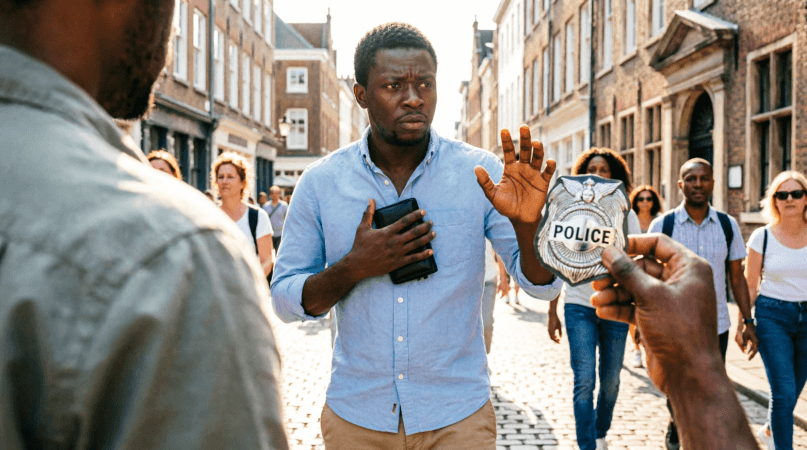
Real police officers don’t usually need to flick through your money on a busy street. This is how the fake police scam works, why it fools smart travellers, and how to walk away with your cash intact.
How the Fake Police Scam Starts on the Street
Police encounters can be scary. We made a post about it.
Now, you could be walking through a busy tourist area in a European city. Maybe you just stepped out of a train station, or you are heading back to your hotel after dinner. Two people approach you. One of them looks like a police officer. They flash a badge and tell you there are problems with counterfeit money in the area.
They ask to see your passport. You show them.
Then, they ask to see your wallet. You bring it out and hand it over.
Because they are claiming to be police, you cooperate. But the problem is that they are not police. They are swapping your money with fake or counterfeit notes that will eventually get you in trouble.
This is called the fake police scam, and it is one of the most common tricks aimed at tourists in Europe today. Dutch police reported arrests connected to a fake-officer case in Amsterdam in June 2026. This guide breaks down how the fake police scam works, why it fools even careful travellers, and what to do if it happens to you.
How the Fake Police Scam Works: Step-by-Step
Alright, let us begin with how it works so that you can protect yourself from it.
1. Approached in a Tourist-Heavy Area
This scam usually happens around places tourists naturally gather:
- Train stations
- Major attractions
- Busy shopping streets
- Public transport hubs
- Popular squares
- Areas just outside hotels
Scammers pick these spots because that is where they find travellers who look a little lost and a little tired. These are exactly the kind of people who will not want to make a scene. And you, as a tourist, seeing policemen in a foreign land will first make you feel somehow.
2. They Claim to Be Police
Many reports say that they do not always look like policemen. But most times, they do. But they might also:
- Wear a partial uniform
- Dress in plain clothes but flash a badge
- Carry a jacket that resembles police clothing
- Show an ID card for half a second, then put it away
A full convincing uniform is not actually needed to run this scam. The appearance of authority is usually enough.
3. They Provide a Believable Reason for “Inspection”
Common excuses include:
- There are counterfeit banknotes in the area
- They are doing a routine currency check
- They need to verify your passport
- There was a theft nearby
- They are checking tourists for suspicious money
Berlin’s official tourism guidance specifically warns visitors about impostors using supposed searches for counterfeit money or drugs as a way to get at your belongings. The counterfeit-money story is clever, because counterfeit notes are a real thing in many countries, so the fake police scam excuse sounds believable.
4. They Ask to See Your Wallet
This is the critical moment of the whole scam. They ask you to hand over your wallet, or to take out your cash and cards. They might say they need to count the notes or check serial numbers.
5. The “Inspection” Becomes a Distraction
While you are focused on complying, the scammer is busy. They might count your notes, shuffle through your belongings, or ask you to step aside. This is where your money or cards quietly disappear.
6. They Leave With Your Cash
Once they have what they wanted, they hand back your wallet and walk off. By the time you notice a few notes are missing, they are already gone. In some cases, they will leave actual fake notes in your wallet so that you will not notice until it is too late. Sometimes there is more than one person involved, so a partner can disappear into a crowd while you are still looking at your wallet in confusion.
Why Smart Tourists Fall for the Fake Police Scam
You might be thinking, “I would never fall for that.” Most people say that, then freeze in the moment anyway. Here is why the scam works.
Authority. Most people do not want to challenge a police officer, especially in a foreign country where they do not know the rules. Saying no to someone wearing a badge takes nerve.
Fear. The scammer may imply that refusing to cooperate will get you into trouble. That threat, real or imagined, is enough to push cooperation.
Confusion. Since you may not know what police uniforms look like in Spain or Germany or what their IDs should look like, you can fall. Also you are not sure if they can really stop you on the street.
Social pressure. Sometimes two or three people approach together. The encounter feels official because it looks official.
The counterfeit-money excuse is believable. Counterfeit cash is a real issue in many countries. The scammer is not selling you something impossible. They are selling you something that could be true.
The key thing to understand is that the fake police scam works even on careful people, because the victim is doing what they believe is the responsible thing. They believe that they’re cooperating with law enforcement.
7 Warning Signs of a Fake Police Scam
Now let me share the warning signs or red flags for this scam. If you see any of these signs, slow down and move away. If possible, make a scene.
- They immediately demand your wallet or cash. A real officer will very rarely need to physically handle your money.
- They will not let you properly look at their ID. A fake badge is so easy to get. And since they will never allow you to see it for long, they just flash it for about two seconds.
- They insist on handling your money themselves. When a stranger, even if it is real police, asks you to hand over your money, ask questions.
- They pressure you to act right now. Scammers do not want you to stop and think. They are usually very pushy and urgent so that someone will not nudge you and wake you up from the scam.
- They ask for your PIN or banking details. No legitimate police interaction turns into a request for your banking credentials. If a stranger asks for your card details, run.
- They try to move you somewhere quiet. Be very careful if someone tries to take you away from a busy area. Never do anything with a stranger in a quiet corner. Always ensure that there is at least one witness nearby.
- They get aggressive when you question them. If you ask a simple verification question and they get angry, that is a red flag, not proof of authority.
Berlin’s official guidance for visitors says anyone who doubts an officer’s identity should ask for identification and call the police through the official emergency number for the country they are in.
What to Do If Stopped by a Suspected Fake Police Officer
Here is a simple response you can keep in your head before every trip.
Don’t panic. You do not need to assume the person is fake. But you also do not need to hand over your valuables.
Ask for identification. Politely ask to see official ID. A real officer will usually understand why you are asking and they will calmly show you and put your mind at rest.
Don’t hand over your entire wallet. If there is a real reason to check identity, hand over the relevant document, not your whole wallet.
Offer to go to the police station. This is the most powerful move you can make. Say something like: “I’ll cooperate at the police station.” A genuine officer will not mind. A scammer will find a reason to leave.
Use the official emergency number. Dial 112 in most of Europe, 911 in the US, or the local number for the country you are in. Do not dial a number the person in front of you gives you.
Move towards other people. If you feel unsafe, your body comes before your wallet. Walk towards the nearest open shop, hotel lobby, or crowd.
What to Do If You Fall Victim to the Fake Police Scam
Even with all the prep, things go wrong. If your cash or card goes missing during an “inspection,” you can still recover it. This is what you should do immediately:
- Move somewhere safe first.
- Contact the real local police and file a report.
- Call your bank immediately if a card is missing and freeze or block it.
- Check recent transactions on your banking app.
- Report any unauthorised transactions to your bank.
- If your passport was also taken, contact your embassy or consulate. Losing your passport abroad is a separate headache, we have a step-by-step guide for African travellers that walks through exactly what to do.
- Write down everything you remember about the encounter while it is fresh. Write details like height, facial features, race, clothing, accent, anything.
A police report for the fake police scam is not just paperwork. It protects you if anyone tries to use your identity later, and it is usually required if you want to claim on travel insurance.
Fake Police Scam vs Real Police Checks: Know the Difference
It is important to say this clearly. Real police officers can legitimately ask tourists for identification under local law. Some countries allow officers to conduct searches in specific circumstances. The point of this article is not to make you refuse every police interaction.
The warning is about unverified individuals demanding access to your wallet, cash, cards, or PIN under suspicious circumstances, which is the hallmark of the fake police scam. The lesson is to verify the person, not to ignore the uniform. Respect the role. Do not surrender your valuables just because someone claims the role. Our broader solo travel safety guide has more on this kind of street awareness.
The Golden Rule to Avoid the Fake Police Scam
A badge is not enough. Verify the person before handing over your valuables.
If someone claiming to be police wants to inspect your wallet because of alleged counterfeit money, do not let fear rush you into handing over everything you carry. Ask for ID. Keep control of your wallet. Offer to resolve the matter at an official police station or through a verified emergency number.
One small habit that helps more than people think: keep your phone loaded with roaming data while you travel, so you can look up the local police number or call your bank the moment something feels off. A travel eSIM like Airalo or a Saily global data plan keeps you online from the moment you land. You can also look at Nomad eSIM or Yesim for similar options. If you’d rather have a physical SIM when you arrive, DrimSIM works in many countries. For the flight itself, Expedia and Trip.com are good places to compare fares. For guided tours once you’re there, Viator and Tripadvisor cover most cities. For accommodation, Agoda and Hotels.com both list options across Europe and beyond.
When you are travelling, respect legitimate authorities. Never let the appearance of authority override basic caution. For more scam-spotting guides and destination-specific safety advice, tune in to Travel Radio Live. Safe travels.
Frequently Asked Questions About the Fake Police Scam
What is the fake police scam?
The fake police scam is a common trick where impostors pose as law enforcement to inspect tourists’ wallets or passports, ultimately stealing cash or cards under the guise of a counterfeit money check.
What should I do if a fake police officer stops me?
Politely ask for official identification, do not hand over your wallet, and offer to cooperate only at a local police station or by calling the official emergency number (e.g., 112 in Europe).
Can real police officers ask to see my wallet?
Real police officers may legitimately ask for identification, but they will rarely need to physically handle your money or demand your PIN.