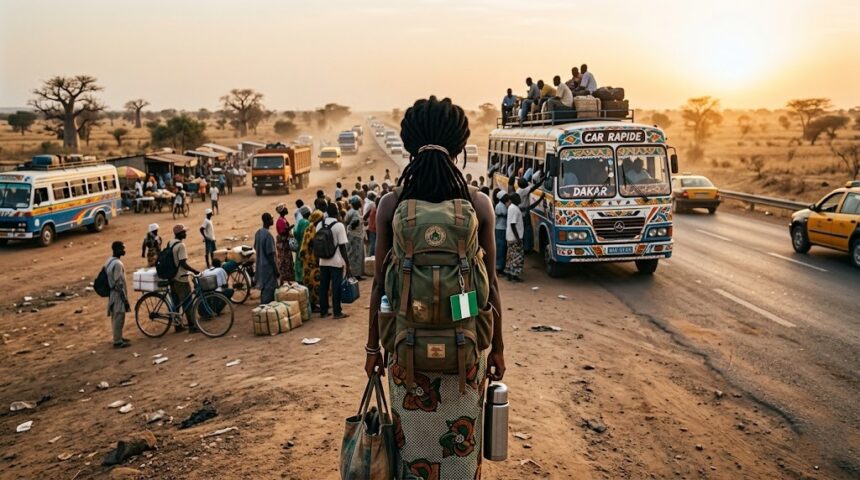
Flying from London to Lagos usually takes seven hours. For our co-founder, Charity, it took 14 days! She left the UK on foot, caught a local bus to Camden, boarded the Eurostar to Paris, and kept going until she reached Lagos, Nigeria, entirely by public transport.
This is one of those things that helps us at Travel Radio Live see Africa in the real light and not the glam of the gram. Do you want the insider gist? Keep reading.
Travel Radio co-founder Charity crossed two continents, 14 countries, and every assumption she’d arrived with entirely by public transport.
London ● Paris ● South of France ● Spain ● Morocco ● Western Sahara ● Mauritania ● Senegal ● Guinea ● Ivory Coast ● Ghana ● Togo ● Benin ● Lagos, Nigeria
The Route from London to Lagos at a Glance
Navigating Europe: Trains, Buses, and Unexpected Contrasts
The journey from London to Lagos started on a local bus in London. But it only made it as far as Camden Town because road works had cut the route short. Ms Charity walked the remaining mile to the international station with her backpack, boarded a train to Paris, and connected from there to an overnight sleeper to the south of France. She travelled that leg with six strangers in a tiny cabin, with bunk beds stacked three high. And she was the only Black person in the carriage.
“Every time I shifted, everybody in the carriage was on high alert,” she recalls.
France, outside of Paris, had different attitudes. For example, she entered a café in the countryside in the morning, when the place opened and watched staff serve every person who came in after her. After thirty minutes, she walked to the counter herself. The man behind it sent her back to her table. She got her coffee eventually, but we all know what is going on.
Paris
Paris was different, though. We are not trying to insinuate anything here. We just want to point out the contrast with what she found further south and later, across the water.
Spain was the opposite of what she’d prepared herself for. She doesn’t speak Spanish. When she stopped to ask for directions, the person she approached couldn’t understand English but immediately went looking for someone who could help. When she thanked them and started walking, they ran after her with two or three more people, all of them piecing together what English they had between them, just to make sure she was pointed correctly. Just a few of the many times she was shown kindness on her journey from London to Lagos.
She spent one night in a hostel in the south, nearly got locked out for arriving late, and caught a bus to the coast the next morning.
Crossing into North Africa: Morocco’s Hospitality & Ferry Routes
She took a ferry from the south of Spain to Tangier to Africa. Ms Charity had heard enough from other Black women about their experiences in North Africa. She just wants to get in, move quietly, and get out fast. She had been through difficult stretches in North Africa before and did not want anything to spoil the start of what she thought of as the real leg of the journey.
Unfortunately for her, she missed the last bus from the coast and found herself at a bus station after dark, alone, and with no accommodation booked. She checked one hotel, and it was so bad that she chose sleeping at the station over it. The overnight attendant at the station offered her the prayer room. She lay on the floor in the dark, with insects around her, too tired to be frightened and too stubborn to go back.
People showed her kindness and it made her happy and safe as she journeyed through.
“I felt bad for the reservations I’d had from London to Lagos. I knew from then on I would have to be really careful about how I presented my own version of events so that it doesn’t minimise what others went through, but my experience was one of extraordinary kindness.”
She chose the long-distance coach through Morocco over the train because she wanted to see the coast. For hours, strangers shared their food with her, attempted conversations in French, which she could barely follow, and pulled her into their small travelling communities. She was the only person on the bus who stood out completely, but she felt entirely welcome on it.
The Western Sahara Border Challenge: Visa Delays & Survival Tips
Western Sahara is the most difficult part of Ms Charity’s journey.
Before leaving London, Ms Charity had checked the entry requirements for Mauritania and understood, incorrectly, as it turned out, that she wouldn’t need a visa. By the time she reached the border, the rules had changed. A visa was now mandatory, and required a specific photo size that wasn’t mentioned anywhere on the official website.
One of the biggest issues we have in Africa is transparency. I think we have this thing for when people show up to our offices clueless so that they can pay undisclosed fees (at no set rates) to get things done.
Anyway, Ms Charity found a local fixer who said he could help. She paid him and he disappeared for two days.
So she was stuck at the border in a hotel she describes plainly as horrible. She had bed bugs biting her throughout the night, in desert heat. And she spent over a weekend when the relevant offices were shut for Friday prayers and stayed shut until Monday. A family she met there—a couple with four or five children, driving from London to Senegal, had been stranded at that same border for a week by the time she arrived.
The Moment Everything Nearly Fell Apart from London to Lagos
“I broke the door down somehow. I can’t explain it to this day. I grabbed my backpack, headed downstairs still crying, told them I was sorry I’d broken the door, and ran for the bus. The taxi took me to the wrong bus first. But I made it.”
On the morning she had decided to leave regardless, the hotel bathroom door handle fell off on the other side, trapping her inside. Her bus, the only one going in that direction that day, and already paid for, was about to leave. She broke the door down. She was crying when she got to the front desk. She apologised for the door, grabbed a taxi to the bus station, was taken to the wrong bus first, found the right one, and made it.
The fixer resurfaced later that same day. A woman she had befriended at the border had asked her husband to send a voice message to the scammer in Arabic and only after hearing it did the fixer reappear with Ms Charity’s visa.
A stranger with a small printer nearby helped her run off several extra copies, refused any money for it, and told her he didn’t know how many she’d need so she should take more. She needed them.
At least, as there are scammers, there are still kind people.
Travelling on foot turned out to be an advantage at the crossing. People with vehicles were held considerably longer. They were doing luggage searches, and paperwork checking multiple times. But at various points she got to, they quietyly expected her to hand them money. But Ms Charity, on foot with her documents in order, moved through faster than she had expected.
Mauritania, Senegal & Guinea: Desert Roads and Mountain Passes
On the Mauritanian side of the border, she met a man she refers to only as Mohammed. He explained the currency to her and sat with her through each checkpoint on the border, explained what each official needed, and when the process was done. Mohammed even flagged a taxi going to Nouakchott and made sure the driver knew where to take her. All of this without charging her anything.
The driver who took her to Nouakchott stopped once along the way to buy her a bottle of water and pass it through the window. She thanked him and held on to it without drinking because she has no idea when the next stop will be and there are no other women in the car to signal when a comfort break is happening.
The Border Moment That Stood Out Most From London to Lagos
One thing from that stretch she did not forget is that all along the desert road between the border and the city, there were small Chinese shops. A visible commercial presence that grew considerably larger once she reached Nouakchott itself. It was one of dozens of things the journey showed her that she hadn’t been told to expect.
In Senegal, the group she was travelling with at one point slept on the expressway. The border had closed for the night with nowhere nearby to stay, so they pulled over and waited for morning on the road itself. Like everybody slept on the bus like that.
“At every juncture, I asked for what I needed and God in his infinite mercies provided. That was the basis of the entire journey. Put one foot in front of the other and keep moving.”
West Africa to Nigeria: Smoother Borders & the Final Leg to Lagos
Ms Charity had planned to pass through The Gambia, but people she met on the road strongly advised against it. They had told her that the onward connections were unreliable and would likely force a long detour through Sierra Leone. She adjusted, routing inland through Guinea instead.
Guinea was the most frightening part of the whole trip from London to Lagos. A path cut through the mountains less a road than a channel forced through very old forest. And it wound along cliff edges where a single misjudgement of the wheel meant a sheer drop, with no emergency services, phone signal, and no realistic possibility of anyone finding you.
“For that alone, I would never recommend anyone do it,” she says, without softening it. “If something goes wrong up there, you’re gone. Nobody would even go looking for you in those depths. Nobody in their right mind.”
People travel it anyway because West Africa’s air and road infrastructure makes moving between neighbouring countries far more difficult and expensive than it has any reason to be. Ms Charity understood this more clearly with every border she crossed.
Flying between neighbouring countries costs what she describes as “stupid money,” and the transactions are in US dollars, in countries where nobody earns their salary in dollars. The difficulty of this journey is not accidental.
Benin Border From London to Lagos
At the Benin border, an official became visibly agitated the moment he saw her Nigerian passport as the only foreign passport in the pile. She was taken into an office. A supervisor moved files around his desk for a long time without speaking. He eventually told her there was a fee to pay. She looked at the bus driver who had come in with her and he nodded in agreement. She paid. “That was the only time a border official physically laid a hand on me and it was not to guide. It stood out because every other crossing, nobody had done it.”
From Ivory Coast onwards, the crossings were some of the smoothest of the entire journey. Ghana, Togo, and Benin, officials checked her documents and waved her through. Nobody questioned her yellow fever card, nobody asked for anything extra. “I was so proud,” she says. “So, so proud.”
The final leg, from Abidjan to Lagos, was on a Nigerian long-distance coach. It was the most comfortable single vehicle of the entire trip. It was air-conditioned, well-maintained, and even equipped with wifi that stopped working the moment it crossed a border. She found that both amusing and telling.
Why Take the Overland Route From London To Lagos? Rethinking African Travel Narratives
When Charity was at university, she read about a man who had boarded a train at his local station and ridden it all the way to China through Europe, Russia, and across Asia, He was sleeping in carriages for weeks. “That made me genuinely jealous,” she says. “I thought: I am going to travel the world. But before I do that, I need to know precisely what the situation is like on my own home continent.”
That is why she wanted to go from London to Lagos overland. She prepared herself to experience all the hostililties she had been told about Africans. She found that what she had heard is different.
The warnings she had heard about danger, about hostility, about what happens to a Black British woman travelling alone through North and West Africa did not hold up against her actual experience of the journey.
“They make it out to seem like travelling around Africa is literally a death sentence. Nothing is further from the truth. What we have in Africa and they make out like we don’t have it is a love of each other.”
The Love in Africa from London to Lagos
Yes, there are still real problems we are facing in Africa. For example, our borders are harder to cross than they should be between neighbouring countries. Some flight prices have no justification. Another example is how we make transactions in foreign currency in countries where nobody earns that currency. Or how we cannot have seamless internet connection among regions or neighboring countries.
What the journey from London to Lagos gave Ms Charity was not something to predict. Strangers sharing food on eighteen-hour journeys in buses. A man working a night shift at a bus station who offered her his workplace’s prayer room. A taxi driver in Mauritania who paid for her ticket, found her somewhere to sleep, and refused payment from her. Women on every bus and in every vehicle who watched out for her, without being asked and without making a production of it.
“Who told you Africa was like that?” she asks, of anyone who holds the darker version of the story. “Why do you believe it? They can never give you a straight answer.” She is not asking rhetorically. She wants people to sit with the question.
If You’re Considering This Route from London to Lagos
- Check visa requirements for every country, then check again two weeks before you leave. Requirements change, and official websites are often behind the actual situation at the border.
- Carry your yellow fever card and several photocopies of all your documents. You will be asked for them at moments you won’t predict.
- Build flexibility into your timeline. A missed bus, a closed border office, or a two-day visa delay are not edge cases — they are part of this journey.
- The mountain road through Guinea is genuinely dangerous. Research current conditions carefully and understand what you are taking on before attempting that stretch.
- Crossing borders on foot is significantly easier than crossing in a vehicle. If you have a choice, walk.
- Learn basic French before you go. Much of North and West Africa operates in French, and even a limited effort is noticed and tends to open doors.
- Pay attention to the women around you. On every leg of this journey, it was women who kept an eye on Charity — quietly, practically, without any fuss.
- Budget around £2,000 for the overland journey from London to Lagos itself. A last-minute return flight from Lagos to London can add over £1,000 on top of that.
“I need to know what the situation is like on my own home continent. I need to do it.”
Charity made it to Lagos. She spent a week there before flying home. She is already thinking about what comes next.