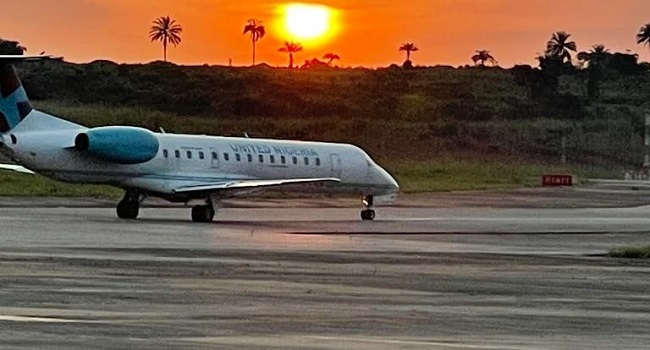
United Nigeria Airlines has grounded two Airbus A320 aircraft following its fourth bird strike incident in less than two weeks.
The latest disruption occurred during take-off from Asaba International Airport forcing precautionary engine inspections across its fleet.
The carrier confirmed Sunday the strike affected one engine on Flight UN0523 bound for Lagos, necessitating immediate grounding to uphold strict aviation safety standards despite mounting pressure on Nigeria’s domestic air corridor.
“This marks our second successive bird strike in under 24 hours on separate Airbus aircraft,” the airline stated in an official bulletin dated February 15, 2026.
Operations between Nigeria’s three busiest domestic routes—Lagos, Abuja, and Asaba—experienced cascading delays as maintenance crews conducted mandatory borescope inspections on all Pratt & Whitney engines in the fleet, a process requiring 8–12 hours per aircraft under NCAA regulations.
Wildlife Hazard
Aviation safety experts point to seasonal migration patterns and inadequate wildlife management at Nigeria’s secondary airports as contributing factors.
Asaba Airport, situated along the Niger River floodplain, has recorded three bird strike incidents involving commercial carriers since January 2026—a 300 percent increase over the same period last year.
Pilots operating the Lagos-Asaba-Lagos shuttle route report frequent encounters with large waterfowl during dawn and dusk take-offs when visibility drops below optimal levels.
“The physics are unforgiving,” explained Captain Ibrahim Musa, a retired NCAA safety inspector.
“A 4-kilogram bird impacting an engine at 250 knots generates force equivalent to a small cannonball. Even if the engine survives, metal fatigue from blade deformation requires full teardown inspection no shortcuts.”
Musa noted that United Nigeria’s proactive grounding demonstrates improved safety culture compared to 2024 incidents where carriers attempted continued operations after minor strike