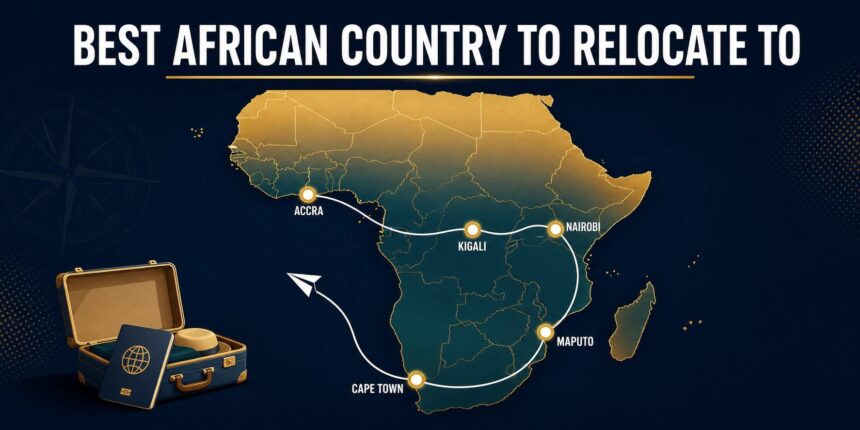
This new reverse japa trend is holding everywhere. Are you thinking about which African country to relocate to? I believe every new video you find on IG or TikTok is leaving you more confused. So, how can you choose the best African country to relocate to?
The honest answer: there is no single best African country to relocate to. Your answer will be the one that matches your specific budget, family situation, career, and risk tolerance.
This blog post gives 12 relevant factors you should use to compare.
TL;DR: The 12 factors, at a glance
- Safety and corruption set the floor. A cheap, beautiful country with a broken justice system will cost you more in the long run than a pricier, well-governed one.
- Your visa path has to survive year three, not just year one. A tourist stamp you renew every 90 days is not a relocation plan.
- Property rights vary enormously. Some countries let foreigners hold freehold title outright; others only offer long leases on state land.
- How you’ll be received matters as much as the immigration rules. Trade tensions, xenophobia, and everyday hospitality differ sharply by country, even within the same region.
- Run every candidate through one question: is this country a platform you can build a life on, a bridge you’ll use for a season, or a trap that looks better on your phone than it will feel in person?
Why does choosing the right African country matter more than picking a popular one?
See, many countries just have good PR. And they are popular because of how much their tourism ministry has invested. Also, the fact that a country is popular doesn’t mean it will work for your specific life.
For example, a destination that suits a single 26-year-old remote worker may not work for a family of five who need to enrol children in school. And a country that looks beautiful for a two-week trip can be completely different once you’re the one paying rent, registering a business, or waiting in a hospital queue.
Upgrade or Downgrade?
See, one of the biggest problems we have in Africa is that our society has conditioned us to treat Europe, North America, and the Gulf as the default upgrade. Therefore, we think low of people who choose to relocate within the continent or travel back from the West.
However, Africans in the United Kingdom are increasingly rebuilding their lives back in Africa. Why? They have realised that a “developed” country doesn’t automatically mean a better one for their family.
The factors outlined in this blog post apply whether you’re moving to an African country from Lagos, London, or anywhere else, because the questions a smart relocation should answer don’t change based on where you’re starting from.
Questions to help you choose the best African country to relocate to
1. Is the country actually safe, or just safe on social media?
This is the first thing to ask. Safety first, right?
No matter how great a country is, if it is not safe to live in for foreigners, you will regret the move. A safe country lets you build a normal life. If you pick an unsafe one, you will be forced to spend money and mental energy on precautions that eat into whatever savings you moved there to protect.
Hence, don’t base your decisions on viral clips. There are three things you must check to verify the safety of any country you are planning to relocate to.
A) check the State Department or foreign office travel advisory level from a country other than your own, B) recent Global Peace Index rankings of that country, and C) whether the crime that exists is opportunistic (small common crimes like pickpocketing and petty theft) or violent and targeted.
Countries like Rwanda, Botswana, Mauritius, and Seychelles consistently score among Africa’s safest on independent indices, and TravelRadio.live keeps a ranked breakdown of the safest African countries to relocate to if you want the country-by-country detail. Whatever you find, weigh it against your own risk profile.
2. How corrupt is the system you’ll actually be dealing with?
See, there is corruption everywhere, but some places have it so worse that it affects everyone living there. Now, some countries just have bad PR and bad reputation. But country corruption is measurable.
Transparency International’s 2025 Corruption Perceptions Index scores countries from 0 (highly corrupt) to 100 (very clean).
Seychelles leads the continent at 68, ahead of Cape Verde at 62, with Rwanda and Botswana tied at 58, Mauritius at 48, Ghana at 43, and South Africa at 41. For comparison, Nigeria sits at 26. Corruption isn’t an abstract governance statistic. It may mean that your land title does not hold up in court because a richer person (or minister) deems it fit to be seized or resold! You could even spend years defending yourself. Corruption may mean that police stops is more than routine, but rather an unofficial toll booth. A country doesn’t need to top the index to be livable, but you should know the score before you sign a lease or start a business in any country.
3. What visa and residency path will you actually be on?
The visa that gets you through the airport may not let you build a life there. Therefore, before you run off, map the realistic path. Be sure of the entry requirement, how long you can legally stay before renewing anything, whether that renewal requires leaving the country, and how many years it typically takes to reach permanent residency if that’s your goal.
These rules can change quickly too. For example, as of 2026, Rwanda, Ghana, Kenya, Seychelles, Benin, The Gambia, Tanzania, and Togo all admit holders of any African Union passport without a visa. Nigerians also carry ECOWAS rights to enter, reside, and work across the bloc’s remaining member states without a visa. And Mali, Burkina Faso, and Niger formally exited ECOWAS in January 2025 to form their own alliance.
TravelRadio.live has a full Nigeria visa requirements breakdown and a guide to touring multiple countries without a Schengen, UK, or US visa if you want the current country-by-country rules. Whatever the entry rule, separate it clearly from the residency rule; they’re rarely the same thing.
4. Can you actually own property there, and on what terms?
I don’t know about you, but relocating and settling down for me involves owning property. However, many bloggers seem to skip this question.
Property regimes across Africa split roughly into three types: 1) full freehold ownership, 2) leasehold on state or communal land, and 3) a right-of-use arrangement where the land itself is never for sale.
For example, in South Africa, currently, foreigners can buy freehold houses, apartments, land, and commercial property in their own name with no nationality-based restriction. However, non-resident buyers typically need a larger cash deposit for financing.
Botswana allows foreign freehold purchase in designated urban and tourism areas, alongside leasehold land available on 50-to-99-year government leases, but charges foreign buyers a steep 30% transfer duty and keeps tribal and agricultural land off-limits.
Namibia follows a similar freehold-with-restrictions pattern, especially around commercial farmland. In other places on the continent, you can expect leasehold or a state-issued land-use right to be the default, so confirm the actual tenure type before you get emotionally attached to a listing.
5. What will rent and daily living really cost, once you strip out the exchange-rate mirage?
When it comes to calculating costs from another country, many of us have this delusion that currency works the same way. Let me explain. A number that looks generous when converted from naira, pounds, or dollars can shrink fast once you’re paying local prices for local goods, not tourist prices for a two-week trip.
Let me give you an example. Someone mentioned that the minimum wage in South Africa is R5,894.40 per month. In Naira, this will be approximately ₦495,601.15. Almost half a million! Now, if you compare that to Nigeria’s 70k minimum wage, you may scream and jump at South Africa. Now, the crazy thing is that the average South African spends more than R15,000 monthly. This means you are still facing a similar economic problem as Nigeria’s 70k.
So, check three specifics: the standard rental deposit structure, whether utilities are metered and reliable, and how much of your budget goes to imported versus locally produced goods.
Rental customs vary more than people expect. Lagos and Accra commonly ask for one to two years of rent upfront. Several Southern African rental markets instead operate closer to a month-to-month structure with a deposit plus first and last month. Neither pattern is universally better, but the point is to confirm which one you’re walking into, because it changes how much liquid cash you need on day one.
6. Is there real work for someone with your specific skills, not just work in general?
Now about work. The fact that you are seeing “The economy is growing” everywhere doesn’t mean someone will hire you or buy what you sell. Before you leave your current home, research the actual sector demand for your field. For example, yes, there is a tech and business process outsourcing cluster in Kenya and Rwanda, but you must research based on your own skill and niche. There are financial services in South Africa and Mauritius, and oil, gas, and agriculture dominate many other places. Still, you must research.
If you’re bringing remote income instead of seeking local employment, you have to check the country’s digital nomad or self-employed visa terms directly. That’s because minimum income and capital thresholds change from year to year and vary sharply by country.
If you’re starting a business rather than seeking a salary, look specifically at how foreign business ownership is treated. Some countries reserve certain retail and trading activities for citizens by law, which matters if your plan involves import-and-resell rather than a service business, a professional practice, or remote consulting.
7. What happens to you or your family if something goes medically wrong?
Healthcare quality is one of those factors you must research thoroughly. Ask about the nearest facility that can handle a genuine emergency, whether private health insurance is available and what it actually covers. And ask whether serious cases get treated locally or evacuated, and to where.
For example, Mauritius, South Africa, and Rwanda are generally regarded as having stronger healthcare infrastructure by African standards, particularly in their capital regions. Quality still drops sharply outside major cities almost everywhere in Africa.
Hence, if you have an existing condition, a young child, or ageing parents joining you, treat this factor as a hard filter rather than a nice-to-have, and get country-specific confirmation rather than relying on a general reputation.
8. If you have children, will the education system actually work for them?
This factor is very important. Check whether the curriculum will transfer back if you ever return home or move again, the actual quality difference between public and international schools, and the realistic cost of international schooling, which can rival university tuition in some capitals.
Ghana runs an education structure close enough to Nigeria’s that many families find the transition manageable. Countries with strong international-school ecosystems, generally Kenya, South Africa, and Mauritius, give you more flexibility but at a meaningfully higher price point. If schooling is a factor at all, visit the specific school during a scouting trip rather than trusting a website, because facilities and staffing can look very different in person.
9. Can you count on power, water, and internet, or are you planning your week around outages?
Infrastructure reliability rarely makes it into glossy relocation content, but it shapes daily life more than almost anything else on this list, especially if you work remotely or run a business that depends on connectivity. Ask locals, not tourism boards, about outage frequency, whether backup power (inverters, generators, solar) is standard or exceptional in your target neighbourhood, and whether tap water is drinkable or whether bottled and filtered water is simply assumed.
Staying connected while you’re still researching, before you’ve committed to a local SIM or a fixed line, is its own small logistics problem worth solving early. TravelRadio.live has a complete eSIM setup guide that’s useful whether you’re on a scouting trip now or already living somewhere and need reliable data as a backup.
10. Does the climate match the life you actually want, not the one in your head?
“Africa” in the collective imagination means savanna heat and beaches, and plenty of the continent fits that image. But Lesotho sits high enough in the mountains to see snow and freezing winter nights, Cape Town has a Mediterranean climate closer to southern Europe than to Lagos, and Nairobi’s altitude keeps it mild year-round despite sitting near the equator. TravelRadio.live’s Lesotho travel guide covers what daily life feels like in Africa’s coldest country, which surprises most first-time visitors.
Match the climate to your actual preferences and any health considerations, not to a mental image built from stock photography. Someone who struggles with heat and someone chasing year-round beach weather need to be looking at completely different shortlists.
11. How will you personally be received, and is that reception improving or worsening?
This is the factor diaspora content handles least honestly, usually flattening it into either “Africans welcome Africans” or ignoring it entirely. The real picture is more specific and worth researching country by country rather than assuming continental solidarity applies evenly everywhere.
Take Ghana and Nigeria as a concrete example. Nigerians benefit from ECOWAS free movement and a large existing community, but retail trade tensions between Ghanaian and Nigerian traders’ associations have flared repeatedly, including shop closures enforced under Ghana’s investment law that reserves certain retail trading for citizens, with fresh enforcement actions reported as recently as late 2025. That doesn’t mean Ghana is hostile to Nigerians broadly; most day-to-day interactions are fine.
It does mean a returnee planning to open a retail shop faces a different reality than one taking a salaried tech job, and that reality is worth researching specifically rather than assuming from general reputation. Ask people who actually live there now, ideally more than one source, before you build a business plan around a country’s name for hospitality.
12. Does the economy give you room to diversify, or does everything run through one sector?
A country dependent on a single export, a single donor relationship, or a single industry carries risk that doesn’t show up in a “cost of living is low” headline. Look at whether the economy has genuine sector diversity, whether the currency has been stable or volatile over the past few years, and whether the country participates meaningfully in cross-border trade frameworks like the African Continental Free Trade Area, which is gradually making it easier to move money, goods, and skills between African countries.
This matters even if you’re not running a business. A diversified economy generally means more banking options, more resilient employment across sectors if one industry contracts, and more predictable currency behaviour for anyone earning or saving in the local unit. Diversifying your own financial footprint, like multiple accounts and multiple income streams, is a reasonable personal hedge no matter which country you land in.
Snapshot: how five countries compare on the factors that get skipped most often
The table below isn’t a ranking. It’s a quick reference for the factors this piece covers that general “best countries” listicles usually leave out. Confirm every figure directly before you act on it, since visa terms and fees change frequently.
| Country | 2025 CPI score | Visa-free for African passports | Freehold property for foreigners | Rental deposit norm |
|---|---|---|---|---|
| Rwanda | 58 | Yes | Generally leasehold, not freehold | Varies, often shorter-term |
| Ghana | 43 | Yes | Limited; retail land ownership restricted | Multi-month to annual upfront common |
| Mauritius | 48 | No (specific schemes apply) | Yes, through approved investment schemes | Deposit plus monthly |
| Botswana | 58 | No | Freehold in designated areas; 30% foreign transfer duty | Closer to month-to-month |
| South Africa | 41 | No | Yes, largely unrestricted | Deposit plus monthly |
Take a scouting trip before you commit to any of this
Every factor above can be researched from a screen, but none of them fully reveal themselves until you’re standing in the neighbourhood, at the actual hospital, in the actual rental market. A one-to-two-week scouting trip, treated as due diligence rather than a holiday, is the cheapest insurance against a relocation you’ll regret.
Book the flight through Expedia or compare fares on Trip.com, and line up accommodation through Agoda or Hotels.com in the specific neighbourhoods you’re actually considering living in, not just the tourist district. Use Tripadvisor and Viator to find real reviews of clinics, schools, and services near those neighbourhoods, since local word of mouth rarely makes it onto relocation blogs. And get a data eSIM sorted before you land, whether that’s through Airalo, Saily, Yesim, or Drimsim, so you can pull up maps, translate, and call landlords the moment you touch down instead of hunting for a local SIM card on day one.
The platform, bridge, or trap test
Once you’ve run a country through all 12 factors, ask one final question that cuts through the noise: is this country a platform, a bridge, or a trap for you specifically?
A platform is somewhere you could genuinely build a decade of your life: stable enough legally, financially, and socially to put down roots. A bridge is a perfectly good place to spend one to three years while you build skills, save capital, or wait out a specific circumstance, without expecting it to be permanent. A trap looks appealing in a nine-minute video but collapses under the weight of an honest visa timeline, an honest cost breakdown, or an honest look at how you personally will be received there. The same country can be a platform for one person and a trap for another, depending entirely on how their answers to the 12 factors line up.
Frequently asked questions
What is the single most important factor when choosing an African country to relocate to?
There isn’t one universal answer, but safety and corruption together form the floor beneath every other factor. A country can be affordable and warm and still be a poor choice if the justice system doesn’t function or violent crime is common, because those conditions make every other factor, from property rights to business ownership, harder to rely on.
Which African country is easiest for Nigerians to relocate to?
Ghana is generally the most accessible starting point because of ECOWAS free movement, cultural familiarity, and an established Nigerian community, though retail trade tensions between Ghanaian and Nigerian trader associations are worth researching if your plan involves opening a shop rather than salaried or remote work.
Do I need a lot of money saved before relocating within Africa?
You need enough to cover your specific target country’s rental deposit structure, several months of living costs as a buffer, and any visa or residency fees, and that figure varies enormously by country and city. Southern and East African cities with month-to-month rental norms generally require less upfront cash than Lagos-style, year-upfront rental markets.
Can foreigners legally own property in most African countries?
It depends entirely on the country. South Africa allows largely unrestricted freehold ownership for foreigners, Botswana and Namibia allow freehold in designated areas with restrictions on agricultural and tribal land, and many other African countries default to leasehold or state land-use rights rather than outright ownership, so confirm the tenure type before committing to any specific property.
Is corruption really that different between neighbouring African countries?
Yes, and often more than people expect. On the 2025 Corruption Perceptions Index, Seychelles scores 68 out of 100 while some neighbouring countries score in the 20s and 30s, and that gap translates directly into how predictable everyday interactions with courts, police, and land registries are likely to be.
Should I visit before I relocate, or can I plan everything remotely?
A scouting trip is strongly worth the cost. Rental listings, school websites, and clinic reviews can only tell you so much; walking the actual neighbourhood, meeting a landlord in person, and sitting in a local clinic’s waiting room reveal things no amount of online research will surface.
Related reading on TravelRadio.live
- The 7 Safest African Countries to Relocate To (Ranked and Explained)
- Why Africans Are Relocating from the UK to Rebuild Family Stability
- Nigeria Visa Requirements: Complete Guide for Travellers
- How to Explore Multiple African Countries Without a Schengen, UK, or US Visa
- How to Use an eSIM: Setup, Activation & Travel Guide
- Lesotho Travel Guide: What It Feels Like to Visit or Relocate to Africa’s Coldest Country