TL;DR- Is Uber Banned at Lagos Airport?
Officials have come out to debunk claims that Bolt or Uber is banned at Lagos airport, but a July 30, 2026 internal FAAN memo suspended both platforms’ commercial pickups at every FAAN-managed airport, and that suspension is still in force today.
FAAN claims that this suspension is due to unresolved licence agreements and wants drivers registered on its own ACHRAMS platform, while insisting that the platform is not an e-hailing app.
The new regulation also states that vehicles must now be 2012 models or newer to be accepted, and 2015 or newer at Lagos’s MM1 terminal.
There’s also a ₦40,000 fine for drivers caught picking up without registering.
As a result, airport cab fares have jumped by more than 150% since enforcement tightened in early August, and there’s still no confirmed date for Uber and Bolt to resume pickups.
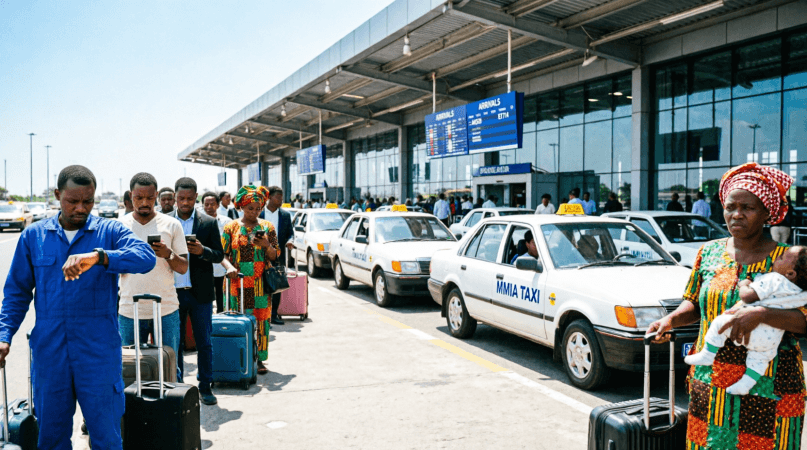
If you’re flying into Murtala Muhammed International Airport (MMIA) or Nnamdi Azikiwe International Airport (NAIA) now, you may not be able to have an Uber pick you up like it used to be. Yes, the app works, but Uber and Bolt drivers may not enter the airport to pick up anyone anymore for a while. That’s why the ride you expect at ₦8,000–₦15,000 is now closer to ₦25,000–₦40,000 through a traditional airport cab.
Is Uber Banned at Lagos Airport and Abuja Right Now?
Technically, no. However, for the most part, we are no longer seeing Bolt and Uber drivers in airport terminals. The Federal Airports Authority of Nigeria (FAAN) has published a memo to say that there is no such thing as a “ban.” The internal memo, signed by the General Manager of Commercial Services, U.R. Liman, directs airport managers at every FAAN-run airport to enforce an immediate suspension of Uber and Bolt’s commercial operations. A separate letter from FAAN’s Director of Commercial and Business Development had already told Bolt the same thing days earlier.
According to their spokespeople, there is a difference between “suspension” and “ban.” And it matters to FAAN. But there’s still the fact that a driver faces a ₦40,000 fine for picking up a fare at Murtala Muhammed. There’s still the fact that if you mistakenly book a ride before you land, you have to drag your luggage outside the airport to enter your ride! As of today, no licence agreement has been signed, and FAAN has not given a resumption date.
What Did FAAN Actually Say About the Uber Ban?
On August 20, 2026, FAAN issued a public statement pushing back on reports of a blanket ban. The authority said the suspension is not intended to restrict passengers’ access to transport, and that it’s still in talks with both companies over a framework covering pickup zones, driver vetting, and security. They are saying that the reason for this suspension is security.
When explaining why Uber is banned at Lagos airport, FAAN’s stated reasons are safety, security, accountability, and what it calls “operational visibility” over who’s picking up passengers on airport property. It also argues that airports are private, regulated land rather than public roads, and that other major airports worldwide license or restrict ground transport in similar ways.
If they use that framing, it sounds reasonable. However, this suspension went into effect immediately and without warning on July 30. People just got to the airport and found themselves stranded. It took weeks before FAAN got around to explaining itself publicly, only after fare complaints and driver protests all around the state.
Why Are Uber and Bolt Being Kept Off Airport Grounds?
Now that we have heard FAAN and Uber/Bolt’s side of the story, we believe that this issue boils down to three things: 1) unresolved licence agreements, 2) vehicle-age rules (which is a stupid one in my opinion), and 3) a registration system that requires handing over driver data.
So, first of all, Bolt previously held a concession and won in 2022 after a competitive process. That was how Bolt drivers started using a designated parking area at FAAN airports. According to reporting on the dispute’s history, that arrangement required a parking-access fee (reportedly around ₦45,000), Bolt-branded uniforms, a biometric check, and a police character certificate. Drivers argued the fee was too high for what they actually earn from airport trips, but the agreement wasn’t renewed.
The second issue now is vehicle age. FAAN is saying that cars used for airport pickups all over Nigeria must be 2012 models or newer. And they will enforce it on October 1, 2026. But they want Lagos’s MM1 terminal to be 2015 or newer, in addition to a mandatory registration on FAAN’s app.
Now registering drivers who’ve already been registered on Bolt or Uber means handing their databases to FAAN. Bolt has reportedly declined, citing data-privacy concerns. Uber, notably, hasn’t said anything publicly at all, despite being named directly in the July 30 memo.
Any one of these issues could plausibly be resolved with negotiation. But the problem and inconvenience caused cannot be repaid. They just enforced a rule overnight with no phased rollout and filled airports with stranded passengers.
What Is ACHRAMS, and Is It Really Not an E-Hailing App?
ACHRAMS stands for Airport Car Hire Rank Management System. It is FAAN’s digital platform for registering and tracking commercial drivers at its airports.
FAAN has been explicit that ACHRAMS is a regulatory and tracking tool, not a competitor to Uber or Bolt. “ACHRAMS is not an e-hailing application and is not intended to compete with or replicate the services provided by Uber, Bolt or any other e-hailing platform,” according to their August 20 statement. They described it instead as infrastructure for managing concessions, charges, and driver accountability.
However, a public-facing ACHRAMS passenger app is already live for Lagos MMIA. The app lets riders search for a registered driver, track a trip, and pay in-app. Drivers who’ve used it describe a booking flow that looks a lot like the apps it’s supposedly not replicating. FAAN’s regulatory framing and the passenger-facing product sitting on top of it are two different things, and the gap between them is exactly what’s fueling driver suspicion.
| Uber / Bolt | ACHRAMS | Traditional airport taxi | |
|---|---|---|---|
| Booking | In-app search and match | In-app search and driver match | In-person, at the rank |
| Pricing | Algorithmic, dynamic | Set by FAAN framework | Negotiated, largely unregulated since the suspension |
| Vehicle rules | Uber/Bolt’s own standards | 2012+ nationally, 2015+ at MM1 | FAAN-concession vehicles |
| Access | Open onboarding, subject to checks | Central FAAN registration and vetting | Closed to concession holders |
How Much Are Lagos Airport Taxis Charging Now?
Considerably higher than before. Fares at MMIA and NAIA have climbed by over 150% since August 1, when FAAN deployed more than 50 task-force personnel to the airports.
One driver-union source put the average fare at ₦18,000–₦20,000 per trip, against fuel costs of roughly ₦80,000 to fill a tank and weekly vehicle-rental remittances around ₦40,000. Against those numbers, a single ₦40,000 fine for an unauthorised pickup can wipe out several trips’ worth of earnings in one stroke, which is why most Uber and Bolt drivers have simply stopped taking airport jobs rather than risk it.
That math also explains why fares have jumped. Fewer registered vehicles are competing for the same demand, and the traditional airport cabs that captured the vacated market are pricing accordingly.
More still, passengers who used to walk to a waiting Uber now spend extra minutes negotiating at the rank, sometimes walking past the terminal boundary altogether to meet a driver who won’t risk the fine.
Who’s Losing and Who’s Winning From the FAA Uber Ban?
Drivers lose income from fewer trips, after paying to register!
Passengers pay more, wait longer, and in many cases end up negotiating an off-app rate directly with a driver outside the terminal.
FAAN gains tighter operational control over who operates on its property and a new revenue stream through ACHRAMS registrations and concession charges, an outcome its critics point to when questioning how much of this is genuinely about safety.
Traditional airport cab operators, who held near-exclusive access before e-hailing arrived, are the clearest beneficiaries of the vacuum left by the suspension.
Drivers under the Amalgamated Union of App-based Transporters of Nigeria (AUATON) have threatened an indefinite strike if the standoff drags on. It wouldn’t be the union’s first show of force this year: AUATON grounded Uber and Bolt across Lagos and Ogun states in March 2026 in a separate dispute over falling trip fares.
Does This Affect Uber and Bolt Rides Outside the Airport?
No. This suspension is specific to FAAN-managed airport property. This means it only affects pickups from inside MMIA, NAIA, and other FAAN airports. Uber and Bolt continue operating normally everywhere else in Lagos, Abuja, and every other Nigerian city they serve.
Also, it’s worth knowing this is a FAAN issue, not a Nigeria Civil Aviation Authority (NCAA) or state government one. FAAN manages the airport premises, but it doesn’t set citywide transport policy. So a resolution here won’t come from Lagos State or Abuja’s FCT administration, but from FAAN negotiating with Uber and Bolt.
Has FAAN Banned Uber at Lagos Airport Before?
Yes, they have in December 2019. FAAN put up signposts at Nigerian airports restricting Uber and Bolt pickups, attaching a ₦10,000 fine to violations at the time. FAAN denied it was a full ban then too, calling it a regulatory clarification, and the underlying disagreement over who controls airport ground transport was never really settled.
Seven years later, the same argument has resurfaced with a steeper fine, a formal digital registration system, and a driver union willing to shut down a city over it. What’s different this time isn’t the dispute itself. It’s the pressure building around it.
I believe that e-hailing has become the default way a huge share of Lagos and Abuja residents move around, which means an airport-transport dispute now touches far more daily commuters than it would have seven years ago. AUATON’s willingness to threaten a citywide shutdown, rather than just issuing a statement, reflects that shift in leverage.
What Can You Do If You’re Landing at MMIA or Abuja Right Now?
With the difficulty of getting an Uber or Bolt, you can still have a few simple workarounds. Let me give you some alternatives.
- Book a private airport transfer before you fly. You can book a pre-arranged pickup, through a service like Viator, to sidestep the whole scramble. You will get a private cab driver is waiting for you by name rather than competing for a fare at the rank.
- Book a hotel with an airport shuttle. Several hotels near MMIA and NAIA run their own transfer service, which avoids FAAN’s registration dispute entirely. Check what’s included when you book through Hotels.com, and see our guide to what to do the moment you arrive at your hotel once you’re checked in.
- Try InDrive or another alternative app. Some travellers have found drivers on other platforms willing to meet just outside the airport perimeter rather than at the terminal itself, though this depends entirely on the individual driver’s risk appetite.
- Sort your data connection out before you land. Whatever option you choose, you’ll need working data to arrange it. Set up an Airalo eSIM ahead of time, and our complete guide to using an eSIM walks through activation so you’re not fumbling with it in the arrivals hall.
- Budget more than you expect. Whichever route you take, price in ₦25,000–₦40,000 for a Lagos airport transfer rather than the ₦8,000–₦15,000 you may remember from before the suspension.
If this is your first arrival experience at a Nigerian airport, plan around the transport chaos. One TRL contributor’s account of the hiccups that came with departing Nigeria is a reminder that airport friction here rarely announces itself in advance. And if you’re carrying cash, it’s worth knowing what you can and can’t bring through Nigerian customs before you land, since currency declaration rules are enforced strictly regardless of what’s happening with ground transport.
So, Should You Trust FAAN’s Timeline for When Uber is No Longer Banned at Lagos Airport?
FAAN says a “mutually acceptable agreement” with Uber and Bolt is close, meaning Uber is no longer banned at Lagos airport. It said something similar in 2019, and that dispute simmered for years without a clean resolution. Nothing about the current standoff, three unresolved conditions enforced simultaneously with no phased transition, suggests this one resolves faster.
For travellers, the honest answer is to plan for the suspension to still be in effect when you land, and to treat any resumption as a pleasant surprise rather than something to count on.
Frequently Asked Questions: Uber Banned at Lagos Airport
Is Uber banned at Lagos airport?
Not officially. FAAN calls it a suspension pending licence agreements, but the practical effect for most travellers is the same: drivers avoid airport pickups because of a ₦40,000 fine, so app-based rides are unreliable at the curb.
Why is Uber banned at Lagos airport?
FAAN cites unresolved licence agreements, a vehicle-age requirement drivers weren’t meeting, and a refusal by Bolt to hand over its driver database for registration on FAAN’s ACHRAMS platform. Uber has not publicly explained its own position.
What is ACHRAMS?
ACHRAMS (Airport Car Hire Rank Management System) is FAAN’s digital platform for registering, tracking, and vetting commercial drivers at its airports. FAAN says it is not an e-hailing app, though a public passenger-facing version is already live at Lagos MMIA.
What happens if a driver is caught picking up a passenger at the airport?
FAAN can issue a ₦40,000 fine for an unauthorised pickup, an amount that can exceed what a driver earns from several trips combined.
What vehicle age is allowed for airport pickups now?
Nationally, vehicles must be 2012 models or newer, enforced from October 1, 2026. At Lagos’s MM1 terminal, the requirement is stricter: 2015 or newer.
How much are airport taxis charging since the suspension?
Fares have risen by more than 50% since early August 2026. Traditional airport cabs are reportedly charging considerably more than Uber or Bolt did before the suspension.
Will Uber be banned at Lagos airport forever?
There is no confirmed date for a permanent ban or resolution. FAAN describes talks as ongoing and expects a “mutually acceptable agreement,” but as of publication, the July 30 suspension technically remains in force.
What should I do if I land at MMIA or Abuja airport before this is resolved?
Book a private transfer or a hotel shuttle in advance, keep a data-enabled eSIM ready so you can arrange alternatives on the ground, and budget for a higher fare than you may remember from previous trips.