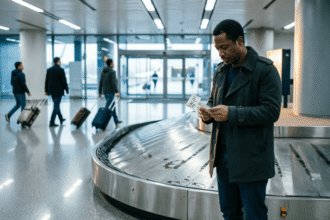
Boarding for the Accra to London flight starts in ten minutes. You open your hand luggage for the passport, and you can’t find it. And the gate agent is already scanning other people’s boarding passes.
I know that feeling when your stomach just drops. But you need to first breathe. Losing a passport abroad is one of the most stressful things that can happen on a trip. A lost passport abroad can add more frustration. You start thinking about your visa that dies with the booklet, a home embassy in another city, and replacement fees. Don’t worry.
This guide walks you through the exact actions to take in the first hour, the documents you need, the real costs and waiting times, and how to stop it happening again.
The links scattered through this post point to tools we actually rate, plus more guides on this site for the messy moments of travel.
Is Your Passport Actually Lost?
Before you panic, many people who have paid to replace their “lost” passport later found it among their stuff. Hence, our first advice is that before you report anything to anybody, retrace your last 24 hours in order.
Work through every compartment of your bag, including the hidden ones at the bottom of backpacks. Empty your jacket and trouser pockets completely. Open the hotel safe, look under the bed, and check the side of the mattress if you kept documents there overnight. Think about the last plane, bus, taxi, okada or boda boda you were on and check the seat pocket in your memory. Did you place it on the restaurant table while paying? On the counter at the bank or the bureau de change? At the photocopy shop? Did it slip between the seats of the airport shuttle?
Then you can start asking people. Call the hotel reception and the last two or three places you visited. Most hotels keep a lost property box, and airport information desks handle dozens of returned items every week. If you are travelling with someone, have them search their own bags too, because passports wander into a companion’s luggage more often than you would think.
Only move to the official reporting steps below once you are genuinely convinced the booklet is gone. Why? Because once you report a passport lost, your government cancels it in their system. So, if you later find it in one of your clothes, it is completely useless. You would then have to return it and apply for another one all over again.
What to Do When You Have a Lost Passport Abroad
Now that you have searched and confirmed that your passport is missing, let us work through the steps. Don’t skip anyone. It doesn’t matter whether the passport was lost or stolen; the only difference is that theft adds a police report at the start.
So, let us start.
Step 1. Report the Loss and Cancel Your Passport
If your passport was stolen, file a report at the nearest police station first. Go with whatever identification you still have, explain what happened, and ask for a copy of the police report. Make two or three copies, because you will need one for the embassy, one for any insurance claim, and a spare for your own records.
A police report is an official record that the loss happened, and it protects you if anyone tries to misuse your identity later.
After the local police, notify your own government so they can cancel the passport. A cancelled passport cannot be used by anybody else to travel, open accounts or commit fraud in your name.
How to Report or Cancel Your Stolen/Lost Passport Abroad
Many governments now let you report the loss online with your phone or computer.
- Nigerians should report to the nearest Nigerian mission and the Nigerian Immigration Service, which keeps the passport record on its portal.
- Americans file Form DS-64 with the US State Department, which cancels the booklet immediately.
- Britons report the loss online through GOV.UK before applying for any replacement.
I must reemphasise that you should cancel only when you are sure the passport is gone. Once you cancel it, you have to apply for a new passport when you get back home.
2. Find Your Nearest Embassy or Consulate
An embassy or high commission is your country’s official office in another country. The consular section is the part that helps you when in trouble abroad, including with lost passports.
Now, countries like the US and UK run missions in many countries. However, Nigeria, Ghana, Kenya and most other African countries have far fewer. So the nearest mission to you might be in another city or even another country entirely.
So the moment you know the passport is gone, search for your country’s mission in the country you are in. Call or email the consular section, and explain your situation and your travel date. Ask what documents to bring and whether they can issue an emergency travel document quickly.
Tip
- Missions work office hours on weekdays. Staff on call at weekends and at night handle life-or-death emergencies, so a passport lost on Saturday usually means waiting until Monday morning. A lot of the panic in this situation is just bad timing, and knowing this spares you a sleepless night.
- If you booked through a tour company, travel agency or employer, tell them as well. They deal with embassies often and can help you move faster. Crew on cruises and package tours frequently have direct contacts inside the missions they visit.
3. Gather Supporting Documents for Replacement
The embassy cannot simply hand you a new passport because you say who you are. They must verify your identity and citizenship first, and the evidence you bring decides how fast that happens.
Documents That Help:
- A photocopy or scan of your lost passport, ideally the data page showing your photo and passport number. This one page cuts verification time dramatically. Email it to yourself, save it in cloud storage, or send it to your own WhatsApp before every trip.
- A second form of photo identification: driver’s licence, national ID, NIN slip, voter’s card or student ID.
- Proof of citizenship if the mission asks for it, such as a birth certificate or an old expired passport, even a cancelled one from years ago.
- Two recent passport photographs. If you did not pack spares, photo studios near embassies do them quickly and cheaply; ask the mission where travellers usually go.
- Your travel itinerary: flight bookings, hotel reservations or tour confirmations that show how urgent your case is. Travellers with flights leaving soon generally get prioritised.
- The police report, if your passport was stolen or the country requires one.
- The application forms the mission uses. Staff will guide you through them; do not pay anyone outside the embassy to “help” you fill them.
Nigerians should take note that missions may ask for a guarantor, a fellow Nigerian with a valid passport or national ID who is willing to sign for you. If you are travelling with or near people from home, knowing who could stand for you in that situation is genuinely useful.
If you have no ID at all, do not give up. Missions can verify identity through family records, a scanned passport sent by relatives, or guarantors. It simply takes longer, which is exactly why the digital copies recommended above are worth the two minutes they take.
4. Apply for an Emergency or Full Replacement
You now generally have two routes, and the right one depends on your travel date.
The first route is an emergency document. Every government has its own version of this. Nigeria issues an Emergency Travel Certificate, a single-purpose paper meant to get you on a flight home. The Nigeria High Commission in London lists it as valid for travel within 30 days of issue. Britain issues an emergency travel document covering one specific journey, applied for online and often ready within two working days. The US issues a limited-validity passport, sometimes on the same day in major cities, which can be valid for up to a year. These documents exist to solve one problem: you need to move, soon.
Understand their limits before you plan around them. Emergency documents usually cover one journey or a short period, and some countries refuse them at immigration or demand extra paperwork because they carry no visa. If your trip continues beyond the journey home, tell the consular officer, because that changes what they recommend.
Full Replacement of Lost Passport Abroad
The second route is a full replacement, meaning you want a completely new passport. It takes days to weeks depending on the mission’s workload. If your trip is long or you plan to keep travelling, this is usually the better choice. You may need to attend a short interview or biometric capture, so keep your phone reachable and your reference number handy, and follow up politely if the promised date passes.
If you are reading this at home in Lagos, Nairobi or Accra as preparation for a future trip, the same logic applies in reverse. Replacing a passport inside Nigeria through the Immigration Service portal, with a police report, an affidavit from a court, the lost-passport penalty and the usual forms. It usually takes three to six weeks. Start any renewal long before your travel date.
Do Not Forget the Visa Inside Your Lost Passport Abroad
When facing a lost passport abroad, most people forget the visa inside. Your visa lived in your passport. With the passport gone, your visa is gone with it, and a brand-new emergency document you get will not come with a visa.
Therefore, in most cases, you will have to apply for a fresh visa before you can continue to the country you were heading for.
However, before you rebook anything, check the rules. How? Contact the immigration authority of your destination, ask your airline what documents they will accept at boarding, and confirm whether your emergency document is accepted for transit through connecting airports. Airlines are strict about this because they pay fines when they carry someone with the wrong papers, so they will refuse you at the gate long before any immigration officer gets involved. Travellers on weaker passports already face extra questions at borders; arriving with an unexpected travel document invites more of them, so give yourself time and answers before you fly.
Costs, Timelines, and Hurdles for a Lost Passport Abroad
Let’s talk money first.
Replacing a lost passport abroad usually costs roughly what a fresh application costs, but with a penalty on top.
The penalty varies by mission and changes often. I can only give you ballparks. For example, around the time of this writing, the Nigeria High Commission in London charged £150 for a lost or damaged passport replacement. The Embassy of Nigeria in Washington listed it for $350, and a Nigerian Emergency Travel Certificate in the UK costs around £120. Britain’s emergency travel document is £125. The US charges about $130 for a replacement passport.
Confirm current fees directly with your mission before you travel to it, and get an official receipt for every cedi, shilling or kobo you pay.
How long does it take?
Now about time. Emergency documents are usually issued within one to three working days, sometimes the same day in big cities. Full replacements take anywhere from a few days to several weeks.
The things that slow cases down are usually a missing police report, no copy of the old data page, identity checks that need family documents, a public holiday on either side, or a mission handling a heavy caseload.
If money is the problem, say so at the embassy. Consular staff can help you contact family or friends who can send funds, and a few governments have small emergency loan schemes for citizens in genuine distress.
The International Organization for Migration also assists stranded migrants in many countries. This is where travel insurance also helps. Policies commonly cover the cost of emergency documents and extra nights of accommodation after document loss, and they usually ask for a police report. Our guide to buying travel insurance without agent fees breaks down what policies actually cost.
If your flight leaves before your document is ready, airlines and booking platforms will usually move it for a change fee. Expedia and Trip.com handle rebooking online without a phone queue. If the mission is in another city, you will need somewhere to sleep for a night or two, and Agoda and Hotels.com tend to have affordable options near city centres where missions sit. And you will need working internet for the forms and the calls home; more on that below.
Travellers Who Recovered from a Lost Passport Abroad
Let me tell you of a traveller in Vietnam who lost her passport on a Thursday. Because she had a scan of the data page in her email, the consulate verified her within hours, and she collected an emergency passport the following Tuesday, two days before her flight home. The booklet was not a full passport, but it got her to work on Monday as planned.
A backpacker crossing Europe had his passport stolen on a night train. He reported it, got a police report the same morning, and received a limited-validity document that let him keep travelling for months. When he finally settled in one country, he applied for the full passport there. Border officers asked extra questions a few times; his police report and printed bookings answered them.
A worker in the Gulf had his passport stolen with his bag. His family in Enugu sent a photo of the data page within the hour, the mission verified him against their records, and he flew home on an Emergency Travel Certificate the following week. In all three stories, the pattern is identical. The people who prepared for the possibility recovered fastest, and the preparation cost them nothing but a few photographs and a cloud folder.
Prevention: Habits to Avoid a Lost Passport Abroad
You cannot make a passport impossible to lose, but you can make a lost passport abroad cheap to fix. These habits cost little and save days:
- Photograph the data page and email it to yourself, then keep a copy in a secure cloud folder or password-protected note. Update it at every renewal.
- Pack two spare passport photographs in your luggage. They weigh nothing.
- Never keep your passport, cash, cards and phone in the same bag. Spread them, so one theft cannot take everything.
- Use the hotel safe whenever the passport is not needed that day. When you must carry it, a money belt or an RFID-blocking pouch, a wallet with lining that stops electronic card skimming, keeps it out of easy reach.
- If your government offers a traveller registration programme, like the US STEP, sign up before departure. If it does not, leave your itinerary and a passport scan with family, and keep a paper copy separate from the passport itself.
- Keep your phone connected abroad. An eSIM you install before departure, such as Airalo or the budget-friendly Saily, gives you data the moment you land, and Drimsim, Yesim and Nomad are solid alternatives worth comparing. We ranked the major providers in our guide to the best eSIMs for Africa travel.
- Travelling with a child whose surname does not match yours? Carry the birth certificate or proof of relationship, because document questions get harder, not easier, when names differ. Our guide to travelling with a child who has a different surname explains what officials accept.
- Check your passport’s validity at least six months before any trip. Many countries refuse entry if the booklet expires within six months, and renewals from home take weeks.
Final Tips Before You Fly After a Lost Passport Abroad
A lost passport abroad is a bad day, not a ruined trip. Check your bags first, report the loss, cancel the booklet, get to your mission with whatever proof you have, and choose the document that matches your travel date. Do those things in order and you will be moving again faster than you expect.
Have you ever lost a passport while travelling, or had to talk a panicked friend through it? Tell us the story in the comments; your experience may be the thing that calms the next reader down. For the other moments travel throws at you, read our guides to handling a missed connecting flight, recovering lost luggage at the airport, and the visa-free destinations open to Nigerian passport holders. And keep Travel Radio Live close for the practical side of moving around the world.
Safe travels, and keep that green (or red, or blue) booklet closer.
Frequently Asked Questions About a Lost Passport Abroad
What is the very first thing I should do if I lose my passport abroad?
Before panicking, retrace your steps and check all your bags, pockets, and hotel safes. If you are absolutely certain it is gone, your first official step is to file a police report (if stolen or required by local law) and then contact your nearest embassy or consulate to cancel the passport and prevent identity fraud.
How long does it take to get an emergency passport or travel document?
Processing times vary by country and mission. Emergency travel documents can often be issued within 24 to 72 hours, and sometimes on the same day in major cities. A full replacement passport will take longer, typically ranging from a few days to several weeks depending on the embassy’s workload.
Will my existing visa be transferred to my new emergency passport?
No, visas are physically tied to the lost booklet. You will generally need to apply and pay for a new visa before you can continue your travels, even if you have an emergency travel document. Always check with the destination country’s immigration authority and your airline before flying.
What if I have no photocopies or digital scans of my lost passport?
While having a scan of your passport’s data page speeds up the process significantly, embassies can still verify your identity without it. They may use family records, contact relatives back home, or require you to bring a guarantor who can vouch for your identity. It will simply take a bit more time.