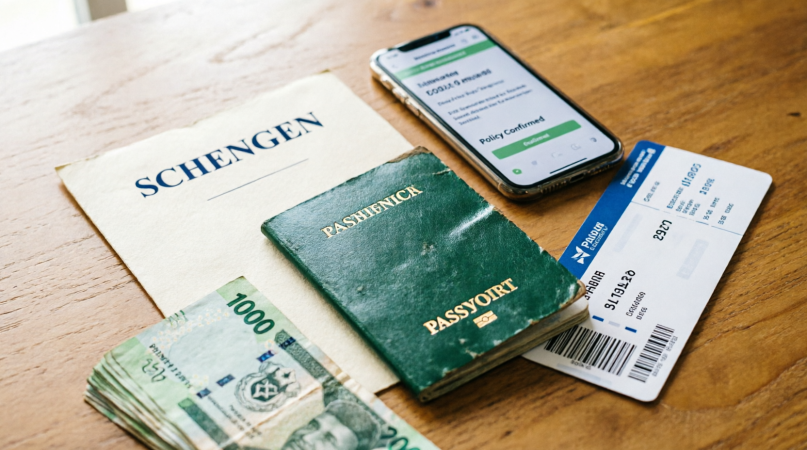
If you ask a travel agent for “Schengen insurance” today, they will most likely tell you to bring ₦168,000, ₦224,000, or even ₦300,000. In fact, we have seen one near ₦900,000. The issue is that if you buy the insurance yourself, you may only spend up to ₦30,000. The difference is the middleman. This is why learning to buy travel insurance in Nigeria is essential.
This may be one of the most unnecessary parts of travel that catches many Nigerians off guard, and they will skip the travel insurance cover altogether. I mean, you have already spent so much on visa fees, flights, and VFS service charges. By the end of this post, you will know how to buy a valid policy yourself, what it should cost, and which clauses to avoid.
If you want the short version on Schengen cover specifically, our guide to the best and cheapest Schengen travel insurance compares the main providers.
Affiliate disclosure: Some links in this guide are affiliate links. If you buy through them, we may earn a small commission at no extra cost to you.
The Two Prices for Travel Insurance in Nigeria
Agents charge a lot to help people process travel visa insurance. The irony is that many people don’t know that they can buy travel insurance easily. For example, a one-month Schengen travel insurance policy comes back at roughly ₦26,000 from many insurance companies. A two-week policy can come in under ₦20,000. The agent buys it here and charges you up to 500k for the same certificate.
All you need is ten minutes, a phone, an email address and a bank account.
It’s the same in Ghana. For example, someone bought a six-month Star Assurance policy in Accra for GH¢330 in 2022. Two weeks later, another person sent to the same office was quoted over GH¢900 for a similar cover. Current market rates for international travel insurance in Ghana are between GH¢500 and GH¢2,000 depending on trip length and cover level.
One more thing to check. If your bank statement shows a charge labelled VISA PROVISIONING SERVICE, that is the card-issuing bank collecting the visa fee on the embassy’s behalf. It has nothing to do with insurance. We broke down that charge here.
Why Do Embassies Demand Valid Travel Insurance?
Embassies ask for valid travel insurance to protect their local public healthcare systems from bearing the medical costs of foreign visitors. Meaning that if you travel and something happens, your insurance will cover your medical costs. So why do you need it to travel?
Countries reject visa applications because of travel insurance. For example, Nigeria’s Schengen refusal rate is 45.9% in 2024. In comparison, other countries have a rejection rate of average of roughly 18%. That is nearly one in two applications turned down, and you can’t get the lost visa fee back when it happens.
The UK is not any better. Nigerians applying for a UK visa get rejections as high as 33.1% in 2025.
Travel Insurance vs. Health Insurance for Nigerian Expats
Which is which? Let me explain it plainly.
Travel insurance is the insurance that pays for every mishap that happens on your journey and the first stretch of your stay. It starts while you are in transit, during your trip, and it stops when you become a legal resident. That’s what the embassy wants to see, because it proves that if you collapse in Lisbon on day two, you are not going to become a burden on the Portuguese state.
On the other hand, statutory health insurance is what you join after you arrive and register as a resident. In Germany, that is the public system, the gesetzliche Krankenversicherung, which you cannot enter until you are registered and have a residence permit. In Ireland, it is the HSE system. The insurance you get in your country does not cover you when you travel. That is why you need travel insurance.
If you are going to Germany specifically, read our breakdown of the 21 visa pathways to Germany before you buy anything, because the pathway determines which insurance the embassy expects.
What Embassies Demand for Schengen Travel Insurance in Nigeria
If you are applying for a Schengen visa, you have to get travel insurance. But what do you need to provide to be able to get this?
The €30,000 Benchmark for Travel Insurance
If you want to visit Europe for a short trip, like tourism, business, or visiting family and you need a visa to enter, there is a rule you must follow. It comes from something called the EU Visa Code, specifically Article 15. This rule says that every person applying for a short-stay visa must have travel insurance.
So, the insurance must cover at least €30,000 in costs. Specifically, it must pay for three things: emergency medical treatment if you get sick or hurt, emergency hospital care if you need to stay in a hospital, and repatriation, which we will explain below. The insurance must also be valid in every single country in the Schengen area, and it must cover the entire length of your trip, from the day you arrive to the day you leave.
Most visa applications are rejected because of just three words in this rule. If you understand these three words properly, you can avoid almost every problem. So let me explain the three words your insurance must cover.
Word one: “Repatriation”
Repatriation means that if you become seriously ill or injured while travelling, and the local doctors cannot give you the treatment you need, the insurance company will pay to transport you back to your home country so you can be treated there. This can be extremely expensive if you have to pay for it yourself, which is why embassies insist on it.
The second related benefit you should check for is repatriation of remains. This means that if a traveller dies during the trip, the insurance covers the cost of returning their body to their home country. It may sound grim, but embassies specifically look for this coverage, and it can matter enormously in real life.
Something that happened in April 2026 shows how important this coverage is. An American travel influencer named Ashlee Jenae Robinson died while on holiday in Zanzibar. Because she had bought full travel insurance for her trip, her insurer paid all the costs of returning her body to the United States. Before this was known, her friends had already started raising money online to cover those costs because they did not realise she was fully covered.
Word two and three: “Entire Schengen area”
Many people buy cheap insurance that does not contain this phrase. Some low-cost insurance certificates only name the one country you are flying into. For example, imagine you tell the embassy you plan to visit Germany, but your insurance certificate only lists France. That mismatch is an automatic reason for visa refusal. To be safe, check that your certificate says “Schengen Area” or “All Schengen Member States”.
In short: buy insurance that covers at least €30,000, includes both repatriation and repatriation of remains, and explicitly covers all Schengen countries for your whole trip. Check the document before you submit.
Visit Visas vs. Study Visas: Insurance Requirements
Now, let us come to two different types of visas and what you will know.
General visit visas: you can choose any insurer
If you are applying for a regular visitor visa, the embassy does not mind which insurance company you use. The insurance company you work with just needs to be officially licensed to sell insurance. Whether you buy from a big international name like AXA Mansard, or a local provider such as Leadway, AIICO, Sanlam Allianz, or a Ghanaian company like Star Assurance, it makes no difference to the embassy. What matters is that your insurance certificate meets the required coverage rules, like the €30,000 minimum, the repatriation cover, and validity across all Schengen countries. The embassy does not prefer any particular brand. You are free to compare prices and buy the cheapest policy that meets all the requirements.
Study visas: the destination country picks the insurer for you
For a student visa, the situation is completely different. Many countries that accept international students have a list of insurance providers they officially approve, and you must buy from one of those. Price comparison is no longer possible because you buy what the country tells you to buy, from the companies they name.
Ireland as an example
Ireland shows how this works in practice. If you are a student from outside the European Economic Area (the EEA covers EU countries plus a few others like Norway and Iceland), and you hold what Ireland calls a Stamp 2 student permission, you must have private medical insurance. The rules are that your insurance must cover at least €25,000 for accidents and another €25,000 for illness, and it must include hospital care. The policy documents must also be written in English.
The specialist provider officially recognised for this is a company called Study & Protect, which is operated by an Irish insurance broker named Arachas. Their standard prices are roughly €229 if your course lasts one academic year or less, and around €479.60 if your course is longer than one year. Both of these prices already include a government tax and an administration fee.
Hence, there are two important details to watch for.
First, Ireland gives you some flexibility only in your first year. If you bought your insurance in your home country before travelling, that policy is accepted for year one. But when you renew your Irish Residence Permit for the second year, you must switch to an Irish insurance provider. Plan for this extra cost in advance.
Second, check whether you even need to buy a policy at all. Many Irish universities arrange a group insurance scheme for their international students. If your university has one, your enrolment letter may already count as proof of insurance. Before spending your own money, ask your university’s international office as this could save you from paying twice for the same coverage.
Hidden Day Limits in Your Travel Insurance Policy
Even an annual policy has a ceiling on any single trip. AXA Mansard states it plainly in their own conditions: cover applies to a maximum of 92 consecutive days of travel per trip, even if you subscribed for a longer period, and student travel insurance caps out at 180 consecutive days.
What does this mean? Well, if you buy a one-year annual policy and then spend four months straight abroad, you are uninsured from day 93. Students get more room but not unlimited room. If your trip runs longer than the cap, you need to renew or buy a separate long-stay policy before you leave, not after.
The same terms say the policy can only be bought before the trip starts, and cannot be extended once the trip has begun.
How to Buy Travel Insurance Online in Nigeria: Step-by-Step
Now that you understand what you need for the different types of visas, let’s walk you through buying it yourself.
You need five things: your passport, your BVN if you are in Nigeria, a working email address, your travel dates, and a naira card or bank app. That is the whole kit. Here is how to buy travel insurance in Nigeria.
Step 1: Pick a licensed underwriter you can buy from directly
When you buy travel insurance in Nigeria, the point of buying direct is that you pay the premium and nothing else. The names that come up most often for embassy-accepted cover in West Africa:
- Leadway Assurance (Nigeria). Probably the most-used option for Schengen applications because the entire purchase happens online and the certificate arrives by email immediately after payment.
- AXA Mansard (Nigeria). The Nigerian arm of AXA Group, with tiered plans from a Schengen-compliant basic up through worldwide tiers with higher medical limits and baggage cover.
- AIICO Insurance (Nigeria). Works with AXA Assistance Maroc, so the certificates carry international backing that embassy reviewers recognise.
- SanlamAllianz (Nigeria). Sanlam’s Nigerian operations merged with Allianz’s in June 2025. Backed by Allianz Global Assistance, which means international hospital networks and, in some cases, direct settlement with European hospitals rather than paying upfront and claiming later.
- Star Assurance, SIC, Enterprise, Hollard (Ghana).
If you are outside Nigeria, the same principle applies: buy from a licensed local insurer rather than through a visa agent.
Step 2: Run the quote honestly
Enter your destination, departure and return dates, and date of birth. This is a tip I will give you.
Buy a few days of buffer at each end. For example, if you fly on the 10th and return on the 24th, cover from the 9th to the 26th. Some consulates, Switzerland being the strictest, expect the policy to run past your return date. That means even if you have a missed connection that leaves you in a transit lounge overnight, it’s also covered, which is worth more than the extra ₦2,000. Our piece on what to do when you miss a connecting flight covers the rest of that situation.
Declare your real age and real destination. The premium rises if the United States is on your itinerary, sometimes doubling. That is not the insurer being greedy; American healthcare is the most expensive in the world and they are pricing the risk honestly. Lying about the destination to save money is how you end up with a policy that pays nothing.
Step 3: Pay in naira, not dollars
This is the barrier that pushes people back to agents, and it does not need to.
You do not need a domiciliary account, and you do not need scarce foreign currency. Nigerian platforms settle in naira through Paystack or Interswitch, which means:
- a regular naira debit card,
- direct bank transfer to the insurer’s account,
- or USSD from your banking app.
Leadway offers all three. Transfer is often the smoothest because it sidesteps card limits and the intermittent failures that plague Nigerian payment gateways. You enter your BVN (your Bank Verification Number, the 11-digit identity number tied to your bank account) as part of identity verification, upload your passport data page, and confirm.
Ghanaian and Kenyan platforms work the same way with mobile money and local cards. The rule: if a platform is asking you for a dollar card, you are probably on the wrong platform.
Step 4: Check the certificate before you print it
The PDF lands in your inbox within minutes. Do not forward it to the visa centre yet. Open it and check five things against your application form:
- Full name, spelled exactly as it appears in your passport. Not your nickname, not your short form.
- Passport number, if the certificate carries one.
- Start and end dates, covering your whole trip plus buffer.
- Territory, saying Schengen Area or all member states, not one country.
- Sum insured, showing at least €30,000 for medical and repatriation, plus the repatriation clause in words.
“Sum insured” just means the maximum the insurer will pay on that section of cover. A policy can advertise a big headline figure for total cover across everything while the medical limit underneath is only €15,000. Read the medical line, not the headline.
If anything is wrong, email the insurer immediately. Corrections are usually same-day if you catch them before submission, and impossible if you catch them at the VFS counter.
Step 5: Print two copies
One goes into the visa file. One goes into your carry-on, folded into your passport sleeve. We will come back to why the second copy matters more than you think.
The Real Cost of Travel Insurance in Nigeria
Here is the honest comparison for a standard two-week to one-month tourist trip from Nigeria when you buy travel insurance in Nigeria:
| Policy Type | Agent quote | Buying direct |
|---|---|---|
| 2 weeks, Schengen basic | ₦100,000 – ₦168,000 | ₦15,000 – ₦22,000 |
| 1 month, Schengen basic | ₦150,000 – ₦224,000 | ₦26,000 – ₦32,000 |
| 1 month, comprehensive worldwide | ₦250,000 – ₦400,000+ | ₦45,000 – ₦70,000 |
| Ghana, 2 weeks Schengen | GH¢900 – GH¢1,000+ | GH¢330 – GH¢600 |
The direct prices are what current quotes return for an adult in their twenties or thirties on a leisure trip. Older travellers pay more, longer trips cost more, and the United States pushes everything up sharply.
For context on the whole trip budget, see our real cost breakdown for travelling from Nigeria to Europe.
When Basic Travel Insurance is Enough
If you are doing a two-week tourist trip to Spain, staying in hotels, walking around cities and eating out, the basic Schengen plan is the right purchase. It meets the embassy threshold and it covers the realistic risks. You don’t have to pay ₦70,000 for a cover you will not touch. In this case, a simple cover is enough.
When You Should Upgrade Your Travel Insurance
Three situations justify the upgrade.
- You are going somewhere with expensive healthcare. The United States usually have the most expensive healthcare. A single night in an American emergency department can run into five figures, and a policy with a €30,000 limit will not stretch. For US trips, look for medical cover in the seven figures.
- You are carrying expensive gear. A laptop, camera kit or drone worth ₦2 million is not covered by a policy with a ₦150,000 baggage limit. Check the per-item cap as well as the total, because insurers often limit single items to a fraction of the baggage total.
- You are doing anything with wheels, ropes or heights. More on this below, because it is the exclusion that catches the most people.
Travel Insurance Fine Print That Ruins Trips
Here are some things you can carry or have in your documents that can cause them to reject your visa:
#1. Pre-Existing Conditions and Travel Insurance
A pre-existing condition is anything you have had symptoms of, been diagnosed with, or sought treatment for before the policy started. Hypertension, asthma, diabetes, a previous surgery, or a mental health diagnosis. Most travel policies exclude them.
What varies is the lookback period, which is how far back the insurer looks. Some policies exclude anything treated in the six months before you bought the cover. Others go back two years. A few exclude every pre-existing condition you have ever had, full stop.
If your application includes a medical questionnaire, answer it honestly. You are legally required to, and insurers routinely pull medical records when a claim is large. An undisclosed condition turns a legitimate claim into a denied one, and repeated non-disclosure can void the whole policy.
Some policies carry an acute onset clause. That means a sudden, unpredictable flare-up of a pre-existing condition, one that could not have been foreseen and needs immediate treatment, may be covered even though the underlying condition is excluded. If you manage a chronic condition, this clause is worth paying extra for. Ask specifically whether it is in the policy before you buy.
Our piece on how your health records affect visa approval covers the other side of this.
#2. Adventure Activities and Travel Insurance Exclusions
Whether you are planning to ride a motorbike in Thailand, ski in the Alps, go scuba diving in Zanzibar, or ride a quad bike in the desert, most standard policies exclude all of it unless you buy an adventure sports rider.
Take the skiing example. Insurers disagree with one another on it. Some treat any skiing as an adventure sport requiring extra cover. Others cover skiing but only at official resorts on marked runs. Only a few companies cover everything. So, if you are going to ski off-piste and your policy only covers groomed runs, if you break a leg, you will have to pay for it yourself.
Another trap is the motorbike cover. Many policies only pay if you held a valid licence for that engine size in your home country and were wearing a helmet. They will not cover an uninsured, unlicensed ride.
Why You Should Not Crowdfund Your Travel Emergency
Some people seem to think that travel insurance is a scam and that friends and family will rally if something happens. This thinking is wrong on all levels.
First of all, we must not harbour that mindset that nothing bad can happen to us. Anything can happen at any minute. Will you gamble your life with fundraising? Besides, it can take weeks to gather enough funds through GoFundMe or WhatsApp appeals, and hospitals will not wait for weeks.
More so, a medical evacuation flight from South America to North America can cost $100,000. A proper evacuation policy can cover that and handle the logistics too. You cannot simply phone an insurer and ask to be flown home.
A doctor has to certify that you are not fit to travel on a normal commercial flight, and the insurer will not commit to a six-figure flight until a hospital bed is confirmed for you at the other end. When a traveller fractured his vertebrae on a boat in the Peruvian Amazon, it took days of doctor sign-off and bed-hunting before an air ambulance flew from Canada to collect him.
How to Win a Travel Insurance Claim From Abroad
Insurers deny more claims than they should, and they get away with it because claimants give up. These are the habits that separate a paid claim from a refused one.
Call Your Insurer Before Admission
The insurer’s 24-hour assistance line is on your certificate. Call it before you walk into a private clinic for anything that is not immediately life-threatening. Many policies require pre-authorisation for non-emergency treatment, and skipping that step gives them grounds to refuse.
When you call, write down the date, the time, the name of the person you spoke to, and a summary of what they told you. That paper trail becomes the backbone of your claim, and it is what protects you when a different representative later says nobody approved anything.
Keep Every Scrap of Paper for Your Claim
For medical claims, you will need to provide itemised hospital bills, doctor’s notes, test results, X-ray and scan reports, discharge summaries, prescription receipts, and the receipt for every taxi to the hospital.
For theft or loss, you need a police report, original purchase receipts for the items, and photographs. Take photos of your valuables before you travel, ideally with timestamps, including a picture of yourself holding the item. It sounds obsessive until the day you need to prove the camera was yours.
For trip disruption, you need cancellation emails, rebooking confirmations, airline delay certificates, and hotel invoices.
Keep both physical copies and phone scans. Some insurers still require originals posted to them, which means handing over the only evidence you have. Photograph and photocopy everything first, number the pages, and put a contents list at the front of the pack. It reads like overkill, and it is the reason some claims get paid.
Watch the Exchange Rate on Reimbursements
If you paid for a hotel in Malaysian ringgit and for hospital bills in Thai baht, your reimbursement should convert each expense at its own currency’s rate. Insurers sometimes apply one rate to everything on the file. In one documented case a claimant received a cheque for $40 instead of $400, because a Malaysian ringgit expense had been converted at the Thai baht rate, a currency roughly ten times weaker at the time.
Check the currency code printed beside each line on your settlement statement against the currency code on the original receipt. If they do not match, you have found their error, and you have the documents to prove it.
Escalate Your Claim Politely and Repeatedly
When a representative insists there is no error and you know there is, you have two moves. Hang up and call back, because a different representative may see it differently. Or ask, courteously, to speak to a manager.
If the manager also refuses, escalate again. Claims handlers work to scripts and to authority limits; the person three levels up has neither. Set a weekly reminder on your phone to follow up, because files go quiet and it is your job to make noise. Expect four to six weeks for a straightforward claim and considerably longer for a complicated one involving several departments.
Getting everything in writing at each step is what makes escalation possible. A verbal “we will look into it” is worthless.
Pre-Flight Checklist for Travel Insurance in Nigeria
- Certificate checked: name, passport number, dates, territory, €30,000 medical limit, repatriation clause.
- Two printed copies. One in the visa file, one in your carry-on.
- Insurer’s 24-hour assistance number and your policy number saved as a phone contact, and written inside your passport cover.
- Digital copy emailed to someone back home, plus the assistance number.
- Your travel companion has a copy of your policy details, in case you are the one who cannot make the call.
- Photos of valuables taken before departure, with receipts.
- Pre-existing conditions declared and the acute onset clause confirmed, if you need it.
- Adventure activities covered, if you plan any.
- Cover dates extended if your itinerary changed since you bought the policy.
While you are getting the paperwork together, sort your connectivity too. Landing without data means you cannot call your insurer, your embassy or your host. An eSIM installs before you board and switches on the moment you land. Get the Airalo eSIM or compare Saily’s regional plans if you are crossing several countries.
3 Habits to Save Money on Your Trip
Insurance only reimburses what you can prove you lost, and only up to the limits you bought. So reduce the size of the loss before you travel.
Book refundable where the price gap is small. A hotel room that costs ₦8,000 more per night but cancels free until 48 hours before arrival is worth it on a visa-dependent trip, because your visa might not arrive. Agoda and Trip.com both label the cancellation policy clearly on each rate, and Expedia lets you filter for fully refundable stays. Filter for it rather than reading the small print on each listing.
Keep every booking confirmation. These are the documents your insurer will ask for when you claim for a cancelled trip. Save them to a dedicated email folder as you book.
Read reviews before you pay, not after. A property with a dozen recent complaints about safety is not a place to leave a laptop unattended. TripAdvisor reviews are still the fastest way to check a neighbourhood before you commit.
Final Thoughts on Buying Travel Insurance Online
The gap between what an agent charges and what the insurer charges when you buy travel insurance online in Nigeria is not a service fee. It is a tax on not knowing that the purchase takes ten minutes.
Buy direct, buy before you fly, buy enough cover for the country you are actually going to, and read the exclusions while you are still calm enough to read them. That is the whole strategy.
If you are still assembling the rest of your Schengen file, start with our complete Schengen visa application guide and the bank statement format that gets applications approved. And if you would rather travel somewhere that does not ask for any of this, here are the visa-free countries open to African passport holders in 2026.
Frequently Asked Questions About Travel Insurance in Nigeria
Can I buy travel insurance for a Schengen visa myself, without an agent?
Yes. Licensed Nigerian underwriters including Leadway, AXA Mansard, AIICO and SanlamAllianz sell Schengen-compliant policies directly online. You pay in naira by card, bank transfer or USSD, and the certificate arrives by email within minutes. No agent is required, and no embassy asks for one.
How much should Schengen travel insurance cost in Nigeria?
For an adult on a two-week to one-month leisure trip, expect roughly ₦15,000 to ₦32,000 buying direct. Comprehensive worldwide cover with higher medical limits runs about ₦45,000 to ₦70,000. Anything above ₦100,000 for basic Schengen cover is an agent markup, not the price of the policy.
Does the policy need to cover 26 countries or 29?
Twenty-nine. Bulgaria and Romania completed their Schengen accession on 1 January 2025. Certificates that list member states individually should include both. The safest wording on a certificate is “Schengen Area” or “All Schengen Member States”.
What is the difference between travel insurance and the health insurance I need after moving to Germany?
Travel insurance covers your journey and your stay before you are registered as a resident. German public health insurance, the gesetzliche Krankenversicherung, only becomes available once you have registered your address and hold a residence permit. They cover different periods, and you need the first one to get the visa.
Can I extend my travel insurance while I am abroad?
Generally no. Most policies, including AXA Mansard’s, state that cover cannot be purchased during a trip and cannot be extended after the trip has started. If your plans change, contact the insurer while you are still inside the original cover period, or buy a fresh policy before the current one expires.
What happens if my visa is refused after I bought insurance?
Check the policy terms before you buy. Some insurers offer a refund or a free date change on presentation of a refusal letter; many do not. Buying a short policy close to your intended travel date, rather than months ahead, limits what you stand to lose.
Is travel insurance required for the UK?
Not as a blanket rule for standard visitor visas, the way it is for Schengen. But the UK refuses a third of Nigerian applications, and an applicant who cannot show they would cover their own medical emergency is a weaker applicant. Most people travelling to the UK buy cover anyway because the cost is trivial against the risk. See our guide to proof of funds for a UK visa for what else strengthens the file.