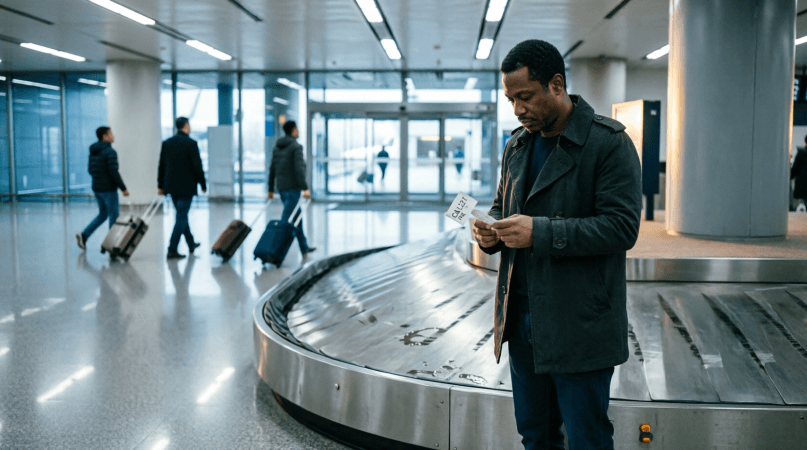
You stand there expectant as the carousel goes round, slows, then stops. Other passengers wheel their suitcases towards Customs while you are left with a baggage-tag stub. The realisation dawns. Your luggage is not coming. Dealing with lost luggage at airport arrivals is a highly stressful experience.
Before you start panicking and leave the airport, let me help you.
Quickly report the missing bag before you leave baggage reclaim. Leaving the airport does not automatically cancel your rights, but they can argue that you already left with it and you want to scam them. You may also miss the airline staff who can trace the bag, record your delivery address and give you a claim reference.
This blog post explains what to do when dealing with lost luggage at the airport, what you may claim afterwards, and when.
Affiliate disclosure: Travel Radio may receive a commission if you buy through selected links in this article. That does not influence the practical or legal guidance below.
Lost Luggage at Airport? Do This Before Leaving the Carousel
- Check the flight number on the carousel screen, then look at the next belt and the oversized-baggage area.
- Open the airline’s app and check any tracker inside the bag (if you have).
- Go to the airline’s baggage service desk before passing through Customs.
- Report the bag and obtain a Property Irregularity Report (PIR) with a working file reference.
- Ask how the bag will be delivered and how to claim for necessary purchases.
See, when dealing with issues like this at airports, every minute matters. While it is true that airline conditions differ, the safest time to act is when you are still beside baggage reclaim.
Steps to Find Your Missing Luggage
Now, let us calmly try to find your luggage together. You are still standing near the baggage claim, so don’t leave there yet. Now follow these steps:
1. Check the Belt, the App, and Your Tracker
Start with the simple possibilities. Confirm that the screen above the carousel shows your flight number and departure airport. If two flights arrived close together, it is possible that your bags may have been sent to a neighbouring belt.
Look near the side of the carousel, where staff sometimes place cases that came off early. Then check the oversized-baggage point. Pushchairs, cartons, large boxes and unusually shaped bags often arrive there.
If your airline’s app shows baggage scans, compare the last scan with your route. If there’s a message such as ‘loaded’ or ‘arrived at station,’ that can help the desk staff to narrow the search. That doesn’t always mean the bag has reached the belt, though.
It is wise to keep a tracker in your bag. If you did that, check the tracker app and save a screenshot that shows the location and time. A tracker may reveal that the bag is still near the aircraft, at your connecting airport or already inside the arrivals building.
Do not enter a staff-only area or try to collect the case from the tarmac. Show the location to the baggage agent. Personal-tracker data is a useful lead, but it is not a replacement for an airline report. Small baggage trackers are generally permitted under the battery limits in IATA’s 2026 passenger guidance, but check your airline’s rules before each trip.
Once the correct carousel has stopped and you cannot locate your luggage, it is officially missing.
2. Find the Airline’s Baggage Service Desk
The right desk is usually inside baggage reclaim, before Customs. You may see signs that say ‘Baggage services’, ‘Baggage enquiries’, ‘Lost baggage’ or ‘Baggage claim’. If the airline does not have its own counter, a ground-handling company may act for it.
For a codeshare journey, begin with the airline that operated your final flight. Its name appears on your boarding pass beside ‘operated by’. For example, if you arrived on Kenya Airways with a ticket sold by another carrier, look for the desk handling the Kenya Airways arrival. On a multi-airline journey, the final carrier is commonly the practical starting point.
However, airport lost property is for something different. These teams only deal with things like a phone left at security or a jacket forgotten in the terminal. A checked suitcase that did not appear is the job of the airline’s baggage team.
So, when you find an agent, ask a plain question first: ‘Can you tell me where my bag is?’ It may already be in the baggage office because its tag came loose, arrived on an earlier flight, or staff removed it from the belt.
If the desk is closed, photograph the counter and any opening hours or telephone numbers displayed there. Ask the airport information desk which company handles the flight. Use the airline’s app, QR code or online missing-bag form before you leave, and save the submission confirmation. A time-stamped photo of the stopped carousel can also support your account.
3. File a Property Irregularity Report (PIR)
A Property Irregularity Report records that checked baggage was delayed, lost or damaged. This is the official first step for lost luggage at airport facilities. Airlines often call it a PIR, delayed baggage report or mishandled baggage report. The report starts the tracing process and creates the file you will refer to in every later message.
A PIR is not normally the same as a written request for reimbursement. The UK Civil Aviation Authority’s baggage guidance tells passengers to report the problem at the airport, keep the PIR and then make a written claim within the applicable deadline. Do both. The agent is obligated to give you this PIR.
What to Provide
Give the agent:
- your boarding pass, ticket or booking reference;
- the baggage-tag receipt issued at check-in;
- the complete route, including any connection or rebooking;
- the case’s colour, size, brand and type;
- distinctive details such as a bright strap, sticker, dent or missing wheel;
- a telephone number, email address and delivery address that will work during your stay; and
- your tracker screenshot, if you have one.
A photograph taken before check-in is far more useful than saying ‘a medium black suitcase’. If you are staying in a hotel, give its full name, street address, postcode, booking name and dates. If you will move to another city soon, tell the agent and ask how to update the address.
What to do before leaving
Before you walk away, check every line of the report. A wrong telephone digit or airport code can waste a day. Make sure each missing case appears and that its baggage-tag number is correct. When a family checks several bags, record which passenger’s tag was attached to each one.
Get the file reference in writing. A WorldTracer-style reference is often a short combination of letters and numbers. It is different from the long baggage-tag number printed at check-in. Open the tracking link on your phone while you are at the counter, if possible, and confirm that the reference and surname work.
Also ask for:
- a paper or emailed copy of the PIR;
- the airline’s baggage-tracing page and local contact details;
- its online expense-claim form;
- the deadline for submitting receipts;
- its arrangements for delivering the bag; and
- an essentials kit or immediate allowance, if one is available.
Do not rely on ‘we will call you tomorrow’. Note the desk, time and name of the company or agent who helped you. Keep your original baggage stub and receipts and upload or hand over copies unless the airline expressly requires an original.
Ask for Delivery, Not Another Airport Journey
Give an address where somebody can receive the case and ask the airline to deliver it there. Do not volunteer to spend your own money returning to the airport. If an agent insists on collection, ask for that instruction in writing and ask whether the airline will repay the transport cost.
Nigeria’s current passenger rules are more specific. Where a checked bag was off-loaded for operational, safety or security reasons, Part 19 of the Nigeria Civil Aviation Regulations 2023 says the airline should carry it on the next flight with space and deliver it to the passenger.
4. Know What You Can Claim for Delayed Luggage
Most missing bags are delayed rather than permanently lost. IATA advises passengers to report at the destination airport, where the airline can enter the description and tag details into a global tracing system.
While you wait, the airline may have to repay reasonable expenses caused by the delay. The exact rules depend on the ticket, route and countries involved. Ask the baggage agent what the carrier provides immediately, then read the carrier’s written policy.
What can you claim?
Reasonable purchases depend on the trip. Basic toiletries, underwear, laundry, a change of clothes and a modest phone charger are easier to justify than luxury replacements. A warm coat may be reasonable after landing in winter with only light clothing. Suitable clothes for a work meeting or wedding may also be defensible if the items were in the delayed case and there is no practical cheaper option.
Buy for the period during which you are without the bag. If it is due the next morning, you cannot ask them for a week’s wardrobe. Claims are often lower when baggage is delayed on the flight home because the passenger already has clothes and toiletries there.
Tips
Keep an itemised receipt for every purchase. If you pay cash in a place where printed receipts are uncommon, ask the seller for a dated receipt showing the shop name, item and amount. Photograph it at once. Save card alerts and bank entries as further proof. Keep a simple list in the currency you paid so the airline can deal with conversion.
Some carriers quote a daily allowance. That figure may describe the carrier’s usual process, but it is not always the final legal limit. For journeys covered by United States rules, the US Department of Transportation says airlines must reimburse reasonable, verifiable and actual incidental expenses within the liability ceiling, and cannot impose an arbitrary daily cap such as US$50. Do not assume that the US rule governs a flight elsewhere. Submit the real, evidenced cost and ask the airline to identify the rule it relies on if it cuts the claim.
An immediate essentials kit or cash payment may be helpful. Ask whether accepting it reduces a later expense claim and do not sign away the rest of your rights without reading the document.
Extra Rights for Lost Luggage in Nigeria
If the airline confirms that your checked bag was off-loaded for operational, safety or security reasons, section 19.18 of Nigeria’s Part 19 regulations provides an immediate inconvenience payment of ₦10,000 for a domestic flight or US$170 for an international flight. The same section says checked-baggage fees should be refunded if the bag is not delivered within 24 hours after the flight arrives.
Those sums do not necessarily settle the value of a case that is later lost or damaged. Keep the payment record and continue the claim process. Travel Radio’s article on passenger rights under Nigerian aviation rules explains where baggage rights fit beside delay, cancellation and denied-boarding rules.
5. Understand the Compensation Ceiling for Lost Luggage
The law that applies follows the journey, not the passport in your pocket, even when claiming for lost luggage at airport destinations. An African passenger on a wholly domestic US flight is covered by US domestic baggage rules. A passenger travelling from Lagos to New York on one international ticket will usually fall under the international convention, including a US domestic connection on that itinerary.
International Journeys and the Montreal Convention
The Montreal Convention governs baggage liability on most international journeys between countries that have joined it. Nigeria, Ghana, Kenya, South Africa, the United Kingdom and many other states are parties. The ICAO list of parties lets you check the countries on your ticket.
For baggage that is delayed, damaged, destroyed or lost, the current ceiling is 1,519 Special Drawing Rights (SDR) per passenger. ICAO raised the limit on 28 December 2024. SDR is an accounting unit whose currency value changes daily. Using the IMF rate published on 2 September 2026, 1,519 SDR was about US$2,077.
That figure is a ceiling, meaning that is the highest possible they can pay. The actual amount you get depends on the actual loss you can prove. For a lost case, the airline may ask for an inventory, age and purchase price of the case and its contents. They will also apply depreciation, so a three-year-old phone is not valued as a new phone. Photographs, card statements, online order histories and old receipts can help where the original receipt is gone.
The limit applies per passenger, not per suitcase. Two bags checked under one passenger do not create two limits. If an item is worth more than the normal ceiling, ask before travel whether the airline accepts a special declaration of value and what extra charge applies.
Another thing that can create issues is weather. Under the Montreal Convention, a carrier can defend a baggage-delay claim by showing that it took all measures reasonably required to avoid the damage, or that such measures were impossible. File the claim with evidence instead of accepting a broad statement that ‘weather means nothing is payable’.
Domestic Flights in the United States
For a journey entirely within the United States, the current federal maximum is US$4,700 per passenger. The airline can pay less when the proven loss is lower. This domestic figure does not replace the Montreal Convention ceiling merely because an international ticket contains a US connection. The US Department of Transportation’s baggage page explains that distinction.
Other domestic journeys follow the law and carrier conditions in that country. For Nigeria, Part 19 presumes a bag is permanently lost after seven days on a domestic flight. For an international flight covered by the same Nigerian regulation, the period is 21 days.
Be Accurate About Your Bag’s Contents
List what was truly in the bag and give honest values. Invented designer clothes, watches, or receipts can cause the airline to reject the claim. False documents or statements may also expose the claimant to a fraud investigation. A well-supported ordinary claim is safer than an impressive list that cannot be proved.
Check Travel Insurance and Card Benefits
Tell your travel insurer about the delay promptly. Some bank cards include baggage-delay or lost-baggage cover when the fare was paid with that card, but benefits offered on cards issued in African markets vary widely. Ask whether the cover is primary or only pays what the airline does not.
The insurer may request the PIR, boarding pass, baggage-tag receipt, airline decision and purchase receipts. Do not recover the same expense twice. Tell the insurer what the airline has paid and follow the shorter deadline if the policy and airline give different dates.
6. Track the Bag and Create a Written Record
Use the file reference on the airline’s baggage-tracing page. Many carriers use WorldTracer. The reference usually works with the passenger’s surname, while the baggage-tag number is used by staff to match the physical case.
After leaving the airport, send the airline a short email or web-form message that confirms:
- the flight and date;
- the PIR reference and baggage-tag number;
- the delivery address;
- the last tracker location, if relevant; and
- the purchases already made or likely to be needed.
Attach the PIR and keep the automatic acknowledgement. This creates a dated record outside a telephone call.
Check the tracking page at sensible intervals. If there is no useful change within 24 hours, contact the baggage team and quote the file reference at the start of the message. Update the delivery address before moving hotels or cities. A tracker screenshot can help, but send it calmly and ask the agent to add the location to the file.
When the bag arrives, inspect it before the courier leaves if this is practical. Photograph the case, seal and any damage. Check for missing contents as soon as possible and record the delivery date and time. Do not throw away the baggage tags until every claim has closed.
7. Do Not Confuse the PIR With the Compensation Claim
The PIR is the airport report that traces the bag. The written claim is you asking them for money to cover the loss. Complete the airline’s claim form even if the PIR contains some of the same information.
For a delayed bag, include dated receipts, proof of payment and a short explanation of why each purchase was necessary. For a lost bag, include an inventory with each item’s approximate purchase date, original price, present value and supporting evidence. Add the cost of the suitcase itself. If the applicable rule permits a checked-baggage-fee refund, request that separately.
Deadlines differ, but these Montreal Convention periods appear in many international claims:
- Damage to checked baggage must be reported in writing within seven days after receiving it.
- A written delay complaint must be made within 21 days after the delayed bag is returned.
- If the carrier admits that the case is lost, or it still has not arrived after 21 days, the passenger may pursue the rights arising from the loss.
Airline forms can impose procedural dates of their own. Use the earliest date that could apply. Send the written claim soon after the relevant expense or loss is known, and save proof of submission.
8. Escalate an Unresolved Lost Luggage Claim
If your lost luggage at airport claim remains unresolved, complain to the airline in writing first. State the outcome you want, attach the evidence and give a reasonable date for reply. Keep the tone factual. A reference number and a clean bundle of receipts usually move a case further than repeated calls with no record.
For a complaint under Nigerian passenger rules, the airline should have a chance to respond first. If the matter remains unresolved, use the NCAA Consumer Protection Portal. The portal accepts the flight documents, earlier airline complaint, correspondence and supporting files. Keep the NCAA reference it issues.
If another country has a closer connection to the journey, its aviation regulator or approved dispute-resolution body may be the better route. Passengers dealing with a UK flight can start with the UK CAA baggage guidance. For a US matter, use the Department of Transportation guidance linked above. A court claim needs route-specific advice, especially near a deadline.
What to Do if You Already Left the Airport?
Act now rather than abandoning the claim. Report the bag through the airline’s app, website, email or telephone line and ask for a PIR or delayed-baggage file reference. Send a copy of the boarding pass and baggage stub. Explain when the carousel stopped, which desk you tried and why no airport report was made. Add photographs and tracker screenshots with visible times.
If the airline refuses to open a file, ask for the refusal in writing. Then use the relevant regulator or complaint body. The missing airport report is an obstacle, but it does not by itself prove that the bag arrived.
How to Reduce the Risk of Lost Luggage on Your Next Trip
Remove every old barcode and routing sticker before check-in. Read the new tag while you are still at the counter and confirm that the three-letter airport code is your final checked-bag destination. If the airline reroutes you after a disruption, ask whether the bag has also been retagged.
Allow a realistic connection between flights, preferably on one protected ticket. Tight transfers and separate bookings give baggage teams less time to move a case between aircraft. Travel Radio’s guide to a missed connecting flight in Africa explains why one booking reference matters. When comparing itineraries on Expedia or Trip.com, look at the airport, terminal change and connection time as well as the fare.
Put a tracker inside the case and test its battery before leaving home. Photograph the outside of the bag and the open case after packing. Save receipts for costly items somewhere online. Place your name, email address and telephone number inside the bag in case the outer tag tears off.
Keep medicines, travel documents, valuables, work files, chargers and enough clothing for the first day in your cabin bag. Power banks and spare lithium batteries belong in the cabin, not checked baggage. Before packing food, herbal products or large amounts of cash, read Travel Radio’s guide to items Nigerian travellers may not take abroad. If baggage weight is the problem before departure, this Nigeria-to-London baggage experience shows why checking the airline’s allowance early saves trouble at the counter.
You will need data to open the airline app, follow the tracker and receive courier calls. Arrange roaming before departure or install an eSIM while you still have reliable internet. Travel Radio has a plain-language guide on how to set up an eSIM. Travellers who want to compare plans can check Airalo or Saily before flying.
Final Checklist Before You Leave Baggage Reclaim
Check that the PIR lists the correct bag, route and delivery address. Test the file reference, photograph the paperwork and keep the baggage stub. Once outside, buy only what the situation calls for and retain every receipt. Send the separate written claim before the earliest applicable deadline to avoid issues with your lost luggage at airport claim.
Save this article to your phone before your next flight to avoid the stress of lost luggage at airport terminals. Share it with anyone who checks luggage, and follow Travel Radio for more practical advice written for African travellers.
Legal note: This article gives general consumer information, checked against official sources on 3 September 2026. Airline conditions and national rules can change, and the applicable law depends on the itinerary.
Frequently Asked Questions About Lost Luggage at Airport
How long does it take for an airline to find lost luggage at airport?
Most delayed bags are located and delivered within 24 to 48 hours. However, if your bag is not found within 21 days, it is generally considered permanently lost under international conventions, and you can proceed with a full compensation claim.
What is a Property Irregularity Report (PIR)?
A PIR is an official document issued by the airline’s baggage service desk when you report lost luggage at airport arrivals. It contains a unique reference number used to track your bag globally and is required to process any expense or compensation claims.
Can I claim compensation for delayed luggage?
Yes. Under regulations like the Montreal Convention, you can claim reimbursement for reasonable, verifiable expenses (such as toiletries and essential clothing) incurred while your luggage is delayed. Keep all itemised receipts to support your claim.