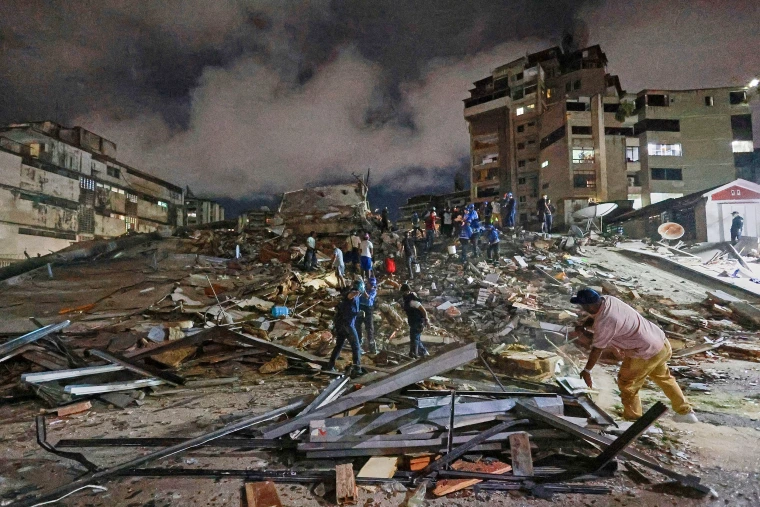
The earthquake today Venezuela reported on the evening of June 24, 2026, was actually two quakes. One with a magnitude of 7.2, and another with a magnitude of 7.5, just 39 seconds after the first. At least 164 people are dead, and 971 are injured. Officials in La Guaira, the hardest-hit state, haven’t finished counting. The US Geological Survey warns the toll could still climb into the thousands.
Editor’s note: This story covers a disaster that is still unfolding. The death toll mentioned here is the most recent confirmed figure as of publication and is expected to rise.
TL;DR: Earthquake Today Venezuela Summary
- The earthquake today Venezuela experienced consisted of twin quakes that struck the coast on June 24, 2026, killing at least 164 people and injuring 971. La Guaira, the hardest-hit state, hasn’t even finished counting.
- The US Geological Survey warns the final toll could run into the thousands, with a real chance it passes 10,000.
- Caracas sits packed into a mountain valley, and La Guaira clings to a sliver of coast — geography that helps explain why the damage concentrated the way it did.
- Venezuela’s Black population has never been accurately counted. Estimates range from under 4% to as high as 60% of the country, and it’s increasingly concentrated in the same poorer Caracas neighbourhoods now hit hardest.
What Happened in the Earthquake Today Venezuela?
The first magnitude 7.2 earthquake Venezuela experienced struck near San Felipe, about 176 miles west of Caracas, at 6:04 pm local time on June 24. Less than 40 seconds later, a second and larger quake with magnitude 7.5 hit near the town of Yumare, according to the US Geological Survey.
Venezuela’s acting president, Delcy Rodríguez, declared a state of emergency and closed their major airport, the Simón Bolívar International Airport. By Thursday morning, she’d confirmed 164 deaths and 971 injuries, but said those figures still didn’t include La Guaira, the coastal state she called a “true tragedy” and a “disaster zone.”
At least 30 aftershocks have rattled the region since the main quakes hit. A lot of people were home when it happened, because Wednesday was a national holiday.
Aid has started moving. The US says it’s “immediately deploying” search-and-rescue teams, medical resources, and humanitarian assistance. China, Brazil, Mexico, Argentina, El Salvador, the Dominican Republic, and Australia have also offered support. President Rodríguez says she’s coordinating with the UN on rescue efforts and with the IMF on an initial $200 million fund for rebuilding.
Why Did Caracas and La Guaira Take the Worst of the Earthquake Today Venezuela?
First, Caracas is packed into a narrow valley between the Ávila mountain range and the coast. La Guaira has it tighter still. It is but a strip of land squeezed between the mountains and the Caribbean Sea. The city has always had to build long and dense rather than wide.
Venezuela also sits in a difficult spot geologically. The country straddles the boundary between the Caribbean and South American tectonic plates, and Al Jazeera’s Bogotá correspondent puts the share of Venezuelans living in meaningful seismic-risk areas at roughly 80%. The quakes were caused by shallow strike-slip faulting, which the USGS says tends to be especially destructive as the energy has less distance to travel before it reaches the people and buildings above it.
This stretch of coast has done this before. An 1812 earthquake devastated Caracas and La Guaira together and is estimated to have killed around 30,000 people. A 1967 quake collapsed several Caracas high-rises and killed 240.
What is La Guaira, the City Now Called a “Disaster Zone”?
La Guaira is a port city of around 19,000 people, about 20 miles (32km) northwest of Caracas across a mountain pass. Small as it is, it’s home to Simón Bolívar International Airport, the country’s main gateway, and it handles a large share of Venezuela’s seaborne trade.
It’s also the capital of La Guaira State, renamed from Vargas in 2019, sitting on one of the narrowest coastal strips in the country. The same geography that makes it visually dramatic, mountains dropping almost straight into the sea, is exactly what makes it so hard to expand, rebuild, or evacuate quickly once disaster hits.
How Many Black People Live in Venezuela?
Nobody actually knows, and that’s a real part of this story. Venezuela collected no data at all on its Black population between 1920 and 2011. Estimates from researchers during that gap ranged anywhere from 7% to 60% of the total population.
When the 2011 census finally let people self-identify, only 0.7% chose “Afro-descendant”, and 2.9% chose “black”, a combined 3.6%. Minority Rights Group International, which tracks data like this globally, says plainly that the figure is “far lower than the likely actual proportion.” Part of the reason is that many Venezuelans of visible African descent identify instead as “moreno” (half-caste) or “pardo,” because Blackness has historically carried social stigma.
Are Venezuela’s Black Communities Concentrated in the Disaster Zone?
Probably, though nobody has published an exact figure. Minority Rights Group International’s research notes that Afro-Venezuelans traditionally lived along the rural coast but have “begun to migrate to urban centres like Caracas in large numbers” in recent decades. The same research flags that Black Venezuelans are disproportionately concentrated in poorer neighborhoods, against a national poverty rate near 40%, and that racial profiling by police is well documented in those areas.
Poorer, older, more densely built neighborhoods are also, almost everywhere in the world, the ones that take the worst structural damage in an earthquake today Venezuela or anywhere else. Put those two facts side by side, and it’s a reasonable bet that Caracas’s Black communities are overrepresented among the displaced, even without a number yet to confirm it.
Do We Know How Black Venezuelans Have Been Affected, Specifically?
Not yet, and possibly never in a clean way. None of the outlets covering this disaster have published a breakdown of casualties by race or ethnicity. And Venezuela’s disaster response doesn’t typically track that data. We’ll update this piece if verified reporting on this emerges.
What Aid is Moving, and How Fast?
The US, China, Brazil, Mexico, Argentina, El Salvador, the Dominican Republic, and Australia have all pledged support. Rodríguez says she’s working with the UN on search-and-rescue coordination. She also mentioned the IMF on an initial $200 million reconstruction fund.
FAQ
How many people have died in the earthquake today Venezuela?
At least 164 people are confirmed dead and 971 injured as of June 25, 2026. Officials hadn’t finished counting in La Guaira, the hardest-hit state. And the USGS warns the final toll could run into the thousands.
Why is Venezuela so vulnerable to earthquakes?
Venezuela sits on the boundary between the Caribbean and South American tectonic plates. Roughly 80% of its population lives in areas of meaningful seismic risk. Also, the narrow coastal geography in places like La Guaira and a mountain-valley capital in Caracas, shows why.
How many Black people live in Venezuela?
Officially, 3.6% self-identified as Afro-descendant or Black in the 2011 census, the only census that’s ever asked. Researchers believe the real figure is considerably higher, with pre-census estimates running as high as 60% of the population.
Is Caracas’s airport open?
No. Simón Bolívar International Airport, which handles about 90% of Venezuela’s international air traffic, closed after the quakes due to damage.
Where is La Guaira?
La Guaira is a port city about 20 miles (32km) northwest of Caracas, across a mountain pass on Venezuela’s Caribbean coast. It’s the capital of La Guaira State and home to the country’s main international airport.