Abdul Samad Rabiu flew from Lagos to Cape Town for the Mining Indaba, the continent’s single biggest mining investment gathering, held on African soil, for African resources. He chairs BUA Group. I don’t even care about his wealth. He went there to do business and they had to turn him back because his visa expired. Why do we have to use visas in the first place?
His visa had expired the day before.
And according to him, while he stood at that immigration counter, three full flights of Europeans walked past him into South Africa without visas! Just because they held a European passport, and he is holding an African one.
Why Nigeria Rwanda Visa-Free Travel Matters for African Mobility
An African billionaire, on African soil, for an African conference, was treated as a foreigner in a house his continent helped build. And the cruellest part is that nobody at that counter did anything wrong. They were simply following the rules. The problem we have are with those rules.
Which is what makes the announcement out of Kigali last week worth more than a diplomatic footnote.
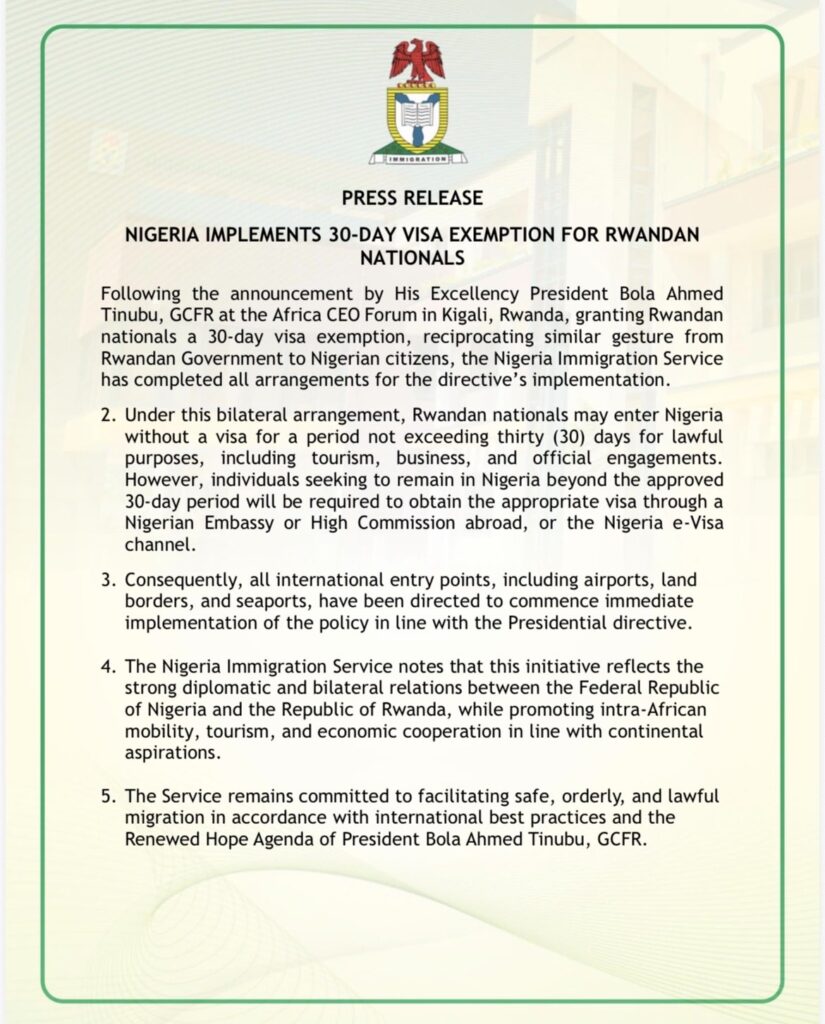
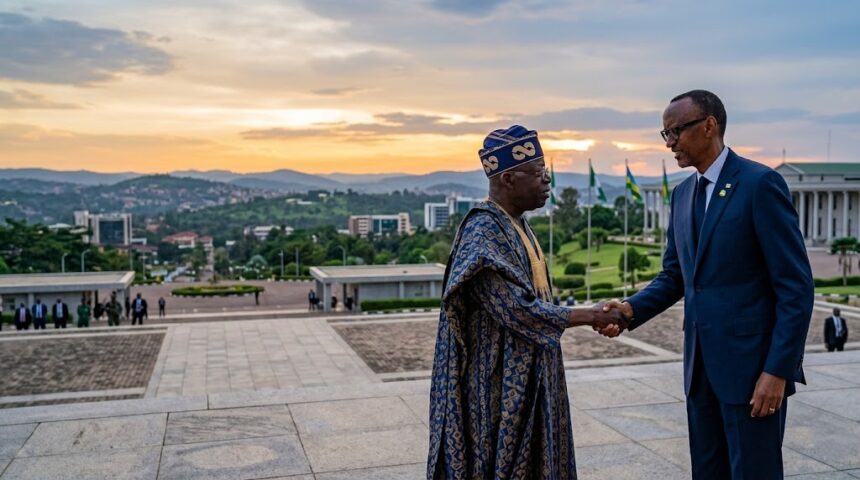
President Bola Tinubu, speaking at the Africa CEO Forum, announced that Nigerian nationals would receive a 30-day visa exemption from Rwanda, a reciprocation of the same courtesy Rwanda had already extended. The Nigeria Immigration Service has confirmed implementation is live, effective at all entry points.
Nigeria Rwanda visa-free travel is now a reality.
Rwandans and Nigerians only need a passport to enter each other’s countries. As it should be.
This is how African travel should work, and the fact that it still surprises us when it happens is a measure of how far the continent still has to go.
The Current Cost of Moving Around Africa
Think about what it currently costs to move around Africa. If you are living in Lagos, for instance, and are planning a trip through East Africa. Say, you are going to Nairobi, Kigali, or Dar es Salaam, you may need three different visas, three sets of paperwork, and three rounds of fees.
Meanwhile, you could easily fly into London, Paris, or Dubai on a single entry visa and spend a month moving freely. The architecture of African mobility was not designed for Africans. It was inherited from systems that were never meant to make intra-continental movement easy.
Rwanda’s Head Start on Accessible African Travel
Rwanda is actually not the first African country to open its doors to fellow Africans. We already have Seychelles, the Gambia, Benin, and Ghana. Rwanda now sits in that same club, offering visa-free or visa-on-arrival access to all African Union member states.
But what makes last week’s announcement different is that it operates on a second track entirely.
Rwanda is opening its door, alright. That is what these other countries are doing. They took it further by shaking hands with Nigeria across a specific border, creating a bilateral lane that did not exist before.
Hence, Rwanda is running two strategies at once: a continental welcome mat for every African, and individual agreements with major economies, like Nigeria, to deepen what that welcome actually means in practice. Nigeria, Africa’s largest economy, is now one of those partners.
Over the past decade, Kigali has quietly become one of the most accessible cities in Africa. They have an airport that works, a government that streamlined bureaucracy, and a visa policy built around the logic that visitors are assets, not threats.
Nigeria’s Step Toward Intra-African Visa Reform
Nigeria, a country of 220 million and Africa’s largest economy, has been slower to move in that direction. The bilateral arrangement with Rwanda does not fix that. But it shows that mobility between African nations is a policy choice. Nigeria Rwanda visa-free travel proves that political will can shift borders.
The Limits of a 30-Day Visa Exemption
There is a counterargument worth sitting with, though. Visa-free access can sound like a clean win, but it arrives in a world of unequal infrastructure. A 30-day exemption at Murtala Muhammed International Airport only matters if the airport functions. It only reaches people who can afford the flights, who hold the right passport, who travel for tourism or business rather than economic necessity.
The diplomatic language of “intra-African mobility” tends to float above the rougher realities of what crossing a border actually involves for most people on the continent, instead of only conference delegates, but also traders, students, migrant workers, and families.
The exemption does not solve that. What it does is shift something at the level of political will. Nigeria Rwanda visa-free travel is a small policy change with outsized symbolic weight.
Who Actually Benefits from Nigeria Rwanda Visa-Free Travel?
When two governments decide to look at each other as partners rather than security risks, the first move is often a visa waiver. It looks like a small change on paper, but it is really something else in practice because the logic, once admitted, is hard to contain. If Nigeria and Rwanda can do this, why not Nigeria and Ghana, or Nigeria and Senegal? Why not Rwanda and every Francophone neighbour it shares a border with?
The Ripple Effect: What This Bilateral Deal Signals
The African Continental Free Trade Area agreement has been in effect since 2021, with 54 signatories and grand ambitions for goods, services, and people moving freely across the continent. Implementation of the policy, predictably, has moved more slowly than the signing ceremony.
Meanwhile, individual bilateral deals like this one quietly do the work that multilateral frameworks struggle to coordinate. Nigeria Rwanda visa-free travel shows how targeted agreements can lead to continental progress.
From Nigeria Rwanda Visa-Free Travel to Continent-Wide Change
There is no bow to put on this. The agreement is 30 days, between two countries, affecting only a subset of travellers who can already navigate international airports. The gap between this and truly open African borders remains wide enough to drive a freight truck through.
But the direction is right. And direction, at this stage, is worth something. Nigeria Rwanda visa-free travel points the way forward.
The Direction Is Right. Now, What’s Next?
Next time you are at an African airport, whether in Lagos, Kigali, Nairobi, Accra, or wherever, watch what happens at the immigration line. Watch which queue moves fastest, which passport gets the shortest stare, and which traveller gets waved through and which one gets pulled aside.
That queue tells you what a government actually believes about who belongs in motion. Two governments just revised their answer, a little.
That is worth noting. It is also worth asking: which ones are next, and how long are we willing to wait for more Nigeria-Rwanda visa-free travel-style breakthroughs?