
If you’ve ever priced a flight from Lagos to Nairobi and ended up routed through Amsterdam, you already understand the problem with African airports for layovers.
We have world-class airports, but the routing logic, especially for intra-African travel, is often counterintuitive. And if you choose the wrong connecting hub, you end up waiting hours, doing a midnight layover, or paying a fare premium you didn’t plan for.
This guide breaks down the five busiest airports on the continent by passenger volume. Like how busy the airports are, so you know that if you ever choose to connect flights, it will not take long before you are back in the air. We will also see whether the hub is worth routing through or worth avoiding.
How to Use This African Layover Guide
The passenger figures below are drawn from Airports Council International (ACI) Africa’s 2023 traffic data. That is the most recent complete annual dataset available at the time of writing. Also, because we have been to most of these hubs, we can tell which data is verifiable. Whenever I say ‘volume(s)’, I mean total passengers that come and go through the airport (domestic and international combined) for the 2023 calendar year.
1. Cairo International Airport (CAI) – North Africa & Middle East Connections

Cairo is the continent’s busiest airport by a significant margin. They see nearly ten million passengers ahead of second-place Johannesburg. That gap deserves an explanation, because it’s not just about population size.
Egypt’s geographic position does a lot for this figure. For instance, Cairo sits at the intersection of Europe, the Arabian Peninsula, East Africa, and North Africa. That means EgyptAir and its partners can funnel traffic from multiple directions through a single hub.
Cairo also benefits from a large domestic network. Egypt’s internal air travel market is huge. Egyptians love to travel by air. Now, for religious travel, many people going to hajj and umrah bring a lot of traffic. That represents a consistent, high-volume passenger segment throughout the year.
Is Cairo Good for Layovers?
Cairo works well if you’re moving between North Africa and the Gulf, or between Europe and East Africa. EgyptAir‘s network is reasonably priced for these corridors.
However, the airport itself is functional but inconsistent. For example, their Terminal 2 is notably older, and the experience is not the same between their terminals. Just factor in extra time for connections if you’re not familiar with the layout, and check whether your itinerary keeps you in one terminal before you book.
One honest caveat: Cairo’s traffic figures include a meaningful proportion of O&D (origin and destination) travellers who begin or end their journey in Egypt. It’s not purely a transit hub, which means the airport is busy in ways that don’t always benefit the connecting passenger.
2. O.R. Tambo International Airport (JNB) – Southern Africa’s Transit Hub
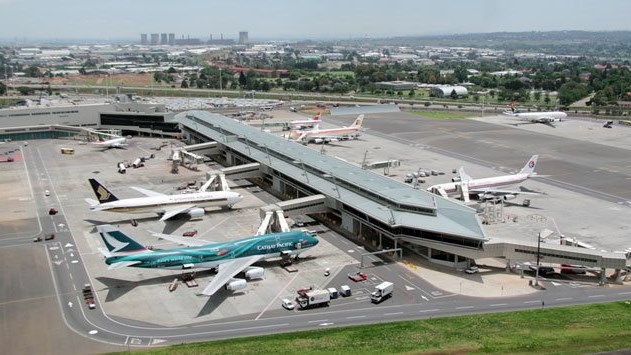
O.R. Tambo is Southern Africa’s dominant hub and, for many passengers routing between Europe, the Americas, and sub-Saharan Africa, it’s the most polished airport experience on the continent.
South African Airways has significantly reduced in scale after its 2020 restructuring, but the airport still hosts a dense schedule from major international carriers like Lufthansa, British Airways, Emirates, Ethiopian Airlines, and Kenya Airways.
The airport has enough critical mass to create genuine competition on key routes, which matters for pricing. Johannesburg–London, Johannesburg–Frankfurt, and Johannesburg–Dubai are all well-served, and that competition keeps fares from running wild.
Layover Experience at Johannesburg
If your journey involves Southern or East Africa and you’re coming from Europe or North America, Johannesburg often produces the best combination of price and schedule. The airport handles connections competently. Immigration for transit passengers is generally efficient, and the terminal layout is clear.
It is, however, a long airport. The walk between remote gates and the main terminal can be very long, so budget your connection time accordingly. Unless you plan to run, anything under 90 minutes for an international-to-international connection is tight.
The post-SAA landscape means some onward connections within southern Africa are thinner than they were five years ago. If your final destination is a secondary city like Windhoek, Lusaka, or Harare, check that your onward flight still operates at a frequency that makes a Johannesburg connection worthwhile.
3. Addis Ababa Bole International Airport (ADD) – Africa’s Premier Connecting Hub

Addis Ababa’s numbers are almost entirely the story of one airline. Ethiopian Airlines has grown into one of the most operationally aggressive carriers in the world over the past decade, expanding its network to over 125 destinations across five continents.
The airline turned Bole into a genuine sixth-freedom hub and a connecting point for passengers whose origin and destination are both outside Ethiopia. They did so by keeping fares competitive and building an actual connecting schedule, not just a schedule that happens to stop in Addis Ababa.
The model is worth understanding because it directly affects how useful the airport is to you. Ethiopian runs a hub structure with defined wave times. Their flights arrive in a concentrated window, passengers connect, and a second wave departs. This design, common at major European and Gulf hubs, is what distinguishes Addis Ababa from airports that have international service without being true connectors.
Why Addis Ababa Works for Transit Passengers
If you’re travelling between West Africa and East Africa, or between either and Asia, Addis Ababa is likely your best option, both for price and for schedule.
Ethiopian’s intra-African network is genuinely impressive. The airport itself has improved substantially with the opening of the new international terminal in 2019. That has raised their capacity from around 7 million to over 22 million annual passengers.
Connections are manageable, though there can be congestion at peak periods at immigration.
Still, Ethiopian’s own transfer desk is responsive if you have a tight connection.
The 2019 crash of Flight 302 was a significant moment in the airline’s history and in the Boeing 737 Max story globally, but Ethiopian has continued expanding and retains strong load factors on most routes.
4. Mohammed V International Airport (CMN) – Casablanca’s Strategic Hub

Morocco’s flag carrier, Royal Air Maroc, turned Casablanca into a connecting point for travel between Europe and francophone West Africa. The logic is similar to Ethiopia’s sixth-freedom model but applied to a narrower corridor, i.e. Paris–Casablanca–Dakar, Madrid–Casablanca–Abidjan, and similar itineraries.
This makes Casablanca highly relevant for some specific travellers and largely irrelevant for others.
For example, if you’re routing between Europe and Senegal, Mali, Côte d’Ivoire, or Cameroon, Royal Air Maroc deserves serious consideration on price and convenience. For almost any other routing, the airport sits outside your natural path.
When to Connect Through Casablanca
The airport is well-organised, and the connections are short enough (the terminal is compact) that even modest layovers are manageable.
Royal Air Maroc’s service levels are adequate for economy travel but well below the standard of Ethiopian or Emirates for premium cabins.
Casablanca also benefits from Morocco’s open-skies relationships with both the EU and the US, which gives the airport more competitive international routes than many African hubs of its size.
5. Cape Town International Airport (CPT)

Cape Town is primarily a leisure destination airport rather than a connecting hub, and that difference matters for how you use it.
Yes, it has a lot of traffic, but it is dominated by domestic South Africa routes and by direct international flights from Europe, particularly the UK, the Netherlands, and Germany. The point is that this airport mainly serves tourists heading to the Western Cape.
The airport does not have the hub infrastructure that you find in Johannesburg. Onward connections from Cape Town to the rest of Africa are limited in frequency, and the airport is not positioned geographically to serve transit traffic in the way that Johannesburg or Addis Ababa do.
Cape Town Layover Limitations
Cape Town Airport is excellent if Cape Town is your destination. It handles the volume it gets reasonably well, though it has been under capacity pressure. Apparently, the airport was designed for around 8 million annual passengers, and current traffic consistently exceeds that figure.
They have been discussing on a planned expansion for years, but when will they do it?
If you’re hoping to route onward from Cape Town to other African cities, build that itinerary carefully and check frequencies. You’ll often find that flying to Johannesburg first and then connecting is more practical than trying to find a direct Cape Town departure.
What About Lagos (LOS)? Africa’s Overlooked Hub
Lagos’s Murtala Muhammed International Airport does not appear in the top five. But I must add it here because it deserves an honorary bonus mention.
The airport consistently ranks between sixth and eighth on the continent by passenger volume in ACI data. They typically see between 8 and 10 million passengers annually.
More significantly, Lagos is the primary gateway for Africa’s largest economy and most populous country.
The airport’s volume reflects genuine demand constraints as much as it reflects the state of Nigeria’s aviation market.
One reason why the stats don’t rate LOS airport is its infrastructure limitations, multiple terminal buildings that don’t connect seamlessly, and a domestic aviation sector that has seen significant carrier exits over the past decade.
If you’re routing to or through Lagos, plan around these facts. The international terminal and domestic terminals are separate. That means connection times between them add meaningful buffer time, and the airport’s on-time performance record historically runs below the regional average. Like they will waste your time.
Quick Comparison: Best African Airports for Layovers
| Airport | Best for | Notable limitations |
|---|---|---|
| Cairo | North Africa–Gulf, Europe–East Africa | Variable terminal experience |
| Johannesburg | Southern/East Africa from Europe or Americas | Long walks, thinner onward network post-SAA |
| Addis Ababa | Intra-Africa, Africa to Asia | Peak immigration congestion |
| Casablanca | Europe to francophone West Africa | Narrow use case outside that corridor |
| Cape Town | Destination travel, Western Europe direct | Not a hub; limited onward connections |
The single most reliable piece of routing advice across all five airports I can give you is that you should book your connection time generously.
African airports, even the best-organised ones, are running closer to capacity than their infrastructure was designed for.
That’s not a failure of planning so much as a reflection of how fast the continent’s aviation market has grown. In 2010, total African air traffic was roughly half what it is today. The airports have been catching up ever since.
Passenger data: Airports Council International Africa (2023). Route and network information current as of early 2025; carrier schedules subject to change.