


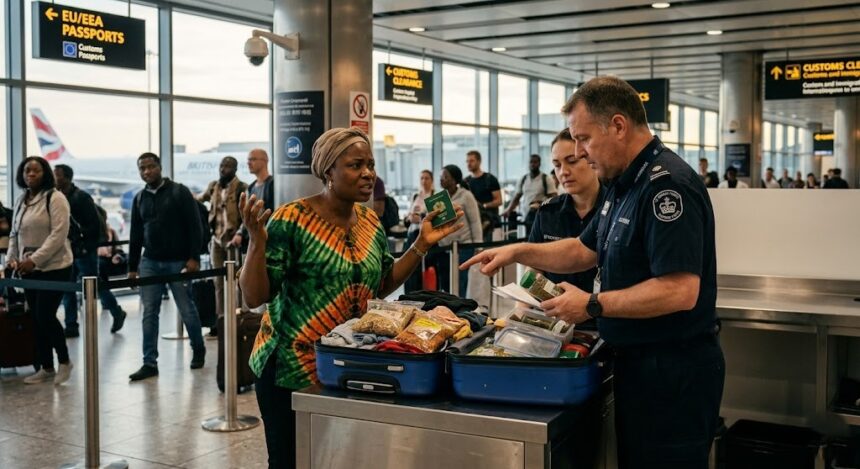
Before you zip up that suitcase, read this because some of the most innocent things you carry are airport prohibited items.
You’ve got your visa, your flight is booked, and your bag is packed with all the things that make home feel close, like kilishi for your cousin, a bottle of palm oil, and egusi to cook when you land abroad. But at the airport, those things you love could be airport prohibited items that flag your bag, delay your travel, or worse, lead to a fine or arrest.
Every year, Nigerian travellers encounter unexpected trouble at foreign customs checkpoints because they don’t know. Customs laws differ drastically from Nigeria’s regulations, and what is completely legal at home can be outright prohibited or strictly controlled the moment you land elsewhere.
This is a full guide to walk you through the most common contraband risks for Nigerian travellers going abroad. We’re covering prohibited food, cash, medications, traditional items, and more with a breakdown of the rules in the most popular destinations. If you’re packing for a trip, knowing the exact airport prohibited items will save you from costly penalties.
General Airport Prohibited Items
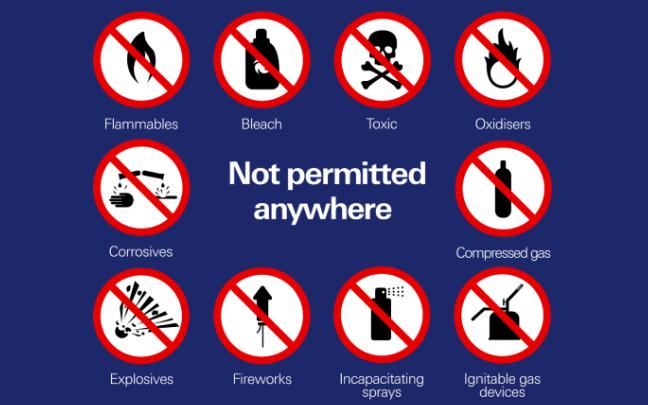
Generally, you cannot travel with illegal items such as cocaine, marijuana, firearms, explosives, etc.
Airport Prohibited Items: Food & Agricultural Products
The biggest surprise for most Nigerian travellers is how food can be prohibited. You see, the foods you grew up eating that you carefully packaged to take abroad are often at the top of customs restriction lists in the UK, USA, Canada, and Europe. Let me list the most common ones that could potentially be contraband items.
Kilishi, Suya, Ponmo & All Meat Products – Airport Prohibited Items
🔴 Risk Level: HIGH for Most Destinations
This may catch you off guard, but virtually all meat and meat products are banned from being brought into the UK, USA, Canada, and most of Europe. Whether it’s dried, smoked, cooked, cured, or raw, as long as it is meat, please don’t carry it in your bag. This covers kilishi, suya, ponmo, nkwobi, cow leg, and even some meat-based seasonings and broths.
The restriction exists to prevent the spread of animal diseases. They believe that these meats can carry diseases like foot-and-mouth disease, African swine fever, and bird flu from crossing borders. Customs officers are trained specifically to detect meat products, and X-ray scans at airports are extremely effective at flagging them.
⚠️ Penalties:
- USA — up to $250,000 fine for bushmeat.
- UK — immediate confiscation of all meat products from non-approved sources.
- Canada — fines between CAD $1,300 and $65,000 for undeclared prohibited goods.
Bushmeat (Antelope, Rabbit, Crocodile, Game Meat) – Airport Prohibited Items
🔴 Risk Level: STRICTLY PROHIBITED — USA, UK, EU
We love bushmeat in Nigeria. Roasted or smoked flesh of wild animals like antelopes, wild pigs, squirrels, rabbits, and crocodiles. However, it is treated as a serious biosecurity and public health threat abroad.
The World Health Organisation says that eating bushmeat contributes to the spread of diseases like Ebola, cholera, and others. In the United States, bushmeat in any quantity is destroyed, along with any personal items that came into contact with it.
⚠️ Penalties:
- USA Fine: Up to $250,000 for importing bushmeat.
- UK and EU: immediate confiscation and potential prosecution under animal health legislation.
Milk, Dairy, Yoghurt & Soft Cheese – Airport Prohibited Items
🟡 Risk Level: MEDIUM — UK, USA, Canada, EU
Fresh milk, homemade cheese, butter, yoghurt, and other dairy products are prohibited from most African countries into the UK, USA, Canada, and Europe. The narrow exception is commercially packaged, branded powdered infant formula or special medical food in sealed, unopened containers that require no refrigeration.
For Canada specifically, commercially packaged hard cheeses from certain approved countries may be permitted in small quantities, but this does not apply to homemade or locally packaged Nigerian dairy.
💡 Tip:
If travelling with a breastfeeding infant, commercially sealed formula in the original packaging is generally allowed. But you must declare it at customs and carry your documentation.
Egusi (Melon Seeds), Raw Groundnuts & Unprocessed Nuts – Airport Prohibited Items
🟡 Risk Level: MEDIUM — UK, EU, USA, Canada
Raw, unpeeled, or unpackaged nuts and seeds, including egusi (melon seeds), raw groundnuts (peanuts), and cashews, cannot be brought into the UK without a phytosanitary certificate from plant health authorities confirming they are free from pests and diseases. The same broadly applies in Canada and the European Union.
You can obtain a Phytosanitary (SPS) certificate in Abuja. All you have to do is apply for certification, obtain an inspection date, take the product for inspection, pay the phytosanitary certification fees, and you get the certificate. At least, that is what it says on the website. If you ask me, unless you are going abroad as an exporter of seeds and nuts, this is nuts.
However, commercially packaged and processed egusi and groundnuts are generally permitted. If you’re packing egusi from the market in a polythene bag, expect that they will confiscate it at the airport. If it’s a sealed, branded product, you have a much better chance.
💡 Safe option:
Buy commercially sealed, branded egusi or processed groundnut flour. Let it have all the proper NIS and NAFDAC labels, instead of market-bought raw seeds.
Fresh Fruits, Vegetables & Leafy Herbs – Airport Prohibited Items
🟡 Risk Level: MEDIUM — Most Destinations
Fresh fruits like agbalumo, garden eggs, and ugba; leafy greens like uziza, utazi, and efirin; and fresh peppers are generally banned or heavily restricted for import into the UK, Canada, and USA without phytosanitary documentation. They can carry pests, plant diseases, and invasive organisms.
Dried versions like dried crayfish, pepper, and vegetables are generally better received, especially if commercially packaged, though you should still declare them. Fresh, unprocessed, and loosely packed produce will almost always be confiscated.
Smoked or Dried Fish (Stockfish, Mangala, Panla) – Airport Prohibited Items
🟡 Risk Level: CONDITIONALLY ALLOWED, so you have to declare it at customs
We can bring smoked or dried fish into any country, but it must be properly declared. Also, some countries have some restrictions. For example, in the UK, only up to 20kg of fish per person is allowed. If you are carrying fresh fish, it must be gutted. Commercially packaged, dried, smoked, or cured fish is permitted. Whole, unprocessed, or fresh fish is not.
The strong smell of smoked fish reliably triggers customs dogs, and the failure to declare it is what gets travellers into trouble.
💡 Rule of thumb:
Always declare any food item at customs, even if you believe it’s allowed. Being asked to discard a declared item is far better than facing a fine for concealing it.
Palm Oil & Other Liquid Food Oils – Airport Prohibited Items
🟡 Risk Level: MEDIUM — Liquid Restrictions Apply
Palm oil, in small quantities for personal use, is generally not a banned product in most destinations. However, it faces two practical problems, as it becomes one of the airport prohibited items. 1) Aviation liquid restrictions in hand luggage (must be under 100ml in cabin baggage). 2) There must be a distinction between personal use and commercial quantities. Large amounts of palm oil packed into bags raise red flags and may be treated as commercial imports subject to duties.
Carry palm oil in checked luggage, in properly sealed containers, and in personal-use quantities. Also, always declare it.
Airport Prohibited Items: Cash Declaration & Currency Rules at Airport Customs
This is not just a foreign customs rule. It applies both when leaving Nigeria and when arriving in other countries. Failure to declare large amounts of cash is one of the most common and costly errors Nigerian travellers make.
Undeclared Foreign Currency Over $10,000
🔴 Risk Level: HIGH — Criminal Offence at Both Ends
Under Nigerian law, any passenger departing or arriving with cash, negotiable instruments, or precious metals exceeding the equivalent of $10,000 USD must declare it to the Nigeria Customs Service.
This is a legal requirement enforced under the Anti-Money Laundering Act. Failure to declare constitutes a criminal offence even if the money was lawfully earned.
On the other end, most popular destinations like the United States, United Kingdom, Canada, EU countries, and Australia all enforce a similar threshold (typically $10,000 or €10,000 equivalent). And they require a formal customs declaration for amounts above it.
You must comply with both Nigeria’s departure rules and the destination country’s arrival rules.
In early 2024 alone, Nigerian customs officers at Abuja’s airport intercepted $193,000 hidden in a yoghurt carton, and at Kano Airport discovered $1.1 million in undeclared cash. At Lagos airport, a passenger was sentenced to six months in prison for concealing $578,000 in luggage.
⚠️ Consequences:
If you are caught with undeclared money, it doesn’t matter whether you are the owner or not. It doesn’t matter whether it is legal or not. They will first seize the entire undeclared amount, and you risk prosecution and imprisonment. Nigerian courts have sentenced individuals for failing to declare even $30,000.
How to declare correctly:
Nigeria Customs operates an e-Currency Declaration Form online via the Nigeria Trade Hub portal. If you’re travelling with over $10,000 (or equivalent), fill out the form before your trip and present it to customs officers at the border for validation. Always carry proof of the legitimate source of your funds, like bank statements, business records, or contracts.
Prescription Medications: Airport Prohibited Items to Avoid
Several common legal medications widely available in Nigeria are restricted or outright banned in other countries. This is an area where cultural familiarity can lead you into serious legal trouble.
Tramadol, Codeine & Controlled Substances
🔴 Risk Level: HIGH — Strictly Controlled Internationally
Tramadol and codeine-based products, which are accessible in many Nigerian pharmacies, are classified as controlled substances in the United States, the UK, Canada, the EU, and the UAE. In many Gulf states, including the UAE and Saudi Arabia, they are outright banned without verified prescriptions and prior authorisation from the destination country’s health authority.
Even with a valid Nigerian doctor’s prescription, the regulations of the destination country govern what you may carry. Japan has banned all medications containing pseudoephedrine, a compound found in common cold medicines. Carrying controlled substances without the correct documentation, often including an apostille-certified prescription and advance notification to the consulate, can result in arrest.
⚠️ In the UAE and Gulf states:
Possession of unauthorised controlled substances, even in small quantities, can result in immediate arrest, detention, and criminal charges. Research your specific destination before travelling with any prescription medication.
Injectable Medications & Medical Devices
🟡 Risk Level: MEDIUM — Declare & Carry Documentation
If you are diabetic and carry insulin, or have any injectable medications or medical devices (including syringes), you are generally permitted to travel with them — but you must declare them at customs and carry your prescription documentation. Syringes without medical documentation may be treated as drug paraphernalia in some jurisdictions.
💡 Best practice:
Carry all medications in their original pharmacy packaging with the dispensing label. Bring a letter from your doctor on official letterhead stating the medication, dosage, and your medical condition. For controlled substances, contact the destination country’s embassy before travel.
Wildlife Products: Airport Prohibited Items
Nigeria is a signatory to CITES (the Convention on International Trade in Endangered Species). Items derived from certain animals, even products bought legally in Nigeria, are internationally regulated and can constitute serious criminal offences when transported across borders.
Ivory, Tortoiseshell, Python Skin & Exotic Animal Products
🔴 Risk Level: HIGH — International Law Violation
Decorative items, jewellery, handbags, belts, shoes, or ornaments made from ivory, tortoiseshell, python skin, crocodile leather, or the parts of any CITES-listed endangered species are illegal to export from Nigeria and illegal to import into virtually every developed country.
This applies even if you purchased them as souvenirs, gifts, or antiques.
Some travellers also unknowingly carry traditional items like animal horns, feathers, bones, or skins, without realising the species involved may be protected. Customs dogs and X-ray systems are specifically calibrated to identify these materials.
⚠️ Penalties:
Under CITES and national laws (like the US Lacey Act or the UK’s Control of Trade in Endangered Species regulations), penalties include up to five years imprisonment, substantial fines, and permanent seizure of goods. These laws are actively enforced.
Live Animals & Pets Without Documentation
🟡 Risk Level: MEDIUM — Strict Documentation Required
Travelling with pets internationally requires extensive preparation. Most destination countries require a health certificate issued within a specific window before travel (often 7–10 days), vaccination records (especially for rabies), microchipping, and sometimes a quarantine period on arrival. These requirements must be met before departure.
Bringing any live bird into or out of Nigeria is prohibited under Nigeria’s own import restrictions. Exotic animals classified as endangered species, and their products, require special permits and CITES documentation.
Herbal Preparations: Grey-Zone Airport Prohibited Items
Roots, Barks & Unpackaged Herbal Preparations
🟡 Risk Level: MEDIUM — High Scrutiny at Border
Traditional herbal preparations like agbo (herbal mixtures), dried roots, bark, leaves, and homemade remedies do not really have a direct law against them. They are not automatically banned, but they face extreme scrutiny because they may contain plant material subject to phytosanitary regulations, undeclared active pharmaceutical compounds, and are difficult to classify under standard customs categories.
In the United States, the FDA treats herbal supplements as food products and requires compliance with labelling standards. Homemade, unlabelled preparations can be confiscated and tested, and if found to contain controlled or undeclared substances, can lead to charges. UK and EU rules apply similarly under pharmaceutical and food safety regulations.
💡 Advice:
If you must travel with herbal supplements, use commercially manufactured, clearly labelled products from registered manufacturers with full ingredient lists. Homemade agbo or herbs wrapped in polythene bags are a consistent red flag at customs.
Cannabis & Cannabis-Adjacent Products (Including CBD)
🔴 Risk Level: HIGH — Zero Tolerance Across Borders
Cannabis remains illegal for transportation across international borders in all circumstances, even between countries where recreational cannabis is legal (like Canada or certain US states). You cannot legally carry cannabis from one country to another, regardless of its legality at the destination.
CBD (cannabidiol) products present a complicated picture. While legal in many countries at the national level, they are banned or heavily restricted in others, including the UAE, Singapore, Japan, and South Korea. Travelling to Gulf states or Southeast Asia with CBD oil, even if it’s below the legal THC threshold in your home country, can result in arrest.
⚠️ In Singapore, Malaysia, Indonesia, and UAE:
Drug trafficking, which includes moving cannabis across borders, carries the death penalty or life imprisonment. Do not travel to these countries with any cannabis or cannabis-derived product under any circumstances.
Final Checklist: Avoiding Airport Prohibited Items
Always declare, never conceal.
The single most effective thing you can do at any international airport is to declare what you’re carrying honestly and completely. Declaring things that turn out to be airport prohibited items typically results in confiscation. However, if you conceal the airport prohibited items, they will confiscate them, and you may either pay fines or risk jail abroad.
Research your specific destination, not just “abroad.”
What is allowed in the UK differs from Canada, which differs from the UAE, which differs from Australia. Check the official customs website of your specific destination country before travel. Also, check the rules of any transit country. For example, if you’re connecting through Doha or Amsterdam, their rules apply to what you are carrying also.
Buy Nigerian foods at destination African shops.
Nigerian and African grocery stores exist in virtually every major city where Nigerian communities have settled. These shops stock egusi, crayfish, palm oil, stockfish, garri, and most staples that have already cleared legal import processes. It is far safer, and often more practical, to buy your Nigerian foodstuffs at the destination than to risk them being confiscated at customs.
Keep medications in the original packaging with prescriptions.
Always travel with medications in their original dispensing container with the pharmacist’s label intact. Carry a doctor’s letter on official letterhead for any prescription medication, especially if it contains a controlled substance. For travelling with controlled substances to the UAE, Japan, or Southeast Asia, contact the destination country’s embassy weeks before travel to confirm authorisation procedures.
Choose commercially packaged over market-bought.
When in doubt about whether a food item will pass customs, the commercially packaged, sealed, and labelled version of that item is almost always the safer choice. It demonstrates the product has met food safety standards, contains no surprises, and is easier for customs officers to quickly clear.
Declare currency
If you are travelling with more than $10,000 (or its equivalent in any currency), complete Nigeria’s e-Currency Declaration form online before travel and declare at both departure and arrival. Carry documented proof of the source of your funds. This is not optional, and it is not negotiable.
When in doubt, leave it out or check first.
If you’re not certain whether something is allowed, the safest answer before you leave Nigeria is to check, not to guess. A quick search of the official customs website of your destination country, or a call to their consulate or embassy in Nigeria, takes minutes and could save you thousands in fines, or far worse.
The Bottom Line
You did not pack kilishi or a bottle of palm oil to cause trouble. It’s just you don’t want to miss home too much. And that is understandable.
But the customs officer at Heathrow or JFK doesn’t share that context and the law doesn’t account for it. What matters at that checkpoint is what’s in your bag and whether it complies with the regulations of the country you’re entering.
Remember that the best protection is knowing exactly what airport prohibited items apply to your route, then declaring everything you’re uncertain about. African supermarkets are everywhere Nigerians have gone. Your ogiri and stockfish will be waiting for you on the other side.
Disclaimer:
This guide is for informational purposes only and should not be taken as legal advice. Customs regulations change frequently. Always verify current rules through the official government websites of both Nigeria and your destination country before every trip. When in doubt, consult a licensed customs agent or legal professional.


