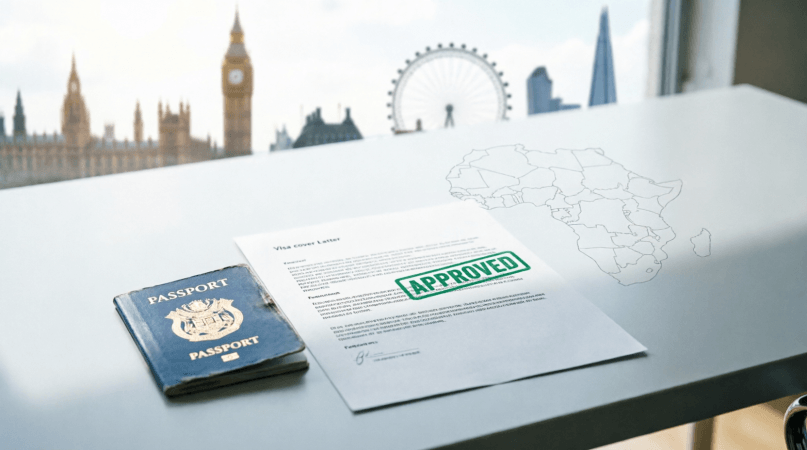
Quick answer: A UK visa cover letter is a one-to-three-page letter that explains to the Entry Clearance Officer (ECO) who you are, why you want to travel, how you will pay for the trip, and why you will return home. The strongest letters preempt doubts. It explains every unusual transaction, changes since a previous application, and every refusal ground before the officer raises it. In this guide, we break down exactly how to write one, using a real UK visa case where a bold, evidence-backed UK visa cover letter turned a refusal into an approval. You will also get a full sample letter you can adapt.
Whether you are applying for a UK Standard Visitor visa, a Schengen tourist visa or a US B1/B2, one document that decides is the cover letter. We have already shown you how to explain a large deposit in your bank statement for a visa, broken down the best tips to avoid Schengen visa rejection, and mapped out Nigeria visa requirements for travelling abroad without problems. And in every one of those guides, we mentioned that you need a powerful visa cover letter.
What Is a UK Visa Cover Letter and Why Does It Matter So Much for African Applicants?
A UK visa cover letter (sometimes called a letter of explanation or personal statement) is a formal letter you attach to your application, addressed to the officer who will decide it. It connects all your documents into one coherent story. This is where you explain your purpose of travel, your finances, your job, your family ties, your travel history and your plan to return home.
It matters more for African applicants than almost anyone else, for three hard reasons:
Decisions are made on paper, not in person. For most UK and Schengen applications, there is no interview. Your UK visa cover letter is the only “conversation” you will ever have with the decision-maker.
African passports face disproportionately high refusal rates. As we reported in our Nigeria visa requirements guide, Nigerians alone faced a Schengen refusal rate of about 45.9%. When refusal is statistically almost as likely as approval, the quality of your written case is your defence.
The UK Standard Visitor visa currently costs £135 (about ₦270,000+) and fees are non-refundable, according to the official GOV.UK guidance. If you submit a weak letter, you are losing both the trip and the money you have spent on the visa.
The UK Immigration Rules require the officer to be satisfied that you will leave at the end of your visit, can support yourself, and will not make the UK your home. Nobody is required to give you the benefit of the doubt. Your UK visa cover letter’s only job is to remove doubt line by line, with evidence.
Can One UK Visa Cover Letter Really Overturn a UK Visa Refusal? (A True Story)
Yes. And there are many cases that they got approved even after prior rejection because of their powerful cover letter.
Why Can A UK Visa Application Be Refused a Second Time?
Let us call our friend Mrs. Adama. She is a Nigerian entrepreneur and she earns ₦15 million per annum in verifiable income. She started applying for UK visitor visa since 2023. However, her application was rejected even though she was qualified. All her earnings were documented well. She planned everything including spending and trip budget. She even has strong ties to the UK.
In their last rejection email, which was last year, the Entry Clearance Officer wrote that the only credits in the account came from the income that had “steadily built up over time”. The officer was “not satisfied that you have demonstrated the reason for this trend… which has significantly inflated your closing balance”. In other words, she was penalised because saving part of a large income made her balance grow.
How Did the New UK Visa Cover Letter Attack Each Refusal Ground?
Mrs. Adama had two options. She can either go for a reconsideration via the Home Office’s pre-action protocol for judicial review (typically two to three months for a response) or a fresh application (much faster). She chose to reapply and this time, with a strong UK visa cover letter.
The new cover letter she got quoted each refusal ground back and answered it with data and calculations. It also enclosed a line-by-line bank statement analysis, isolating the three one-off transfers from regular monthly spending.
What Happened and What Can You Learn From This UK Visa Cover Letter Case Study?
The visa was approved. Mrs. Adama travelled, visited the UK, and returned to Nigeria.
The lessons for every African applicant:
Boldness only works on a foundation of evidence. For your cover letter to be powerful, you must have evidence and you must be qualified. This means that there will be no legal reason for any officer to refuse you.
To be able to clear this, you should get an accountant to audit your bank statement before you submit it to the ECO.
Moreso, never try to pad, guess, or conceal any detail. Even if it seems unecessary, you mjust explain it. And every number in your letter must trace to a document. (If money entered your account unusually, read our guide on explaining a large deposit in a bank statement for a visa before you write a single word.)
What Should Every UK Visa Cover Letter Contain?
Whether it’s your first UK application, a Schengen visa or a Canadian TRV, a complete UK visa cover letter contains these building blocks:
| Section | What It Proves to the Officer |
|---|---|
| Your details + application reference (GWF/VAF) | The letter attaches to the right file |
| Purpose of travel & exact dates | A credible, specific reason for the trip with “proper justification” |
| Itinerary summary | The plan is real and thought through |
| Employment & income | Economic stability and a reason to return |
| Trip cost & funding source | You can afford it (≈ UK rule V 4.2: support + return journey) |
| Bank statement analysis | Your money story is explained, not just shown |
| Explanation of unusual transactions | Nothing looks like “funds parking” or borrowed money |
| Ties to home country | Job, family, business, property, obligations pulling you back |
| Accommodation details | Where you’ll stay is settled |
| Travel & immigration history | A record of compliance (previous visas, returns on time) |
| Response to previous refusal(s) | You’ve addressed every past concern head-on |
| List of enclosed documents | Makes the officer’s job easy. It’s never a bad idea |
| Respectful close + availability for interview | Confidence without arrogance |
Missing any of the first ten is where most self-prepared African applications quietly die.
How Do You Write Your Own UK Visa Cover Letter, Step by Step?
Follow these nine steps in order. Do not skip Step 1. It is the one that decides everything.
Step 1: Audit your own evidence before you write your visa cover letter.
Get three documents in front of you: 1) your bank statements (3–6 months), 2) your application form, and, if applicable, 3) your refusal letter and every old application form you’ve ever submitted. Read the refusal word for word. Calculate your own income, your true monthly spending, and your balance trend. If your forms, statements and letter disagree with each other, the officer will find it. Gerald’s rule: triple-check.
Step 2: Start Writing. Open with respect, purpose and context.
In the first paragraph, state who you are, what visa you’re applying for, your travel dates, and, if this is a reapplication, acknowledge the previous refusal immediately and confidently, never defensively. Example: “I have carefully reviewed and fully understood the reasons stated by the Entry Clearance Officer, and I am confident that this reapplication… directly and completely addresses every concern raised.”
Step 3: State your numbers like an accountant.
Don’t write “I earn a good salary.” Write: “I earn ₦11,500,000 monthly, verified by my employment letter, payslips and corresponding bank credits. My regular monthly expenses average just over ₦1,000,000. I have budgeted ₦4,500,000, which is less than half of one month’s income, for this trip.” Then show what that arithmetic means for your balance. Officers doubt gaps and trends they can’t explain; make the trend explain itself.
Step 4: Explain every unusual transaction.
Walk through your statement like a prosecutor would. Every large or odd credit/debit gets a label, a date, a person and a purpose (“₦5,000,000 transferred to my wife on [date] as capital for her retail business; non-recurring”). Then annex a bank statement analysis so the officer can verify each line in seconds. We go deep on this in our guides to explaining large deposits and beating the lump-deposit trap in Schengen bank statements.
Step 5: Prove your ties to home.
What ties you to your home country may be your job (with approved leave dates and return-to-work commitment), spouse and children remaining at home, a business that cannot run without you, property, ongoing contracts, or community obligations. When stating these, be specific. Just saying, “I have strong family ties” means nothing. Write “my wife and three children remain in Lagos. My daughter’s school term resumes 7 September and I must be there to take her to school.”
Step 6: Cover accommodation, itinerary and travel history.
State where you’ll stay (bookings or host details), what you’ll do, and where you’ve travelled before especially visas used correctly and exits on time. Prior compliance is your strongest predictor argument.
Step 7: If you were ever refused, answer every ground directly.
One subheading per refusal ground. Quote the officer, answer with documents, move on. (Full strategy in the next section.)
Step 8: Close firmly and respectfully.
Summarise in two or three lines, state that you’re available for an interview and further documentation, thank the officer. Confidence reads as credibility while pleading reads as risk.
Step 9: Cross-check your UK visa cover letter against your form and every document.
Proofread everything. Check all the names, dates, figures, and references. One contradiction between form and letter can undo nine perfect steps. Budget time for this on the same day you budget for the real cost of the trip itself.
How Should You Address a Previous Refusal in Your UK Visa Cover Letter?
This is where African applications are most often lost. I will share five rules on how you can address a previous rejection to make your new visa cover letter more powerful.
Rule #1
Never hide or minimise a refusal. The Home Office already knows how many times you have applied and got refused. If you try to hide or dance around the fact in your cover letter, it will bite you in the ass.
Rule #2
Quote each ground they reject you on verbatim, then answer it. In fact, it will be easier for them to read if you label them “Ground 1,” “Ground 2,” etc. An officer scanning your letter should be able to tick off every prior concern in order.
Rule #3
Attack with evidence, not emotion. For a winning letter, every rebuttal or response ended in a document like payslips, employment letter, annexed statement analysis, enclosed old cover letter, etc. you don’t just “explain”. You state it like this: “as explained at page 2 of Annexure B…”.
Rule #4
You may point out contradictions calmly. If the refusal says each application is judged on its own merit while importing figures from an old application, say so plainly and show both quotes. Logic, not adjectives, is what embarrasses a bad decision.
Rule #5
If you intend to pursue reconsideration or judicial review, say so as transparency rather than as a threat. The pre-action protocol route is a legitimate, published Home Office process. Stating that you have prepared (but withheld) such a letter signals that your case is evidence-backed and that you know your rights. But only use this if it is true and your case genuinely merits it.
What UK Visa Cover Letter Mistakes Get African Applicants Refused?
I have talked about this in previous posts on this website. One of the biggest reason people’s visa gets flagged is unexplained lump-sum deposits or transfers. The classic “funds parking” trigger. If you want to deposit money into your account to boost your balance for the application, do so in bits.
Another thing that cause rejection is when you have figures in your account that don’t match the bank statement. For example, you declared ₦1m monthly spending but the statement says otherwise and you did not explain it.
There is also inconsistency between old and new applications. For example, if a figure that appeared in 2024 vanished in 2026, you must explain it, otherwise it becomes a problem.
Also avoid copy-paste template letters. If your UK visa cover letter looks similar to what they have been reading, they may reject you.
Another reason is vague purpose of travel. “Tourism” without dates, cities and a budget is barely a purpose at all.
If your letter sounds emotional, is pleading or has threatening language, you might get refused. Sympathy doesn’t issue visas.
Another reason is hiding a sponsor’s role (or inventing one).
Also applying when you’re not yet qualified can get you rejected. Sometimes the honest advice is don’t apply until you have fixed your profile.
What Does a Real, Winning UK Visa Cover Letter Look Like? (Sample Letter)
Let me give you an adapted version of a powerful UK visa cover letter. Please don’t do copy and paste. This is just to show you the structure and arguments that can turn a flawed refusal into an approval.
How to use it:
Replace every [bracketed] item with your own verified information, and rewrite the arguments so they match your refusal grounds and your documents. Never submit this word-for-word; an ECO who recognises a template will treat it as one.
[Your Full Name]
[House Address], [City], [Country]
[Phone Number] | [Email Address]
[Date]
The Entry Clearance Officer
UK Visas and Immigration
[Visa Application Centre / Post handling your application]
Re: Cover Letter in Support of a Fresh UK Standard Visitor Visa Application — [Full Name], Passport No. [XXXXXXX], GWF Ref: [GWFXXXXXXXX]
Dear Entry Clearance Officer,
I am writing to respectfully submit a fresh application for a UK Standard Visitor visa. My previous application (GWF Ref: [XXXXXXXX]) was refused on [date]. I have carefully reviewed and fully understood the reasons stated by the Entry Clearance Officer, and I am confident that this reapplication, supported by more comprehensive and thoroughly documented evidence, directly and completely addresses every concern raised.
Purpose of Travel
I wish to visit the United Kingdom from [date] to [date] for tourism. I hold a valid Schengen visa and intend to spend [X] days in Germany and [X] days in France before arriving in the UK for [X] days to visit [London, Manchester, etc.]. I will return to [home country] on [date], where I live and work. The purpose, cost and logistics of this trip are set out below and supported by the enclosed documents.
Employment and Income
I am employed as [job title] at [employer], where I have worked for [X] years. My verified monthly salary is ₦1,500,000, confirmed by my employment letter, payslips and the corresponding salary credits on my bank statements (Annexures A and B). My approved annual leave runs from [date] to [date], and I am expected back at my desk on [date]. My employer’s leave confirmation is enclosed.
Trip Cost and Funding
My regular monthly expenditure averages just over ₦1,000,000. And I have budgeted ₦4,500,000 (approximately £[X]) for this trip, which is less than half of one month’s income, itemised in Annexure C (flights, accommodation, local transport and daily expenses). The trip is funded entirely from my own savings and salary. No third party is funding it, and no part of my funds has been borrowed.
Response to Previous Refusal Reasons and ECO Concerns
I have studied the refusal letter dated [date] (VAF [XXXXXXXX]; GWF [XXXXXXXX]) with great care, and I wish to address each ground of refusal directly, transparently, and with the full weight of the evidence now before you.
Ground 1: Steady balance growth doubted as a true reflection of my circumstances.
The refusal states that the only credits in my account are from my salary, that these have steadily built up over time, and that the officer was not satisfied that I had demonstrated “the reason for this trend,” which “significantly inflated” my closing balance. With respect, this finding is not sustainable on the evidence. My salary of ₦1,500,000 per month is a documented, verified and employer-confirmed figure, supported by my employment letter, payslips and direct bank credits. The arithmetic consequence of a verified monthly income of ₦1,500,000 against verified monthly expenses of about ₦1,000,000 is a steady, consistent accumulation of my balance over time. There is nothing suspicious, irregular or unexplained about this pattern.
Ground 2: State it
Explain it with evidence…
Ties to [Home Country]
My life, livelihood and family are firmly rooted in [home country]. For instance, I have my employment of [X] years with an approved leave and a fixed return date. My wife [and children], who remain at home during this short trip also await my return at the said date. I must also be at home at the set date for [my business/property/ongoing contracts]. Every obligation I have points homeward, and my return flight is booked for [date].
Accommodation and Itinerary
I will stay at [hotel name and address/my friend/relative, name, address, immigration status], as confirmed in the enclosed [booking/invitation letter]. A day-by-day itinerary is enclosed.
Travel and Immigration History
[List previous visas and trips — e.g., “I hold a valid Schengen visa issued [date]. I previously visited [countries] between [dates] and returned on schedule on each occasion. I have never overstayed, breached conditions or been refused entry at any border.”]
Conclusion
I respectfully draw the officer’s attention to the fact that this is my third application for a UK visa, following refusals in [2024] and [April 2026]. I have studied both decisions carefully, and I am firmly of the view that the most recent refusal was based on material errors of reasoning. One of which points to a failure to engage with evidence clearly placed before the decision-maker and an irrational conclusion drawn from the mathematically inevitable growth of a well-documented bank balance.
These errors have been fully documented in a reconsideration (pre-action protocol) letter prepared and dated [27 April 2026]. I have deliberately chosen to hold that letter in abeyance, to give this fresh application the opportunity to be assessed fairly on its full merits. If this application is approved, as I genuinely believe it should be, that letter will never need to be submitted, and this matter will be fully and finally resolved. However, if the application is refused again, and in particular if the refusal repeats the same errors of reasoning identified above, I will submit the reconsideration letter to the Entry Clearance Manager immediately and proceed with judicial review proceedings in accordance with the published pre-action protocol, without further notice. I make this statement not as a threat, but as a matter of complete legal transparency, and in the sincere hope that it will not prove necessary.
I remain readily available for an interview and willing to provide any additional documentation you may require. Thank you for your time and consideration.
Yours faithfully,
[Signature]
[Full Name]
Enclosures: Application form and appointment confirmation; passport; employment letter and leave confirmation; payslips ([X] months); bank statements ([X] months); Bank Statement Analysis (Annexure B); trip budget (Annexure C); previous cover letter and supporting explanation (Annexure [X]); hotel booking/invitation letter; itinerary; flight reservation; [any other supporting evidence].
If this is your first application (no previous refusal), delete the “Response to Previous Refusal Reasons” section and the firm conclusion, keep everything else, and the UK visa cover letter shrinks to a tight 1–2 pages.
When Should You Get Professional Help With Your UK Visa Cover Letter?
You can write your UK visa cover letter yourself if your case is straightforward. That is if you have a stable income, clean statements, no refusal history, clear purpose. But get an expert review it or write it for you if you have had a previous refusal (especially more than one), irregular income or business cash flow, large recent deposits, past overstays, or circumstances you don’t fully understand how to present. While you build your profile, our guides to UK immigration pathways and visa-free countries open to African passports are excellent homework.
What Do People Ask Most About UK Visa Cover Letters?
Is a UK visa cover letter compulsory for a UK visa?
No. The official list of supporting documents does not make one mandatory. But for African applicants it is effectively essential, because it is the only place you control the narrative your documents tell. Applications are refused every week for doubts a two-page UK visa cover letter would have dissolved.
How long should a UK visa cover letter be?
One to two pages for a clean first application; two to four pages if you are responding to a refusal with multiple grounds. Long enough to answer every doubt, short enough to be read. No officer has ever complained that a letter was too clear.
Can I use one UK visa cover letter for the UK, Schengen and Canada?
The skeleton is universal, so yes, about 70% carries over. But rewrite the refusal-response and regulatory sections for each destination, and match each letter to that country’s forms and terminology. A “UK” letter full of Schengen-format assumptions reads like what it is: a recycled file.
Should I mention my sponsor in the UK visa cover letter?
Absolutely hide nothing. Name the sponsor, state your relationship, explain why they are sponsoring you, and reference their financial evidence (bank statements, employment or business documents) the same way you would your own. An unexplained sponsor looks like a red flag; an explained one looks like family.
Can I mention reconsideration or judicial review in a UK visa cover letter without sounding like a threat?
Yes, if you frame it as procedural transparency exactly as the sample letter does, and only if it is true. Referencing a legitimate, published Home Office process while explicitly disavowing any threatening intent (“I make this statement not as a threat, but as a matter of complete legal transparency”) is very different from demanding an approval. If you have no genuine basis, leave it out entirely.
Will a strong UK visa cover letter guarantee an approval?
No document can guarantee an approval so be wary of anyone who tells you otherwise. What a strong UK visa cover letter does is ensure your application is refused only for real reasons, not for avoidable doubts, unexamined explanations or contradictions an officer never had to resolve. In Mr. Shehu’s case, that difference was the difference between two refusals and a boarding pass.
Do I need a different UK visa cover letter if I am self-employed?
Yes. A UK visa cover letter for a self-employed applicant should clearly explain the business, income sources, business registration, tax documents, invoices, contracts, and how profits enter the personal bank account. The officer needs to see that the income is real, consistent, and compatible with the trip budget.
Should I upload my UK visa cover letter as a separate PDF?
Yes. Upload your UK visa cover letter as a clean, separate PDF with a clear file name such as “UK Visa Cover Letter – [Your Name]”. This makes it easier for the Entry Clearance Officer to find, read, and reference.
Can a UK visa cover letter be handwritten?
A typed UK visa cover letter is strongly recommended. It is easier to read, easier to scan, and looks more formal. If you must handwrite it, ensure it is extremely neat, but typing is always the safer option.
Are You Ready to Write a UK Visa Cover Letter the ECO Cannot Ignore?
The formula is not magic: audit your evidence, state your numbers, explain your transactions, prove your ties, answer every doubt, and stay respectful while standing your ground. Do the unglamorous work first, and the confident letter writes itself.
Found this useful? Keep building your application toolkit with our guides on explaining a large deposit in your bank statement, avoiding Schengen visa rejection, and the Nigeria visa requirements for travelling abroad without problems and if the paperwork all feels like too much wahala right now, here are the visa-free countries open to African passport holders in 2026 where no cover letter is required at all.
Have a UK visa cover letter or refusal story you’d like us to break down? Send it to the Travel Radio team at hello@travelradio.live.