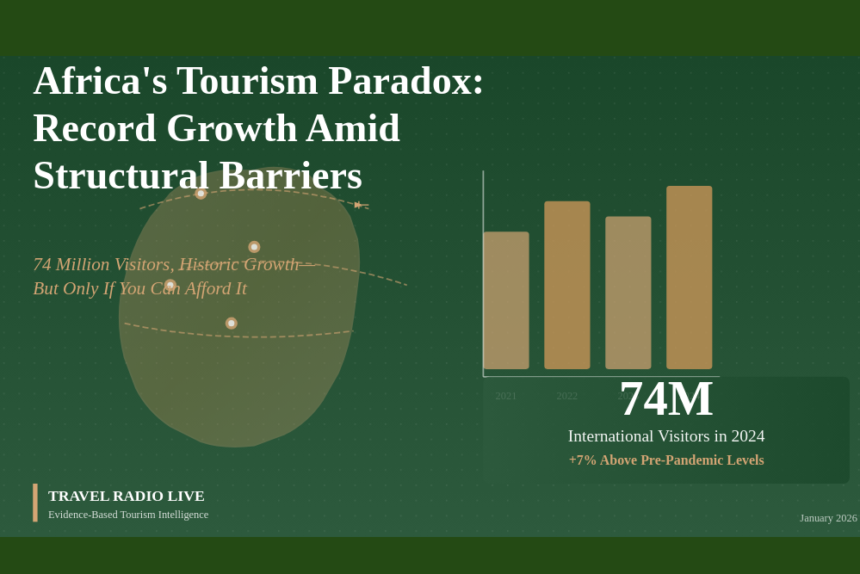
The continent achieved historic visitor numbers in 2024, yet systemic challenges threaten to limit who can access its promise
LONDON, UK. – Africa welcomed 74 million international visitors in 2024, representing a 7% increase compared to 2019 and 12% growth from 2023, according to the UN World Tourism Organisation. This milestone marks the continent’s full recovery from the pandemic and positions Africa as a global tourism success story.
Yet beneath these encouraging headlines lies a troubling contradiction: the very countries celebrating this growth continue to maintain policies that make Africa one of the world’s most expensive and complicated regions to visit. Aviation costs remain prohibitive, visa processes byzantine, and operational expenses significantly higher than comparable markets in Asia and Latin America.
The question facing governments, businesses, and tourism stakeholders across the continent is stark: Will Africa’s tourism sector evolve to serve a broader demographic, or will it remain accessible primarily to affluent travelers and business visitors?
$1.6 trillion
International tourism revenues reached this figure globally in 2024, with Africa capturing a growing but still disproportionately small share relative to its visitor numbers.
The Numbers Tell Two Stories
Regional performance reveals significant variation. The Gambia led growth at 46%, followed by Morocco at 22%, Egypt at 21%, Ethiopia at 7%, and South Africa at 6%. Morocco attracted 17.4 million arrivals in 2024, nearly half from the Moroccan diaspora, while Egypt welcomed 15.7 million visitors and Tunisia received 10.25 million.
South Africa recorded 8.92 million international arrivals in 2024, marking a 5.1% increase from 2023, with tourism now contributing 8.8% to GDP and supporting 1.68 million jobs. Ghana’s transformation proved particularly dramatic: the country recorded a 149% increase from 2023, reaching 36,656 arrivals, largely attributed to visa waivers implemented in November 2023 and increased airline connectivity.
74M
Total visitors to Africa in 2024
+12%
Year-over-year growth from 2023
+7%
Growth above pre-pandemic 2019 levels
16%
Q1 2025 exceeded 2019 levels by this margin
Aviation: The Fundamental Barrier
The continent’s aviation sector presents perhaps the starkest contradiction. While African airlines saw passenger traffic grow by 13.2% in 2024, with an estimated 98 million passengers, the structural impediments to affordability and connectivity remain severe.
The Cost Crisis
African airlines operate on extremely thin margins, with average net profit per seat at approximately $1.20, compared to the global average of $7.70 per seat and over $20 per seat for Gulf Cooperation Council carriers. This margin pressure directly translates to higher ticket prices for consumers.
Allan Kilavuka, Group Managing Director of Kenya Airways and chairman of the African Airlines Association Executive Committee, stated that Africa is “an extremely expensive place to run an airline,” noting that the policy framework does not effectively support connectivity.
“We have 54 states in Africa, many of which want national carriers with fewer than five aircraft — this is simply not viable. We need to work together to build a sustainable aviation industry.” — Allan Kilavuka, Kenya Airways
SAATM: Promise vs. Implementation
The Single African Air Transport Market (SAATM), launched in 2018 to liberalize air services across the continent, has achieved mixed results. As of 2025, 38 countries have signed up to SAATM, with full implementation expected to increase intra-African passenger traffic by 51% while reducing airfares by 26%.
However, implementation lags ambition. A 2024 survey by the African Airlines Association revealed that several countries have yet to fully liberalize and implement SAATM, as evidenced by the denial of Fifth Freedom Rights, with political goodwill and reciprocity identified as significant hindrances.
Only 19% of intra-African routes offer direct flights, forcing passengers to endure longer, costlier journeys, with protectionist bilateral agreements restricting competition and limiting route availability.
$880M
The amount of airline funds blocked in African countries as of June 2024, representing 52% of the $1.68 billion in blocked funds globally. Nigeria cleared 98% of previously blocked funds, but the continent-wide challenge persists.
Safety and Infrastructure Progress
Safety improvements offer a counterpoint to cost challenges. While the global accident rate stands at 1.1 accidents per million flights, Africa’s rate is 10.3 per million flights. However, the continent has made progress: fatality rates reached zero for two consecutive years in 2024, though underlying risk profiles require continued attention.
Infrastructure investment is accelerating. Major projects include Ethiopia’s new Bishoftu International Airport, a $10 billion infrastructure project that will become one of the largest in African aviation history, and Rwanda’s Kigali International Airport, which received over $30 million in major upgrades including three taxiways.
Visa Reforms: The Accelerating Momentum
Perhaps nowhere is the gap between policy rhetoric and practical reality more evident than in visa accessibility. Yet 2024-2025 has witnessed unprecedented momentum in visa liberalization.
Breakthrough Reforms
Ghana implemented visa-free travel for all African citizens in early 2025, fulfilling President Akufo-Addo’s commitment made at the 2024 Africa Prosperity Dialogues. This decision makes Ghana the fifth African country to allow entry for all holders of African passports, joining Rwanda, Seychelles, The Gambia, and Benin.
Kenya implemented a pan-African visa-free policy in 2025, allowing citizens from all African countries to enter without a visa, with exceptions only for Somalia and Libya, whose travelers remain subject to additional security reviews. The policy allows stays between sixty and ninety days for most African visitors, with East African Community members permitted to remain for up to six months.
28%
Intra-African travel routes that are visa-free (up from 20% in 2016)
25%
Routes offering visa-on-arrival
47%
Routes still requiring pre-departure visa (down from 55% in 2016)
5 countries
Now offer visa-free access to all Africans
The Economic Impact of Openness
The Ghana-South Africa case study demonstrates visa reform impact. South Africa’s Tourism Minister Patricia de Lille attributed Ghana’s 149% growth to the fact that travelers between the two countries no longer need visas, combined with increased airline connectivity and targeted marketing initiatives.
By 2025, 31 African countries—57% of the continent—offered e-Visas for Africans, up from just 9 countries (17%) in 2016. Yet significant challenges remain: African applicants for Schengen visas experience rejection rates often exceeding 30%, higher than the global average, due to stringent requirements.
The Affordability Question
Beyond aviation and visas, everyday costs present barriers that traveler testimonials consistently highlight: accommodation pricing that exceeds Southeast Asian equivalents despite lower service standards, restaurant prices for international cuisine running two to three times comparable destinations, and alcohol costs inflated by taxation policies.
These patterns reflect broader economic realities—import dependence, limited competition in nascent tourism markets, and revenue policies that prioritize short-term taxation over long-term sector development. Countries demonstrating tourism success have addressed these systematically through duty-free zones for tourism businesses, competitive accommodation sectors spanning budget to luxury, and tax structures that balance revenue needs with sector competitiveness.
Who Benefits? Who’s Left Behind?
Current pricing and accessibility structures create a tourism sector that serves narrow demographics. Business travelers on corporate budgets, affluent leisure tourists from high-income countries, and diaspora visitors with family connections dominate arrivals. Missing are budget-conscious independent travelers, younger demographics, intra-African tourists constrained by currency exchange realities, and middle-income families from emerging markets.
The African tourism paradox: celebrating record growth while maintaining the exact policies that ensure only the wealthiest can afford to visit.
This demographic skew has implications beyond economics. Tourism shapes global perceptions, cultural exchange, and soft power. When only affluent visitors can access a continent, the stories told, connections formed, and understanding developed remain limited to those who can afford the premium.
Models of Success
Several countries demonstrate that accessibility and growth are compatible. Morocco, Egypt, and Tunisia combine affordable accommodation, simplified visa processes, and competitive pricing to attract tens of millions of visitors annually. Rwanda’s visa reforms and tourism infrastructure investment have positioned it as a premium destination while expanding accessibility. Ghana’s visa liberalization yielded immediate, measurable results.
Regional cooperation offers another pathway. The East African Tourist Visa allows visitors to travel simultaneously across Rwanda, Kenya, and Uganda for tourism, costing $100, valid for 90 days with multiple entries within the three countries. This model could be replicated across West, Southern, and Central African regions.
The Path Forward: Questions for Stakeholders
Travel Radio Live exists as a convening space where industry intelligence, policy analysis, and lived experience intersect. The data presented here demands conversation among the stakeholders who shape Africa’s tourism future.
Questions for Dialogue
For Governments: How do we balance revenue maximization with long-term sector development? What trade-offs are we willing to accept to broaden tourism demographics?
For Airlines & Aviation Authorities: What operational models can deliver both sustainability and affordability? How can regional cooperation overcome national protectionism?
For Hotel & Hospitality Operators: What market segments are we failing to serve? How can we develop affordable options without compromising quality or worker conditions?
For Tour Operators & Travel Agents: How do current pricing structures exclude potential markets? What partnerships could expand accessibility?
For Civil Society & Consumer Organizations: How do we advocate for policies that serve broader populations rather than narrow elites? What accountability mechanisms ensure tourism benefits communities?
Toward Inclusive Tourism Development
IATA projects that by 2043, the African aviation market will connect an astounding 345 million passengers annually. International tourist arrivals are projected to grow by another 3% to 5% in 2025, with Africa well-positioned to benefit from this upward trend.
Whether this growth creates genuinely inclusive tourism or reinforces exclusivity depends on choices made now. The technical solutions exist: regulatory frameworks for aviation liberalization, proven visa reform models, competitive pricing strategies demonstrated by successful markets, and infrastructure investment blueprints from countries making progress.
What remains is political will—the willingness to prioritize long-term sector health over short-term revenue maximization, regional cooperation over national protectionism, and broad accessibility over narrow elitism.
The Travel Radio Live Commitment
As a global convening space for travel and tourism dialogue, Travel Radio Live commits to:
- Publishing evidence-based analysis that holds stakeholders accountable to stated goals
- Amplifying voices excluded from current tourism benefits—local communities, budget travelers, intra-African visitors, and workers throughout the value chain
- Facilitating conversations between governments, businesses, civil society, and travelers on accessibility barriers and solutions
- Tracking implementation of commitments like SAATM, visa reforms, and infrastructure investments with the same rigor we celebrate announcements
- Centering responsible travel narratives that recognize tourism not merely as movement, but as a force shaping economies, identities, and global solidarity
Africa’s tourism sector stands at a crossroads. The continent can continue celebrating growth accessible only to elites, or it can undertake the difficult policy work to make its cultural richness, natural beauty, and human warmth available to the global middle class. The data shows both the promise and the barriers. The choice belongs to those with power to change policies.
Data Sources & Further Reading
This article synthesizes data from:
- UN World Tourism Organisation (UNWTO) World Tourism Barometer 2024-2025
- International Air Transport Association (IATA) African Aviation Reports 2024-2025
- African Union – SAATM Implementation & Visa Openness Index 2024
- African Development Bank Tourism & Aviation Sector Analysis
- South African Government Tourism Statistics 2024
- World Travel & Tourism Council Africa Economic Impact Reports
About Travel Radio Live: A global convening space where industry intelligence, lived experience, and cultural storytelling meet. By centering inclusive voices and responsible travel narratives, we empower businesses, policymakers, and travelers to understand travel not merely as movement, but as a force shaping economies, identities, and global solidarity.
Editorial Standards: All statistics cited from January 2024-January 2026 sources. This article reflects evidence-based analysis without exaggeration, presenting successes, failures, and improvement areas with equal rigor.
© 2026 Travel Radio Live. Published January 2026.