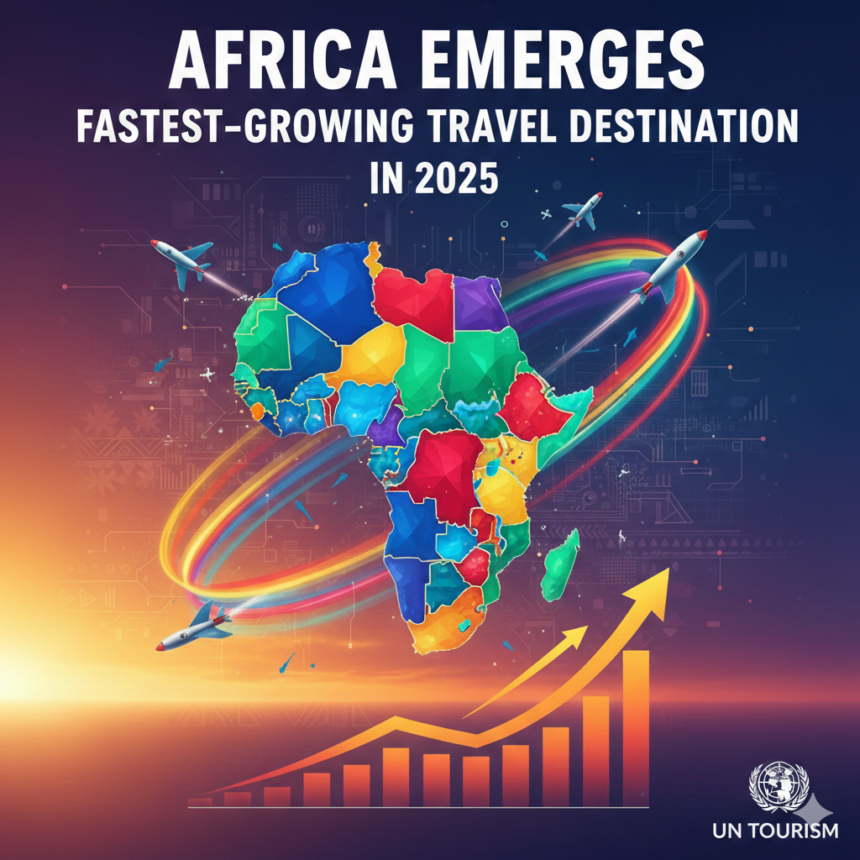
Africa has emerged as the fastest-growing tourism region globally in 2025, recording approximately 10% growth in international arrivals.
According to new figures from the World Tourism Barometer released by the UN Tourism, North Africa led regional performance with an 11% increase, while Sub-Saharan Africa followed closely with growth of around 10%.
The results underscore Africa’s rising profile as a competitive global travel destination.
Europe continued to dominate global tourism, welcoming an estimated 625 million international arrivals in the first nine months of 2025, up 4% compared with 2024.
All European subregions reported growth, with particularly strong performance in Western Europe and Central and Eastern Europe.
Asia and the Pacific recorded an 8% increase in international arrivals as the region continued its post-pandemic recovery, although some destinations remained slightly below 2019 levels.
The Middle East posted modest growth of around 2%, maintaining the strongest rebound relative to pre-pandemic benchmarks, while the Americas also recorded overall growth of approximately 2%.
Steady Movement
International tourism maintained strong momentum in 2025, with global travel demand continuing to rebound despite economic uncertainty, inflationary pressures and geopolitical tensions.
International tourist arrivals increased by 5% in the first nine months of 2025 compared with the same period in 2024 .
Between January and September 2025, more than 1.1 billion international trips were recorded worldwide — approximately 50 million more arrivals year on year.
Global tourism volumes also stood around 3% above pre-pandemic 2019 levels, highlighting the sector’s resilience.
“International tourism has continued to experience sustained growth so far in 2025 in terms of international arrivals and most importantly in receipts, despite high inflation in tourism services and geopolitical tensions. Africa and Europe in particular stand out for their results, ” says UN Tourism Secretary-General Zurab Pololikashvili.
Outlook for Global Travel and Tourism
International air travel demand continued to underpin tourism growth, with passenger traffic rising by approximately 7% during the period alongside increased airline capacity.

Global hotel occupancy rates remained solid, averaging close to 68% by September 2025, reflecting sustained travel demand.
The sustained rise in international tourist arrivals highlights the resilience of the global tourism sector and points to continued growth through the remainder of 2025 and into 2026.
Africa and Europe are expected to remain key drivers of global tourism performance as destinations continue to invest in connectivity, infrastructure and sustainable travel development.