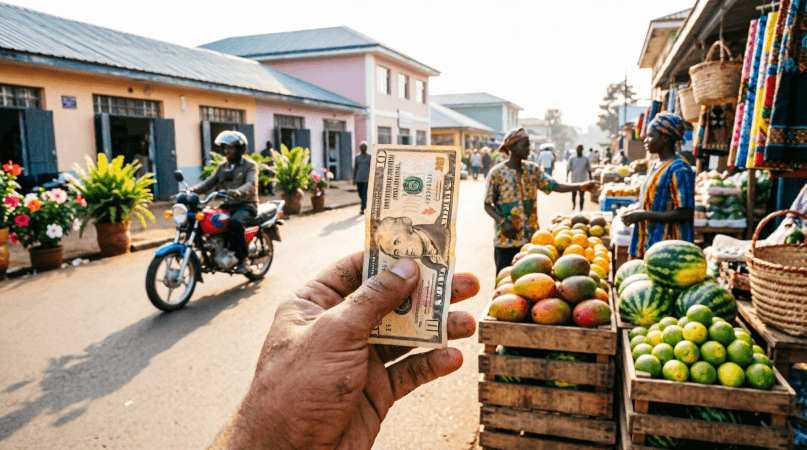
It’s a hot afternoon in Kigali, I’ve got a rucksack digging into my shoulders, a bus to Kampala catching at 7 p.m., and exactly one crumpled ten-dollar note in my pocket. My only plan is to document my day and how fast 10 USD can run out in Rwanda so that I can create this Kigali travel budget.
So what can you do with 10 USD in Rwanda? I spent the money on transport, food, a couple of errands, and a little chaos along the way. If you’re budgeting a trip through this part of the continent, this is the kind of ground-level number you actually need to build a realistic Kigali travel budget.
How Much Is 10 USD in Rwandan Currency?
First things first, I needed local money. Rwanda spends Francs. And the mid-market rate in early July 2026 sits around 1,450 Rwandan francs (RWF) to the US dollar, give or take, according to live currency trackers like Xe. So in theory, my ten dollars was worth somewhere near 14,500–14,700 RWF.
However, you must know that theory and street-level reality are two different things. I walked up to a changer near Nyabugogo. He gave me 14,000 francs. I guess I am paying the extra as convenience fees. It was not worth haggling over when I was on the move.
Quick tip:
Nyabugogo isn’t just a bus park. It’s more like the transport nerve centre of Rwanda. The Kigali–Kampala coaches leave from here (you can skip the bus park queues and book your cross-border bus tickets on Trip.com), roughly a seven-hour ride across the Gatuna border for about $20–65 depending on the class. If you’re linking Rwanda into a wider East Africa loop, this is your launch pad.
So, my 10 USD was adjusted to 14,000 RWF.
Kigali Transport Costs: Crossing Town by Moto
To really complete my project for you guys, I targeted a market. And that was Kimironko, on the far side of the city, where Kigali’s biggest and most famous open-air market is. Now I started from Nyabugogo and was faced with the question of how to get there cheaply. So, I was told to use the moto. Moto is the motorcycle taxi for quick move-arounds in Kigali.
Motos are everywhere, cheap, and well regulated. Like helmets are compulsory for passengers. After a bit of cheerful back-and-forth in broken English and forced sign language, I landed a fare of 1,500 RWF to Kimironko. That’s about one US dollar for a long ride clear across town.
For context, Kigali moto fares in 2026 typically run 500–1,000 RWF for a short hop, 1,500–2,500 for a medium distance, and 3,500–6,000 for a long cross-city haul. My ride sat right in the middle of the fair band, and it was a long ride. You can also skip the haggling entirely with the homegrown Yego Moto app. It is the Uber for motorcycles in Rwanda, and they give the fairest rates and show transparency. I wished I knew about it before my visit. Lesson for next time.
Running total: 1,500 RWF spent · 12,500 left.
Kigali Prices at Kimironko Market
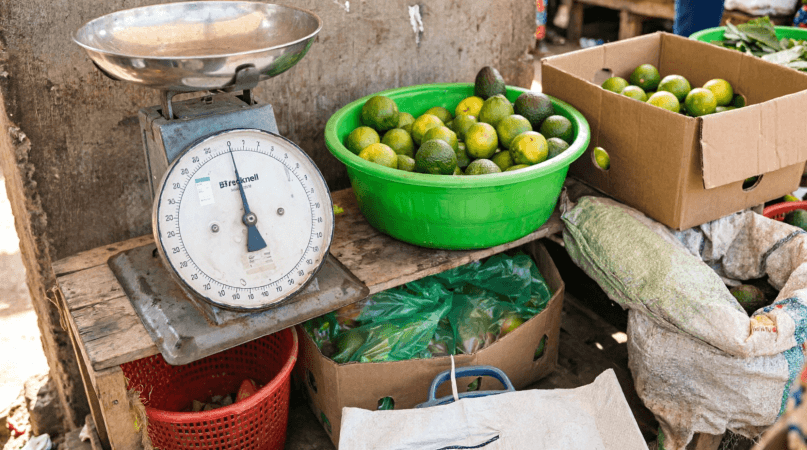
So I got to Kimironko Market, Kimironko Isoko. This is a big market. The kind of place that swallows you whole, in the best way. There are different sections for fruit, fabric, fish, electronics, tailoring, second-hand clothes, cosmetics, and a whole corridor of handicrafts that travellers love. It’s free to wander, and prices run well below the supermarkets, but nothing is labelled like in a supermarket. You have to talk your way into pricing for everything.
I wanted to try East African mangoes, so I was on the hunt for fruit. I brought out the Nigerianness in me and negotiated like a Yoruba mother. The seller first gave me 500 RWF for two mangoes. The mangoes looked spoiled, and the price was suspicious. So I left her and went to another stall. The second vendor opened at 1,000, dropped to 800, and we finally shook on 700 RWF for a single ripe one. That is around 50 US cents. I bit into it on the corner, juice running down my wrist, and decided that alone was worth the trip.
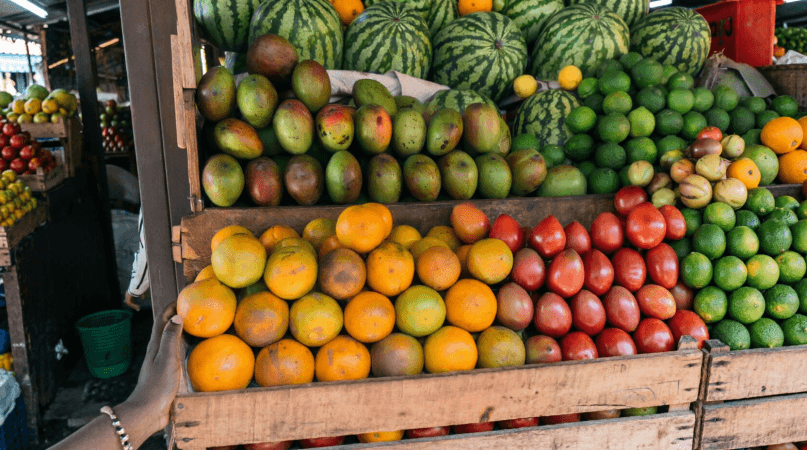
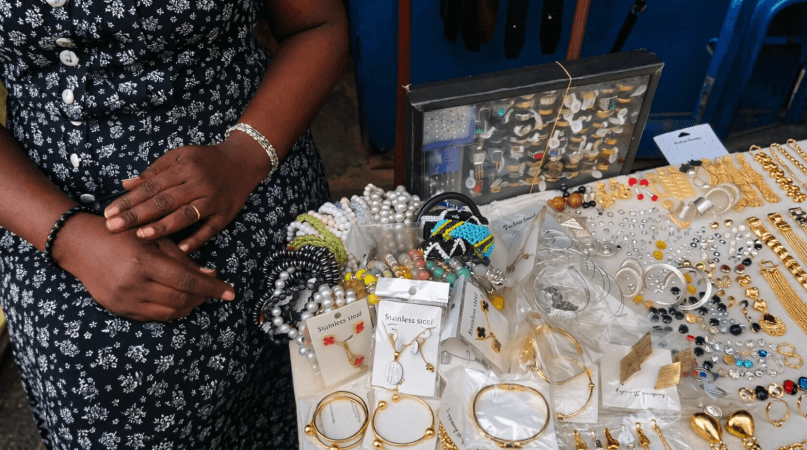
I bought souvenirs, vegetables and fruits.
A note on market etiquette: every seller here is expecting you to bargain. So they may start at a high price. So, for souvenirs, the locals’ rule of thumb is to open around 30–40% of the asking price and work up. For fruit and veg sold by the kilo, the wiggle room is smaller, but the kilo prices are already low, roughly 500–2,000 RWF per kilo for most produce.
Running total: 2,200 RWF spent · 11,800 left.
The Errand I Didn’t Plan: Printing for $0.14
And then I forgot to mention that the paperwork is the unglamorous reality of overland travel. I had a Ugandan visa approval letter and an invitation letter that needed hard copies before the border. Somewhere near the market, a tiny copy shop did the job at 100 RWF a page, so 200 RWF for two pages, about 14 US cents.
Running total: 2,400 RWF spent · 11,600 left.
Cost of Food in Kigali: Matooke and Fish for Lunch
By now, it was nearly 4 p.m. I was melting, and I hadn’t eaten properly. I asked around for food. There was no restaurant in the market. So I had to carry my belongings outside the market to find a restaurant. I tried their matooke, the steamed green banana that’s a staple of this whole region.
For the uninitiated, let me give you a Kigali food cheat sheet:
- Matooke: green bananas steamed (often in banana leaves) until soft and faintly sweet, like a firm mash.
- Isombe: cassava leaves pounded and cooked with groundnuts and palm oil; arguably Rwanda’s national dish.
- Ubugali (or ugali): a dense maize/cassava flour “swallow” eaten with stews.
- Brochettes: skewers of goat, beef or chicken grilled over charcoal, the city’s favourite street smell.
I over-ordered on principle. I wanted something local. After a hilarious back-and-forth about whether the fish should come “mixed” or “separated” with the matooke, I settled on white boiled fish with matooke and a water, for 5,000 RWF, about $3.40. That was the single biggest line item of the day, and it was a proper sit-down plate.

Running total: 7,400 RWF spent · ~6,600 left.
The Human Tax, and a Word in Kinyarwanda
There are two small things worth mentioning, because they are part of the spending.
First, we have to pay the “human tax”. That’s the small tip you give someone who helps you. For example, a guy near the bus park took me where I entered the first moto, and even helped me negotiate with the riders. I gave a 200 francs and told him “murakoze”.
Second, and I have to confess this with some embarrassment, I spent the entire day butchering the single most useful Kinyarwanda word. Murakoze means thank you. Murakaza (as in murakaza neza) means welcome. I kept thanking people by welcoming them, and they kept gently correcting me, “murakoze, murakoze”. And for the better part of four days before it finally stuck. If you learn one phrase, learn that one, and learn it properly. Rwandans are warm, patient, and almost supernaturally polite, and they notice the effort.
So, What Did a $10 Kigali Travel Budget Actually Buy?
At the end of the day, this is the full reckoning, at roughly 1,400 RWF to the dollar on the street:
| What I bought | Cost (RWF) | Cost (USD) |
|---|---|---|
| Moto across town (Nyabugogo → Kimironko) | 1,500 | ~$1.05 |
| Samosa | 200 | ~$0.14 |
| 2 earrings and one chain | 2,000 | ~$1.40 |
| One ripe mango at the market | 700 | ~$0.50 |
| Printing 2 pages (visa + invite) | 200 | ~$0.14 |
| Sit-down lunch: fish + matooke + water | 5,000 | ~$3.40 |
| Small tip for a helpful local | ~300 | ~$0.20 |
| Total spent | ~9,900 | ~$6.85 |
I’d burned through only about seven of my ten dollars, and I hadn’t been frugal. I’d taken a long moto, eaten a real restaurant meal, bought fruit, run my errands, and thanked a stranger. With the remaining ~4,000 RWF, I could comfortably have added a few brochettes (a couple of hundred francs each at a roadside grill), another round of market fruit, a fresh juice, and as I’d half-planned, a quick pedicure or nail paint at one of the market’s beauty stalls before the evening bus.
In other words, $10 in Kigali in 2026 buys you a genuinely full afternoon. You can get cross-city transport, a market adventure, documents sorted, a proper local meal, snacks, and a little left over for self-care. Try doing that with a tenner in London or New York.
Budget Travel Rwanda: Things to Know Before You Try This
A reality check on the wider context, so you plan smart:
It’s safe. Kigali consistently ranks among the safest and cleanest capitals in Africa, with low street crime and a strong security presence. (Keep the usual big-city instincts after dark, of course.) The wider region does occasionally carry health advisories. There was a 2026 Ebola travel-warning episode touching Uganda and Rwanda, so check current guidance before you cross borders.
Book your beds in advance. Even on a strict $10 daytime budget, you need a safe place to crash. Agoda consistently has the best rates for Kigali’s budget guesthouses, hostels, and mid-range hotels compared to other Western booking platforms.
Mind the plastic ban. Rwanda has banned plastic bags since 2008, and they mean it. Your luggage can be checked at the airport, and bags are confiscated. Pack in reusable pouches. It’s also a big part of why Kigali looks so immaculate.
Carry small notes. Motos, market vendors and copy shops run on cash, and change for a 5,000 RWF note isn’t always there. Hoard your 500s and 1,000s.
Sort your connectivity early. Skip the airport SIM roulette. An eSIM gets you data before you land. (I highly recommend grabbing a Yesim eSIM here and activating it before you even board the plane). That will help you navigate maps or even use Yego Moto. Also, you will have a data connection to translate.
Moving money across borders? If you’re stringing together several countries, think about how you’ll carry and convert funds before you’re standing at a border clutching cash. Our guide to moving money without the $10,000 cash-limit problem is a good place to start.
The Verdict: Is Kigali Expensive on a Budget?
The headline number people forget about Rwanda is the value, not the cost. Yes, you can drop serious money on a gorilla permit or a hilltop hotel, but at street level, Kigali is one of the most generous cities on the continent for a traveller on a tight wallet. Ten dollars may not be much but it can do a lot in the streets of Rwanda.
By 7 p.m. I was on that Kampala-bound bus out of Nyabugogo, a little sunburnt, full of fish and matooke, my bag mercifully lighter of paperwork, already plotting what I’d do with the next ten.
Because if this is what a single note buys in Kigali, imagine what a real Kigali travel budget could do.
Frequently Asked Questions About a Kigali Travel Budget
How much money do I need per day in Kigali?
A comfortable Kigali travel budget for a backpacker sits around $15–$25 per day, covering moto transport, two local meals, market snacks, and small errands. You can survive on less if you stick to street food and walk, but $20 keeps you comfortable.
Is Kigali expensive compared to other East African capitals?
No. Kigali prices for food, transport, and accommodation are generally lower than Nairobi or Kampala for equivalent quality. A sit-down local meal costs $2–$4, and a cross-town moto is around $1.
Can I get by on $10 a day in Kigali?
Yes, tightly. As this article shows, $10 covers transport, a market visit, a full lunch, printing, and still leaves change. You would need to skip alcohol, taxis, and restaurant-grade dinners, but the Kigali travel budget at $10 is genuinely workable.
What is the cheapest way to get around Kigali?
Moto taxis (motorcycle taxis) are the cheapest motorised option, starting at around 500 RWF (~$0.35) for short hops. The Yego Moto app meters fares transparently. Walking is free and Kigali is very walkable in the centre.
Do I need cash or can I pay by card in Kigali?
Carry cash. Motos, market stalls, and small restaurants operate in Rwandan francs only. ATMs are available in the city centre, and some larger restaurants accept cards, but for a true budget travel Rwanda experience, small notes are king.
Travelling through Africa on an African passport, or just curious where you can go visa-free next? Check our 2026 guide to visa-free countries for Africans, and keep following Travel Radio Live for more boots-on-the-ground stories from across the continent.