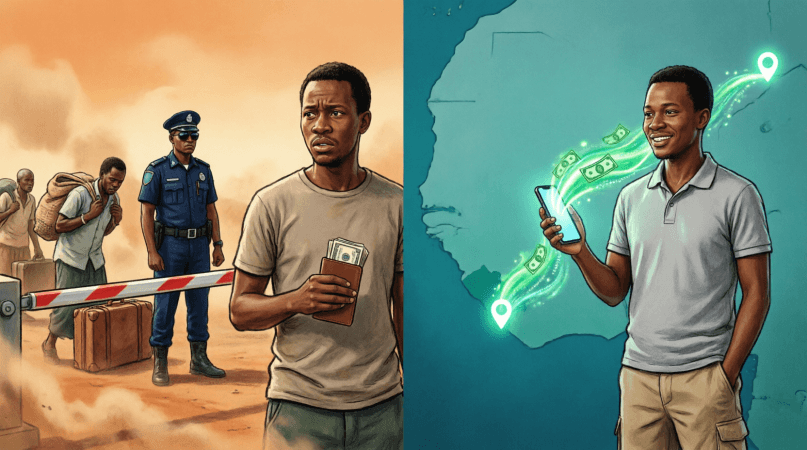
If you’ve ever crossed Seme with cash strapped to your body, you already know the drill. ECOWAS says there is free movement, but the guys at the border say something else. That’s why we must deal with this issue of cross-border payment West Africa.
I learned this the hard way last year. I was heading from Lagos to Accra to pay a supplier for a small shea butter order, about $3,500. My guy said, “Just bring dollars, we go change am for Accra, rates better.” So I folded the cash inside my passport holder like I was in a Nollywood scene.
By the time I got from Badagry to Seme, I had already been stopped 8 times. By the time I actually crossed into Benin, my “duty-free” movement under ECOWAS had cost me almost ₦25,000 in “Oga, anything for us?” fees. And that was with only $3,500. Imagine if I was carrying more.
The $10,000 Cash Declaration Rule: What Does the ECOWAS Free Movement Actually Mean?
Under the ECOWAS Protocol on Free Movement, you as an ECOWAS citizen can enter any member state visa-free for 90 days with just your passport and yellow card. However, that doesn’t mean free movement of unlimited cash. At all.
Almost every country uses the famous $10,000 rule as a benchmark:
- USA, Canada, Nigeria, Ghana: You must declare if you’re carrying $10,000 or more (or equivalent)
- EU: €10,000 or more
- WAEMU / UEMOA zone (Benin, Togo, Ivory Coast, Senegal etc): CFA 10,000,000 (about $16,000) if you’re a WAEMU resident, but only CFA 500,000 in foreign currency, roughly $800, before you must declare.
- Ivory Coast as of Feb 2026: They’ve gone fully digital. You must declare via SYDEF (Border Cash Declaration System) before you reach customs.
And what counts as “cash” is not just dollars. It’s CFA, Naira, Cedis, traveller’s cheques, money orders, even signed blank cheques.
The law says that you can carry any amount, but you MUST declare above the threshold. If you don’t declare, they can seize everything.
If you think this is theory, read what happened at the Nigeria-Benin Border Chaos that ECOWAS itself called out. President of the ECOWAS Commission Dr. Omar Alieu Touray visited Seme and called the mismanagement “unacceptable”. There were millions in scanners and biometric gates sitting idle while 30+ unofficial checkpoints collect cash. One driver in that report said it perfectly: “Each one wants a cut. No receipt, no accountability. Just bribes.”
Why Carrying Physical Cash Makes You a Walking ATM at West African Borders
I spoke to Joseph, who shuttles Ankara fabrics between Lagos and Lomé every two weeks. He told me he stopped carrying more than $2,000 cash after one trip where Benin customs asked for proof of where his dollars came from, then “helped him keep it safe” for 15%.
This is the extortion loop:
- You carry dollars because you think forex is better across the border.
- You don’t declare because you don’t want to pay duty or you don’t know about SYDEF.
- An officer finds it. Now you’re either smuggling or money laundering until you pay to prove otherwise.
- You pay “facilitation”, and your profit margin disappears.
It gets worse if you’re carrying commercial goods too. ECOWAS allows duty-free personal effects, but if you have 100 pieces of Brazilian hair or 50 sneakers, agents will classify you as a commercial trader. Now you have to pay both cash declaration and import duty on the spot.
This is exactly why so many tour operators now avoid Seme completely for diaspora travellers doing heritage trips, as covered in Travel Radio’s piece on Safest African Countries for Black Solo Travellers. If your first contact with West Africa is a shakedown, you lose the trust forever.
Cross Border Payment West Africa: 3 Methods That Actually Work in 2026
After that $3,500 lesson, I tested everything. Let me explain what actually works in 2026 for cross border payment West Africa:
PAPSS – The Cross-Border Payment West Africa Game Changer Nobody Talks About
PAPSS, the Pan-African Payment and Settlement System, launched in January 2022 by Afreximbank and the AfCFTA Secretariat. Honestly, it’s the first time Africa’s financial system started acting like one continent before our roads do.
For decades, if I in Ghana wanted to pay someone in Nigeria, my Cedis had to become dollars first, then become Naira. It would take two conversions, three days, and at least $40 in fees.
However, with PAPSS, it doesn’t have to be that way.
- You send instructions to your local bank app: “Pay ₵50,000 to this Nigerian account”
- Your bank pings your Central Bank, which pings PAPSS
- PAPSS validates, converts at a transparent rate, and pings the beneficiary’s Central Bank
- The seller in Nigeria gets Naira in their account, often in under 2 minutes.
You don’t need to convert anything. No forex mallam at the border needed.
As of early 2026, PAPSS connects more than 160 commercial banks across 15-20 countries including Nigeria, Ghana, Kenya, Zambia, Liberia, Gambia, Guinea, Djibouti, Morocco, Rwanda and more. Banks like Access Bank, Ecobank, Zenith Bank, UBA, Stanbic, and GCB Bank are all live. You can access it via your bank branch, mobile app or online banking. Just look for “PAPSS” or “African cross-border payment” in the menu.
I used it last month to pay a hair supplier in Lagos from my Ghana bank. She got the alert while we were still on WhatsApp. I paid less than $2 in fees. No border drama.
The Digital Nomad Stack: Chipper Cash, Eversend & Grey
PAPSS is perfect for business-to-business. For person-to-person, especially if you’re a trader living between markets, use the fintechs that already run on similar cross-border payment West Africa rails.
Chipper Cash: My go-to for Ghana-Nigeria-Uganda-Rwanda moves. Free transfers between African countries, arrives in minutes, and you get a USD virtual card. Business accounts are live in Nigeria and Ghana officially, personal in 21+ countries. Perfect if you sell on IG and need to receive from Ghanaian customers fast. If you’re weighing bases like in Kigali vs Nairobi for Digital Nomads, these apps are literally how nomads survive paying rent across borders.
Eversend: Bigger flex if you need multi-currency. You can hold USD, EUR, GBP, KES, NGN, GHS in one wallet and convert at 0.9%. You can send to mobile money or bank. They give you USD/EUR virtual accounts, which is useful if you’re also getting paid from the US while trading in West Africa.
Grey/Geegpay: This platform is perfect for those school fees or supplier payments that require a proper foreign account. It is less ideal for Trader-to-Trader. Are you looking for proof-of-funds faking? Don’t. If you’re reading this and also planning Japa, check Travel Radio’s guide on Proof of Funds for UK Visa & Schengen and How to Explain a Large Deposit in Bank Statement for Visa. ECOWAS border agents aren’t the only ones who scrutinise suspicious bulk cash.
Pro tip: Never exchange large amounts at the border bureaus in Seme or Aflao. Rates are theatrical. Do Chipper or PAPSS to your local currency wallet, then withdraw locally.
Old School but Smarter: Cash Declaration Rules If You Must Travel With Notes
If you must carry cash (say, emergency funds for a road trip on the new Lagos-Abidjan $15.6B Highway):
- Keep it under $9,500 total equivalent to avoid mandatory declaration and split between parties if you’re travelling as family (family threshold is shared!).
- Have receipts. Bank withdrawal slip, Bureau de Change receipt, business invoice. If you can justify it, they can’t seize it.
- Declare anyway on SYDEF for Ivory Coast entry, and verbally for Nigeria/Ghana. Honest declaration rarely gets you extorted. Hidden cash always does.
- Carry in mixed denominations and two places. Not hidden in your shoe like a drug lord, unless you want to trigger searches.
Your Cross Border Payment West Africa Playbook: Lagos to Accra
This is what I tell every first-time trader DMing me on Instagram now:
- Before you travel: Ask your supplier: “Do you have bank account that receives PAPSS?” If yes, pay from your home bank. Done.
- If they insist on cash/cash-like: Send via Chipper Cash to their phone number. Let them cash out locally. Record the transaction ID.
- If you must travel with goods + money: Keep your goods list printed with values (for ETLS duty-free if within allowance), and your cash under $10k declared. Check the current Visa-Free Destinations for Nigerian Passport Holders rules because free movement doesn’t mean free commercial import.
- Never: Carry $10k crisp wrapped rubber-banded on the Lagos-Seme night bus. You’re advertising.
The Bottom Line: Move Your Money, Not Your Risk
A few years ago, we thought African integration would be measured by how many trucks crossed borders. Today, integration is already happening – but in the bank app, not at the border post. PAPSS now moves money in local currencies within seconds through African financial infrastructure. The trucks are still waiting.
For us regular travellers, that’s actually good news. It means you don’t need to become a smuggler to be a trader.
The next time someone tells you to bring physical dollars across Seme, Elubo, or Paga, send them a PAPSS payment instead and use that ₦25k border “fee” to buy yourself jollof in Accra.
You’ll eat better, sleep better, and cross faster.
Frequently Asked Questions About Cross Border Payment West Africa
What is the cash limit for crossing West African borders?
Most ECOWAS countries enforce a $10,000 (or equivalent) declaration threshold. However, WAEMU/UEMOA nations (Benin, Togo, Ivory Coast, Senegal) require declaration of foreign currency above roughly $800 (CFA 500,000). You can carry any amount, but failing to declare above the limit risks full seizure.
What is PAPSS and how does it work for cross border payment West Africa?
PAPSS (Pan-African Payment and Settlement System) is an Afreximbank-backed platform that lets you send money between African countries in local currencies. Your bank routes the transaction through your Central Bank and PAPSS, and the recipient receives local currency, often in under 2 minutes.
Can I use PAPSS from my regular bank app?
Yes. As of 2026, over 160 commercial banks in 15–20 African countries support PAPSS. Look for “PAPSS” or “African cross-border payment” inside your bank’s mobile or online banking menu. Banks like Access Bank, Ecobank, Zenith, UBA, Stanbic, and GCB are live.
Is it legal to carry $5,000 cash from Nigeria to Benin?
Yes, provided you declare it at the border if the amount meets or exceeds the declaration threshold. For Nigeria and Benin, the general benchmark is $10,000, but WAEMU rules on foreign currency can be stricter. Always carry a bank withdrawal receipt or invoice to prove the source.
What is the cheapest way to send money from Ghana to Nigeria?
For business payments, PAPSS via your bank typically costs under $2 and settles in minutes. For personal transfers, Chipper Cash offers free or near-free transfers between Ghana and Nigeria with instant delivery.
Do I still need to declare cash if I use PAPSS or Chipper Cash?
No. Digital cross-border payment platforms like PAPSS and Chipper Cash move funds electronically through regulated banking channels, so no physical cash crosses the border and no customs declaration is required.
More Resources
- Safest African Countries for Black Solo Travellers (Ultimate 2026 Guide)
- Kigali vs Nairobi for Digital Nomads: Why Remote Workers Are Switching Cities in 2026
- Cost to Travel from Nigeria to Europe in 2026: Real Budget Breakdown