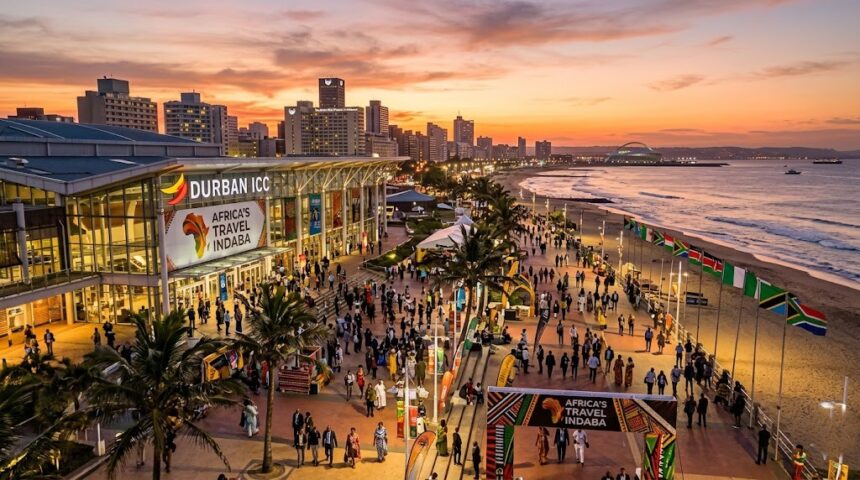
Africa’s Travel Indaba is back in Durban, and if the rest of the continent isn’t paying close attention, the continent’s richest tourism opportunity may continue to be a one-country conversation dressed up as a continental one.
The main announcement came from South Africa’s The Presidency.
There is a particular kind of gathering that the organisers call pan-African while doing most of its business in one city, in one country, and under one flag.
You’ve seen it at summits where the host nation’s ministers outnumber everyone else three to one. They do it at trade fairs where the booths are mostly local, the buyers are mostly foreign, and they don’t even care to invite the neighbours, or they’re mostly an afterthought.
Africa’s Travel Indaba, which opened in Durban on Tuesday with President Cyril Ramaphosa at the podium, is many things. It was ambitious, commercially serious, and well-organised.
Now, the claim is that it is for Africa. The question now is whether it is genuinely continental.
The theme this year is “Unlimited Africa: Growing Africa’s Tourism Economy.” The word unlimited is doing a great deal of work in that sentence.
What Is Africa’s Travel Indaba, Really?
Every May, Durban’s Inkosi Albert Luthuli International Convention Centre becomes the largest tourism trade gathering on the African continent. Buyers fly in from Europe, Asia, and the Americas. It is, in our opinion, one of the biggest tourism trade fairs in Africa.
South African tourism boards, lodge operators, safari companies, airlines, and hospitality groups line the halls. International tour operators and travel agents come to build packages, negotiate rates, and fill their brochures with Africa. The event runs for three days and generates numbers that get quoted in press releases for months. For instance, last year’s edition produced R246.8 million in direct expenditure and R610.6 million in GDP contribution, with hotel occupancy hitting 97% across Durban.
By any commercial measure, it works. At least, it works for South Africa.
The Host Advantage: Why One Nation Dominates the Floor
Like I said, this is an effective event for the nation. South Africa’s tourism sector employed 953,981 people directly by 2024, contributed 4.9% to GDP, above the pre-pandemic figure of 3.7%, and now sustains roughly 1.8 million jobs when indirect employment is counted. These are numbers any African government would want. Ramaphosa arrived at the Indaba with those figures in his brief, and he had every reason to speak of them.
But the event’s own mandate, as stated on the invitation, is to grow and develop tourism on the continent. Like, the main selling point is to develop the entirety of Africa. I don’t know if you were there, or you watched it on TV.
If you walk the floor of the air, or ask how much of the floor space belongs to Zambia, Rwanda, Senegal, or Ghana, or even Nigeria. Ask how many tour operators from Nairobi or Accra are selling to the European buyers in the same room.
The Indaba provides what it calls an opportunity for buyers to purchase tourism products from “South Africa and across the continent.” I guess they picked the second word of their name to make it look like they are referring to the rest of us.
The Structural Reality of an African Tourism Trade Fair
This is not an accusation. We are only stating a structural fact about how some of these trade events work. The host absorbs most of the commercial oxygen, especially when the host has the infrastructure, the marketing budget, and the President opening the morning session.
South Africa earned this position, no doubt. Their national parks are extraordinary. Have you been to their coast? They have awesome facilities. Their wine country, urban food scenes, and guided wilderness are genuinely competitive on a world stage. No one challenges Durban. We can all see the receipts.
The question for the rest of Africa is whether showing up to someone else’s trade fair is a strategy or a placeholder.
Consider what a traveller from Paris or Seoul will encounter at the Indaba. When you come, you will find South Africa front and centre. You may find a handful of East African safaris in the adjacent aisle, or a scatter of West and Central African experiences, but you will need a specialist to find them.
The Indaba markets Africa, but not evenly. Not with the same depth, and not with the same conversion rates on the floor. Countries that cannot afford a serious stand, a capable English-speaking sales team, or a government-backed marketing budget will leave the event with only brochure or flier exposure and little else.
The “Leaking Value” Argument vs. Shared Decision-Making
Now, some people might have some things to say about my position on this matter. For example, they may say that the Indaba exists at all because South Africa built the infrastructure to host it. They own the convention centre, the hotel stock, the airport connections, and overall, the political will. No other African city has put its hand up to take the burden on. Kigali might be able to join in, eventually. Nairobi also has the aviation connections. But neither has tried. Until they do, Durban hosts, and the continent benefits from having a single serious trade platform rather than none.
And someone may also bring up the multiplier argument that when a buyer walks into the venue and books a South African tour, the itinerary frequently includes Zimbabwe, Botswana, Mozambique, or Lesotho. Well, truly, the southern African tourism circuit is genuinely interconnected. Rand spent in Cape Town often touches Zambian Victoria Falls guides, Swazi crafts, and Zimbabwean national park fees. The platform is not hermetically South African; it leaks value across borders.
But “leaking value” is not the same as sharing the table. The countries that receive tourist overflow from South Africa’s marketing machine are price-takers in a conversation they did not set. They did not negotiate the tour package. They may not even know anything about the buyer. All they got was the booking as an add-on, and they will be dropped from the itinerary the moment the rand strengthens or a South African operator decides to build his own lodge near Victoria Falls.
What an “Unlimited Africa” Actually Looks Like
As a traveller, when you book an “African safari” through a European operator who came to Durban and bought a package off a South African wholesaler, you are getting a version of the continent filtered through one country’s commercial infrastructure. The guide who speaks your language, the lodge aesthetic you sleep in, and the conservation narrative you’re sold were shaped in Durban, not Dakar, not Dar es Salaam, not Douala.
That’s not nothing. South Africa’s hospitality industry is skilled, its guides are often excellent, their conservation model, whatever its contradictions, has produced functioning ecosystems at scale. But it is a partial picture of a continent sold as a whole one.
The Africa’s Travel Indaba’s theme asks for an unlimited Africa. That is worth holding to account.An unlimited Africa would mean Nigeria’s extraordinary cultural tourism like Osun-Osogbo, the Badagry slave route, Benin’s bronzes in their newly reclaimed home, getting the same floor time as the Kruger. It would mean a Senegalese fishing village experience receiving the same buyer attention as a Western Cape wine estate. It would mean the Democratic Republic of Congo’s Virunga, with its impossible mountain gorillas and its improbable resilience, being sold from the same room, with the same professional support, at the same volume.
None of that will happen this week in Durban. It may not happen next year either.
How to Turn the Africa’s Travel Indaba Into a Truly Continental Platform
What Africa’s Travel Indaba could actually push is a funded fellowship programme for smaller African tourism operators to attend and exhibit at reduced cost. Maybe a buyer education programme that specifically builds itineraries crossing multiple African borders. Or a dedicated floor section for under-represented tourism destinations with marketing support built in. These would be structural changes, not branding ones.
The Africa’s Travel Indaba is not the problem. It is, in fact, evidence that African tourism can organise itself commercially and attract serious global buyers. That capability exists. The problem is that it exists in one city, under one government’s stewardship, and the rest of the continent flies in as guests.
Ramaphosa opened the event on a Tuesday morning and spoke of growing Africa’s tourism economy. He is not wrong to want that. But there is a difference between South Africa growing its tourism economy and Africa growing one. Right now, only one of those things is happening with conviction.
The rest of the continent should be glad the party exists. It should also be asking, loudly and persistently, when it gets to co-host.
What’s one African destination that the global travel market consistently overlooks and what would it take for buyers to actually book it?
Filed from the travelradio.live desk, May 2026.