Nigerian journalist Rufai Oseni was first to frame the debate around the Nigeria UK deportation deal March 2026.
“Nigeria will be taking in failed asylum seekers that are Nigerians for the new immigration deal.”
Additionally, Oseni outlined six criticisms driving public anger.
First, the deal is a one-way street, the UK gains a streamlined deportation mechanism while Nigerians gain no reciprocal visa easing.
Second, Nigeria’s acceptance of UK Letters to identify deportees without passports raises sovereignty concerns.
Third, the deal was signed alongside a £746 million ports package, creating the perception of a cash-for-migrants arrangement.
Fourth, critics find it hypocritical that the UK recruits Nigerian doctors and nurses through the Japa wave while fast-tracking removal of those it deems burdensome.
Fifth, the agreement targets 961 failed asylum seekers from regions where Nigeria’s security situation may make returns unsafe.
Sixth, returning over 1,110 foreign national offenders simultaneously strains Nigeria’s security and welfare systems.
1. Asymmetry of Power The deal is viewed as a "one-way street." While the UK gains a streamlined mechanism to deport thousands of Nigerians (including those without passports), there is no reciprocal easing of visa restrictions for ordinary Nigerians. Critics argue this mirrors…
Public reaction on X to the Nigeria UK deportation deal March 2026 was immediate and divided.
Femi Mohammed said: “Publish the agreement; let Nigerians have access to the rubbish you signed on their behalf.”
Harrison Iyere wrote: “While leaders of strong nations strike economic deals, ours show up with stories of failed asylum claims and deportations.”
Additionally, John Okpoie drew a sharp comparison with the abandoned UK-Rwanda scheme: “The Rwanda shenanigans of Cruel Britain has finally been buried and they have turned to their ZOO and given them the exact same task.”
Oluwasegun Funmi asked: “Just to be sure — when they say foreign criminals, does that mean Nigerians only?”
Meanwhile, Ade Ademola took a more measured view: “Better late than ever — the clarification was essential.”
What the Nigerian Government Said
The Presidency moved swiftly to contain the mixed reaction around the Nigeria UK deportation deal.
Temitope Ajayi, Senior Special Assistant to the President on Media and Publicity, said:
“For clarity, the agreement only relates to Nigerians who do not have legal status to live and remain in the UK. Nigerian government is not taking back non-Nigerians.”
For clarity it is important to state that the agreement signed by the Minister of Interior, Olubunmi Tunji-Ojo during the State Visit of President Tinubu on behalf of the government of Nigeria and Home Secretary, Rt Hon Shabana Mahmood on behalf of the UK government only relates… pic.twitter.com/tS4s5E2OOV
Presidential Special Assistant Dada Olusegun said:
“Nigeria has over a thousand of its citizens whose stay in the UK has either expired or were awaiting deportation. These are our brothers and sisters who are no more wanted over there home is the next destination.”
As usual, I will be disappointed if our brothers from the other side do not attempt to clutch at straws with some misinformation, following the successful outing of President Bola Ahmed Tinubu in the United Kingdom.
“The agreement guarantees that returnees will be treated with dignity, rights retention under domestic law, and may re-enter in the future if they meet applicable immigration requirements.”
The Ministry of Interior (@MinOfInteriorNG) says the migration agreement signed between Nigeria and the United Kingdom is to ensure the dignified return of Nigerians without legal status in the UK. The pact, signed by Interior Minister Olubunmi Tunji-Ojo @BTOofficial and UK Home… pic.twitter.com/wvubACLAhW
First, secured travel documentation covers all returnees; including UK Letters where passports are unavailable.
Second, case-by-case identity verification applies to every individual before removal.
Third, safeguards for vulnerable individuals and potential trafficking victims are explicitly written into the framework.
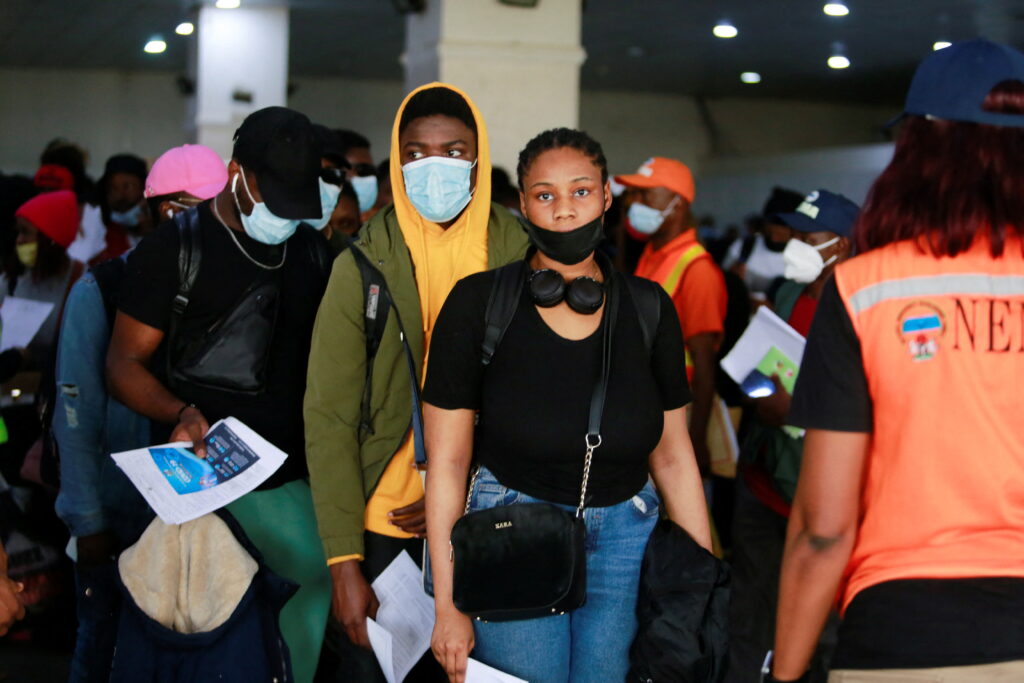
Nigerian students arrive at the Nnamdi Azikiwe International Airport from Ukraine after fleeing the invasion by Russia, in Abuja, Nigeria March 4, 2022. REUTERS/Afolabi Sotunde
Fourth, detailed information-sharing between UK and Nigerian border agencies will be established.
Fifth, joint research on migration management and border security will be conducted by both governments.
Therefore, the Nigeria UK deportation deal March 2026 is a managed returns framework, not a mass deportation conveyor belt.
Summary — What Nigeria’s UK Deportation Deal Means for Nigerians
The Nigeria UK deportation deal March 2026 is narrow in legal scope but enormous in political symbolism.
Furthermore, it affects only Nigerian citizenswithout legal status in the UK covering failed asylum seekers and foreign national offenders.
It does not cover non-Nigerians, does not ease visa restrictions for ordinary Nigerians, and does not compel Nigeria to accept deportees from third countries.
However, critics raise legitimate questions about sovereignty, the use of UK Letters, the timing alongside a £746 million infrastructure deal, and the human rights implications for returnees from conflict zones.
Therefore, the Nigeria UK deportation deal March 2026 leaves one fundamental question unanswered: whether a stronger Nigeria could have negotiated better terms.