A state with no airport seven years ago just flew 345 people to Saudi Arabia. Is Gateway International Airport cooking something in Ogun State? What does this mean for you in Africa?
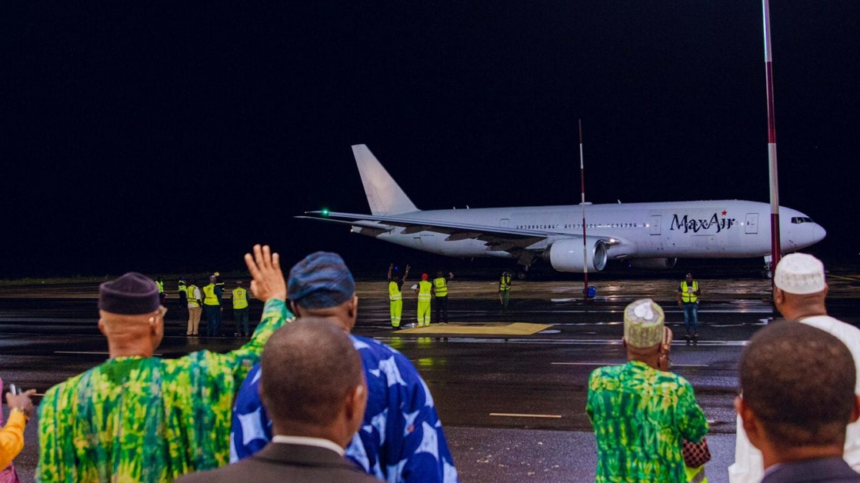
It was in the night on Sunday 3rd of May 2026 in Iperu, Ogun State. A Max Air wide-body plane lifts-off 345 people bound for King Abdulaziz International Airport in Jeddah. This is the first international departure from Ogun State and it was a silent event. What impact will this have on Nigeria’s aviation?
It is true that if not for this news covered by TheCable, showing photos of MaxAir plane in the terminal, even I did not know what Gateway Airport was cooking. And most travellers outside southwest Nigeria may not even know of those places like Iperu or Ogun, or even Gateway Airport. They don’t appear in airline codes on Skyscanner. They didn’t exist in any aviation conversation five years ago. But that gap between what a place is and what it is about to become is exactly where the interesting travel story lives.
The Quiet Takeoff From Iperu
There’s a habit among travel writers, and among travellers themselves. People only pay attention to airports once they’re already famous. See, for instance, we track Changi’s latest terminal and mourn the closure of a beloved gate at JFK. There is a debate on which lounge serves the best noodles at Narita. And the airport, in this news, is already a destination, already embedded in the mental map of the world.
When news of the first international flight from Ogun State made headlines, the usual travel circuits barely blinked.
Our thoughts at Travel Radio is about the gap between what a place is and what it’s becoming. That is where the real editorial tension lives. You don’t wait for an airport to trend; you notice it when it clears its first wide-body.
How Gateway International Airport Ogun State Changed the Map
The terminal wasn’t on anyone’s radar. The land it now occupies was, by Governor Dapo Abiodun’s own account, a forest that became a dump site. Former governors had conceived of an airport here for nearly two decades but none of them had built one.
When construction began in 2021, residents and commentators called it political theatre. But then, a runway appeared in February 2023.
By October 2025, ValueJet was flying Ogun residents to Abuja in a Bombardier CRJ-900, and passengers no longer had to battle Lagos traffic to board a flight.
Seven months later, an international charter departed. Iperu Airport, Nigeria, had quietly crossed a threshold most infrastructure projects never reach. It went from promise to pavement to payload.
Reclaiming Time: The Real Win for Local Travellers
Before that Sunday night, most of the local travellers would have been planning a first trip to Lagos or Abuja. But now, they experienced something flying as a genuinely local thing.
Residents of Abeokuta, Sagamu, and the towns flanking the Lagos-Ibadan Expressway, do not need to spend two to three hours in Lagos gridlock before ever seeing a boarding gate. Now, they can arrive at the terminal in twenty minutes.
One of my fondest interviews was of one Mr. Adedotun Idowu, a passenger on the inaugural commercial flight. He said it plainly to Vanguard, “I live in Abeokuta; this airport would now save me the stress and time of going to Ikeja to travel to Abuja.”
That sentence should travel further than it has. It contains the thing most aviation expansion rhetoric misses. I mean the relief the local folks are having is not about prestige, but about reclaiming time. It’s about a person who used to factor an entire day into a domestic trip, now factoring in an hour.
Beyond the “Ghost Terminal” Narrative in African Aviation
The story of Nigerian aviation infrastructure travel has, for a long time, been told through the lens of failure. The airport’s infrastructure that was announced but never built. Expansion plans that were abandoned mid-construction and the ghost terminals of continent-wide ambition.
Actually, it is not like this narrative was invented to slander the country. But it could be that they went to actually do something because of the consistent application of that lens.
The Nigerian Civil Aviation Authority, which certified the facility under current regulatory standards, reportedly praised it as a model operation. That assessment, coming from regulators with no political incentive to complement a state government, matters.
Wide-body clearance is not a formality. It means the runway geometry, the navigation aids, the ground handling capabilities, and the safety systems all passed scrutiny for aircraft larger than the regional jets that opened domestic routes. In modern African aviation, that is harder than it looks, and rarer than the press releases suggest.
The Road Ahead: Infrastructure, Reality, and Regular Service
To be fair, the flight that departed on Sunday was a Hajj charter. It was not a scheduled international service. Max Air was the operator. Hajj charters follow their own logistics, regulatory pathways, and separate demand patterns.
The pilgrims who boarded at Iperu were travelling for a specific religious obligation, and not on a leisure itinerary. When they return, the international route ends, for now.
Some residents who responded to the airport’s launch in October noted that crumbling roads around Ogun State could make consistent access difficult. That is a valid concern. An airport is not a closed system. It is supposed to draw from the infrastructure around it. If the approach roads collapse, passenger numbers will too.
So the work is not done. The significance of Sunday’s departure does not erase the friction that could ground the ambition before it matures into regular service.
Why the Next Chapter of Nigerian Travel Starts Here
But even if there is still much to be done, we cannot unsee the fact that a state that was told it was hallucinating an airport flew 345 people internationally from that very runway.
Every place you have ever landed at was, at some point, a cleared field with an uncertain future. Whether Lagos, Nairobi, Dubai, or Singapore, all of them began as the kind of infrastructure someone dismissed as premature, mislocated, or politically motivated.
The travellers who shape the next chapter of this airport are not the ones who arrive when the lounge is famous. They’re the ones who notice what’s happening before the lounge exists.
Gateway International Airport is located in Iperu-Ilishan, Ikenne Local Government Area, Ogun State, Nigeria. Domestic flights to Abuja operate via ValueJet. International charter operations, including Hajj services, commenced in May 2026.
travelradio.live will continue tracking Gateway International Airport’s development.