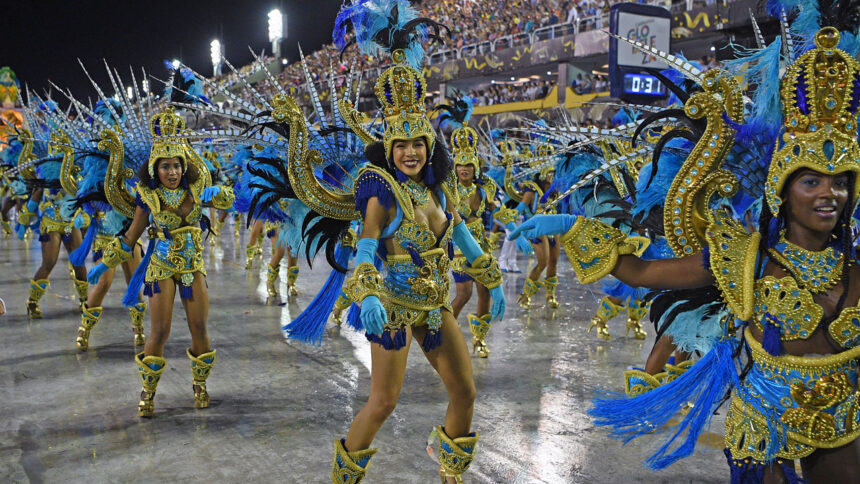
When Paraíso do Tuiuti opened the third and final night of the Special Group parades at Rio de Janeiro’s iconic Sambadrome on February 17, 2026, it did so carrying the weight and the glory of an entire civilisation.
Under the blazing lights of the Marquês de Sapucaí avenue, the blue-and-yellow school from São Cristóvão unveiled “Lonã Ifá Lukumí,” a sweeping, spiritually charged tribute to Yoruba culture that transformed Brazil’s greatest stage into a sacred space honouring one of the world’s oldest living religious traditions.
The theme traces the journey of Ifá, the Yoruba oracle system governed by the deity Orunmilá, from the cosmology of creation in West Africa, across the Atlantic through the brutality of slavery, and into its flowering as the Lucumí tradition in Cuba and, ultimately, Brazil. Carnival designer Jack Vasconcelos, speaking ahead of the parade, framed the entire narrative through the Yoruba concept of destiny:
“He [Orunmilá] is the lord of destiny. He knows our past, our present and our future. He is the witness of the creation of all things and all people,” Vasconcelos told Correio da Manhã.
The title itself is a theological statement: Lonã refers to connections and pathways between humans and divinities; Lukumí identifies the Yoruba descendants enslaved in Cuba; while Ifá represents a system of religiosity that:
unites spirituality and rationality, philosophy and technical knowledge,” as described by scholar Nei Lopes, whose book Ifá Lucumí: o resgate da tradição inspired the entire enredo.
The parade transformed the avenue into a place of reverence. Imagery, costumes, and choreography made visible how Ifá traversed different civilisations, survived the African diaspora, and took root in new territories without losing its core.
The opening float depicted the Yoruba creation of the universe while subsequent sections honoured the Orixás: Orunmilá, Eleguá, Ogum, and Olokun whose names rang across the Sambadrome in the school’s samba-enredo, widely praised as one of the best compositions of Carnival 2026.
Highlights
The highlights included the baianas section representing the vital force of Ashé, and a float depicting the arrival of Ifá in Ancient Egypt, drawing a direct civilisational line from ancient Africa to the modern Americas. Costumes favoured Afro-diasporic references, with a striking opening in white and silver evoking symbolic elements associated with the Orixás.
The samba-enredo, considered one of the best of Carnival 2026, was executed with perfect integration between the sound car led by Pixulé and the percussion battery of master Marcão. The performance drew a thunderous response from the audience and critics alike.
Cultural historian Luiz Antonio Simas, co-author of the samba lyrics, told Agência Brasil he joined the partnership because:
“The theme interested me,” reflecting the intellectual seriousness with which Tuiuti approached its Yoruba homage.
The parade not only celebrated a specific tradition but also highlighted the Atlantic flows connecting Africa, Cuba, and Brazil, reaffirming carnival as a space of memory, cultural circulation, and diasporic reunion.
In a Carnival increasingly reclaiming its African roots, Paraíso do Tuiuti’s Lonã Ifá Lukumí stood apart, not as spectacle, but as scholarship in sequins and samba, reminding the world that Yoruba civilisation did not perish in the Middle Passage. It endured. It transformed. And on February 17, 2026, it danced.