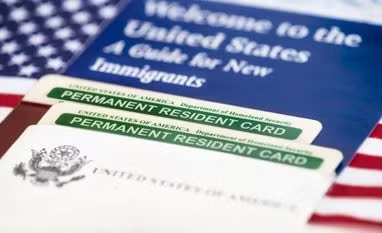
The United States has taken decisive steps to revoke the lawful permanent resident (green card) status of several Iranian nationals linked to the Iranian regime through family ties and alleged propaganda connections.
Marco Rubio ordered the action, which resulted in arrests by U.S. Immigration and Customs Enforcement (ICE) and the initiation of removal proceedings.
The most prominent case involves Seyed Eissa Hashemi, his wife Maryam Tahmasebi, and their son.
The family entered the United States in 2014 on visas issued during the Barack Obama administration and obtained green cards in 2016 through the Diversity Immigrant Visa Program.
Their residency status was terminated this week, resulting in their immediate arrest by federal agents.
Eissa Hashemi is the son of Masoumeh Ebtekar, widely known as “Screaming Mary”.
She served as a lead spokesperson for the militants during the Iran hostage crisis, in which 52 Americans were held for 444 days.
Ebtekar later rose to senior positions within the Iranian government, including vice president.
Last week, U.S. authorities revoked the green cards of Hamideh Afshar Soleimani and her daughter, relatives of Qasem Soleimani.
READ ALSO: Niece of Iran’s Soleimani arrested after U.S. green card revocation
They were arrested in Los Angeles last week and remain in ICE custody.
In a separate case, the residency status of Fatemeh Ardeshir-Larijani, daughter of senior Iranian official Ali Larijani, and her husband Seyed Kalantar Motamedi was also terminated.
Both individuals are no longer in the United States and have been barred from future entry.
National Security
The Trump administration has maintained that the United States should not serve as a safe haven for individuals connected to regimes considered hostile to American interests.
The State Department said the actions were carried out in coordination with the Department of Homeland Security and ICE, thanking partner agencies for efforts aimed at safeguarding national security.
Global Travel
While the measures specifically target individuals with documented regime ties, they highlight a broader global shift: national security is increasingly shaping immigration and travel policies.
For legitimate travellers, including Nigerians and others across West Africa, the development reinforces the importance of proper documentation, transparency, and compliance with immigration laws.
Clean records and lawful mobility are becoming central to maintaining access to international travel opportunities.
Lesson
Across Nigeria and the wider region, travel culture is evolving, from eco-conscious tourism along the Atlantic coast to heritage exploration in northern Nigeria and beyond. As this shift continues, stable and trusted travel systems are critical.
Policies that strengthen document integrity and border security can ultimately support smoother travel experiences while building confidence with international partners.