Nigerian tourism: The NTDA-OOU partnership puts Nigerian destinations on more screens. It does not yet put the country on more itineraries, and that is the work still ahead.
There is something quietly striking about an alumnus walking back onto his university campus decades after graduating and announcing that the same institution will help build a national tourism platform.
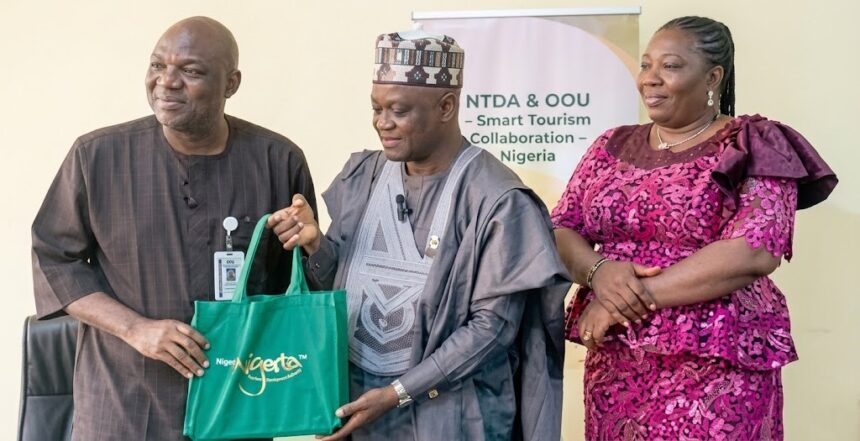
It is the kind of full-circle public-life story Nigeria does not give us often. The partnership announced this week between the Nigeria Tourism Development Authority and Olabisi Onabanjo University, anchored by NTDA Director-General Dr. Ola Awakan’s return to Ago-Iwoye, is welcome news for anyone who believes the country’s destinations deserve a global audience. It deserves applause. It also deserves perspective.
See the full gist here: NTDA and Olabisi Onabanjo University to Launch Smart Tourism Hub on Ago-Iwoye Campus
Let us be honest about what the Smart Tourism Hub is, and what it is not.
The Smart Tourism Hub: What It Solves for Nigerian Tourism
A campus-based hub paired with a national streaming platform showcasing Nigerian destinations is genuinely useful work. It addresses a real and well-known gap.
Most international travellers cannot picture Yankari, Erin Ijesha, the Sukur Cultural Landscape or the Idanre Hills with anything like the clarity they bring to Cape Town or Marrakech. Virtual access lowers the cost of curiosity. It puts the country on more screens, more syllabi, and more search results. And anchoring the hub inside a university rather than in a government office also gives students a reason to engage with tourism as a discipline, not just an industry that hires them after graduation.
That last point may be the most important one in the whole announcement. Nigeria’s tourism sector has long suffered from a thin talent pipeline. We have hospitality graduates. We have far fewer trained tour-operations specialists, destination marketers, heritage interpreters, travel-tech builders, sustainable-tourism analysts and accessibility consultants. Like these are the specialists who actually move a destination from “interesting” to “ready”.
If NTDA’s stated plan to develop tourism-focused curricula across universities is followed through with funding, accreditation and industry placement, the OOU hub could become a template rather than a one-off ribbon-cutting.
But the supply side is where the harder work lives.
The Hard Part: Infrastructure, Not Just Imagery
Streaming a destination is not the same as making it ready to be visited. Smart hubs do not pave the road to Obudu. They do not staff the boutique hotel that does not yet exist near Ogbunike Caves. They do not reduce the cost of a domestic flight from Lagos to Calabar, secure that route on the worst-case day, or train the guide who will meet a guest at the airport.
They do not, on their own, fix the perception problem that international travel insurers, embassies and corporate-travel risk teams have priced into Nigeria for two decades. A beautifully shot virtual tour of a destination that a foreign visitor cannot safely or affordably reach is a brochure for a holiday that has not yet been built.
The tourism economies that have actually transformed in the last generation like Rwanda, Morocco, Vietnam, Kenya, and even the UAE, did three things at the same time.
They invested in product (sites, hotels, transport, sanitation, safety). They invested in story (branding, content, partnerships, diaspora outreach). And they invested in people (training, regulation, professionalisation, customer service).
Nigeria has been comparatively strong on story-when-pushed and weak on the other two. A streaming platform sharpens the story. The harder lift is to match that story with airports that work on a Tuesday afternoon, roads that survive the rainy season, hotels graded honestly rather than aspirationally, and a security architecture that does not collapse a destination’s brand with a single news cycle.
The Talent Gap Nigeria Can’t Ignore
There is also a soft-power case to be made here that goes beyond visitor numbers. Nigeria’s culture already travels through its film industry, music, writers, food, and fashion. What has been missing is an institutional vehicle that can carry that cultural momentum into the formal tourism category. That is where Nigerian tourism will really shine, where governments measure it, investors fund it, and universities teach it.
A streaming platform run by NTDA, fed by university hubs, taught in Mass Communication and Performing Arts departments, could become exactly that vehicle. It is worth getting right.
I am not trying to make an argument against the Smart Tourism Hub. It is a very fine idea. This editorial is an argument for treating it as the opening move rather than the headline win.
What Success Looks Like in 12 Months for Nigerian Tourism
If NTDA, OOU and the partners that will inevitably join them treat this hub as a recruiting tool for talent, a research base for policy, a content pipeline for the streaming platform, and a feeder for a credible national tourism brand, it can do real, measurable work. However, if it is treated as a launch and a press cycle, it will join the long and discouraging list of Nigerian tourism initiatives that read better than they performed.
The next twelve months will tell us which one we are watching.
The views expressed in this editorial are those of travelradio.live and do not necessarily reflect the official positions of the Nigeria Tourism Development Authority, Olabisi Onabanjo University, or any other named party.