Our thoughts on Ghana visa-free entry. For the full news: Ghana to implement visa-free entry for Africans from May 25
On May 25, 2026, on Africa Day, Ghana becomes the fifth African country to offer visa-free entry to every African passport holder.
Now, you don’t need to pay visa fees or apply for an e-visa online. You can now enter Ghana free of charge as long as a passport can prove that you are African.
The date this will take effect is three weeks away.
Let that settle.
Ghana’s Visa-Free Africa Policy Launches May 25, 2026: Key Facts
Ghana’s President John Mahama announced this in April during a state visit by Zimbabwe’s President Emmerson Mnangagwa. Ghana’s Foreign Affairs Minister also confirmed this following the state visit. The Cabinet has also approved it, and we are all made to believe that the e-visa platform is being built.
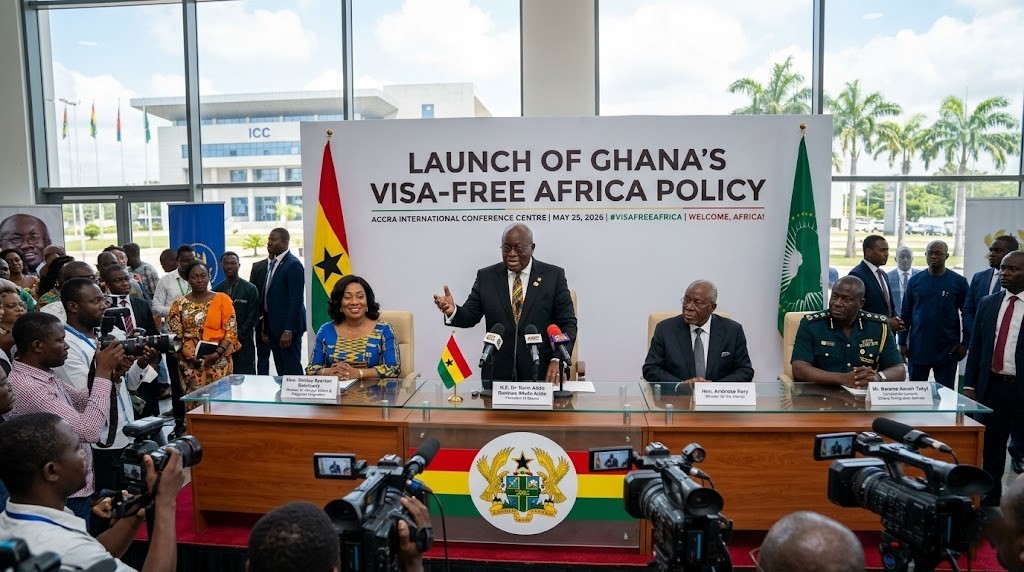
They are also creating a security infrastructure, linked to international crime databases and Ghana’s passenger screening systems, alongside this wonderful system.
That is to show that this is not just any press statement. They made it a policy and are already executing.
And the uncomfortable truth for the continent is that Ghana is not doing something radical. Ghana is doing something that other African countries like Benin, The Gambia, Rwanda, and Seychelles have all promised and fulfilled. Now Ghana has figured it out, too.
What Visa-Free Access Means for African Travellers & Intra-Continental Tourism
Moving people freely across Africa is actually good for Africa.
Imagine a Kenyan entrepreneur who wants to explore business in Accra. Now, he will no longer pay $150 for a 30-day stay.
A student travelling from Dakar to attend a West African conference does not navigate a visa office.
A Zimbabwean tour operator, a Congolese journalist, an Ethiopian designer, the Nigerian content creator. You know, all of them land in Accra with nothing more than a free online application they completed before they left home.
The screenings will still happen, of course. It’s not like Ghana is opening a back door. They will still do their checks for criminal records and the like. They will still screen out security risks. But the cost barrier that quietly tells Africans they are not quite welcome in each other’s countries is gone.
How Free Movement Keeps Tourism Spending Within African Economies
That ability to move freely matters for tourism in ways that compound.
When Africans can move freely in each other’s countries, they travel more within Africa. When they travel more within Africa, they spend money in other African cities, sleep in African hotels, eat in African restaurants, and buy from African markets.
Our money stays on our continent. We are, in effect, building the intra-African tourism economy that has been a talking point at AU summits for two decades and a reality almost nowhere.
Ghana is making it a reality in three weeks.
Why Africa’s Intra-Continental Travel Has Been Broken — And How Ghana Is Fixing It
Now for the part that should make the rest of the continent pay attention.
Africa is the youngest continent on earth. Yet, it has more languages, more distinct cultures, beautiful and exotic landscapes, finger-licking cuisine, amazing music traditions, and more living history than almost any comparable landmass.
Unfortunately, however, we also have some of the most expensive, most complicated, and most humiliating intra-continental travel in the world.
For example, you, as an African, travelling within your continent, will often face more paperwork and fees than if a European were travelling to Africa.
A visa process that would take a Western passport holder twenty minutes can take an African traveller two weeks, two embassies, and up to two hundred dollars just because you want to visit a neighbouring country.
It is one of the most annoying things in the world. And it has been quietly bleeding the continent’s tourism economy for generations.
Addressing Legitimate Concerns: Security, Scale & Infrastructure for Open Borders
There are some people who will argue for keeping things as they are.
It is true that there is border complexity and security considerations. The infrastructure to build a biometric e-visa system capable of handling continental inbound volumes is not a small business.
If we also think about population pressures, informal or illegal migration, and existing bilateral tensions between states, we see the different layers of genuine difficulty.
But Benin did it. The Gambia did it. Rwanda did it, and Rwanda built its entire post-1994 identity around open borders, a credible national brand, and a willingness to move first and adjust in motion. Seychelles has offered it for years. All of them still have functioning borders, and none of them collapsed.
What those countries had was a political will to act, rather than commissions to study the action until the moment passed.
Most of the continent is still studying.
Ghan Visa-Free Entry: A Working Template for AU Agenda 2063 & AfCFTA Goals
The real opportunity here, and this is what May 25 actually represents, is not just that Ghana is opening its borders. It is that Ghana is running the proof of concept that the rest of Africa can now point to.
If it works and if Accra can handle the inbound volume, and the e-visa platform can hold under pressure, let’s say the security integration does what it is designed to do, and Ghana sees a measurable uptick in African visitors by the end of the year, then every remaining argument against continental free movement loses a layer of justification.
We will have good data for them and a model live and direct. Let us now hear the excuses they want to make by then.
The Real Question: Which Version of Africa Will Show Up When Free Movement Goes Live?
Ghana visa-free entry is Ghana’s gift to Africa if this goes well.
It is not just about opening borders for itself, but creating a working template that makes it harder for every other government to say it cannot be done. A West African state with real security pressures, a mid-sized economy, and a complex border geography figured it out. What is everyone else waiting for?
The African Union’s Agenda 2063 calls for a continent with free movement of people. The African Continental Free Trade Area was built on the premise that goods, services, and people should flow more easily across the continent. Those are not fringe ideas. They are frameworks that African heads of state have signed, endorsed, and photographed themselves next to.
What has been missing is the country willing to go first and make it real rather than aspirational.
Ghana went first. Or more precisely, Ghana went fifth, and in doing so, Ghana has crossed the threshold where this is no longer an experiment run by small or island states. It is now a policy that a West African nation of 33 million people, with land borders, with regional trade exposure, and with real security infrastructure requirements, has chosen to implement.
That changes the conversation.
The question for the rest of the continent is no longer whether free movement across Africa is possible.
Ghana just answered that.
The question is which version of each country they want to be when Africa gets there, the ones who moved, or the ones who watched.
The views expressed in this editorial are those of travelradio.live.