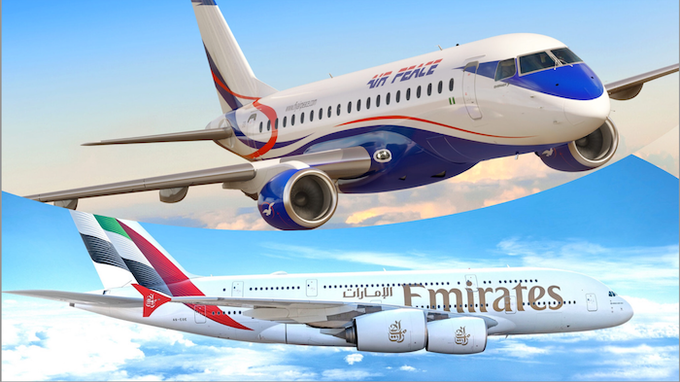
The bilateral interline agreement between Nigerian aviation giant Air Peace and Emirates is emerging as a landmark development for African aviation, significantly improving connectivity between West and Central Africa, the Middle East, Europe and Asia.
The partnership allows passengers to travel on a single ticket, enjoy seamless flight connections, and have baggage checked through to final destinations across both airlines’ networks—eliminating long-standing friction points for African travellers accessing global routes.
This expanded scope marks a significant upgrade from the initial interline agreement signed in February 2025, which first opened Emirates access to Air Peace’s domestic Nigerian network.
Nowel Ngala, Chief Commercial Officer of Air Peace, said the agreement is integral to the airline’s strategic vision of linking Africa more efficiently to global markets.
“By combining our strong regional presence with Emirates’ extensive international network, we are delivering seamless connectivity, improved travel experience, and greater access to key global destinations for African travellers,” he said.
“This partnership further reinforces Air Peace’s role as a critical bridge between Africa and the global aviation ecosystem.”
Adnan Kazim, Deputy President and Chief Commercial Officer of Emirates, described the enhanced partnership as transformative for regional and international travel.
“Enhancing our interline partnership with Air Peace allows us to expand our footprint across more of Africa, creating new opportunities for people to fly better … while helping international tourists explore more of the region, via Lagos.”
Positives
Industry observers say the agreement marks one of the most consequential collaborations between a major African carrier and a global aviation powerhouse in recent years.
Beyond aviation, the interline agreement carries broader economic implications. Improved air connectivity is expected to boost tourism arrivals into Africa.
It will also support trade and investment flows ease mobility for students, professionals and diaspora communities and enhance Africa’s integration into global supply chains
Tourism and trade experts note that seamless air travel is a critical enabler for economic diversification and regional integration, particularly under the African Continental Free Trade Area (AfCFTA).
Strengthened Aviation Hubs
A central feature of the partnership is its impact on Nigeria’s aviation positioning, particularly Lagos, which serves as a major gateway for both regional and international traffic.
By linking Air Peace’s domestic and regional routes with Emirates’ long-haul services, the deal enhances Lagos’ role as a strategic West African hub, offering travellers smoother onward connections to global destinations while increasing inbound access to African cities.
Aviation analysts say the model demonstrates how African carriers can leverage partnerships—rather than competition alone—to scale their global reach.
The Air Peace–Emirates deal is increasingly viewed as a template for future airline collaborations involving African carriers—one that prioritizes network complementarity, passenger convenience and global competitiveness.
As demand for international travel rebounds and Africa’s aviation market continues to expand, partnerships of this scale are expected to play a central role in shaping the continent’s air transport future.
For travellers, businesses and tourism stakeholders alike, the agreement signals a clear shift: Africa is no longer on the margins of global aviation connectivity—it is becoming an integrated part of it.